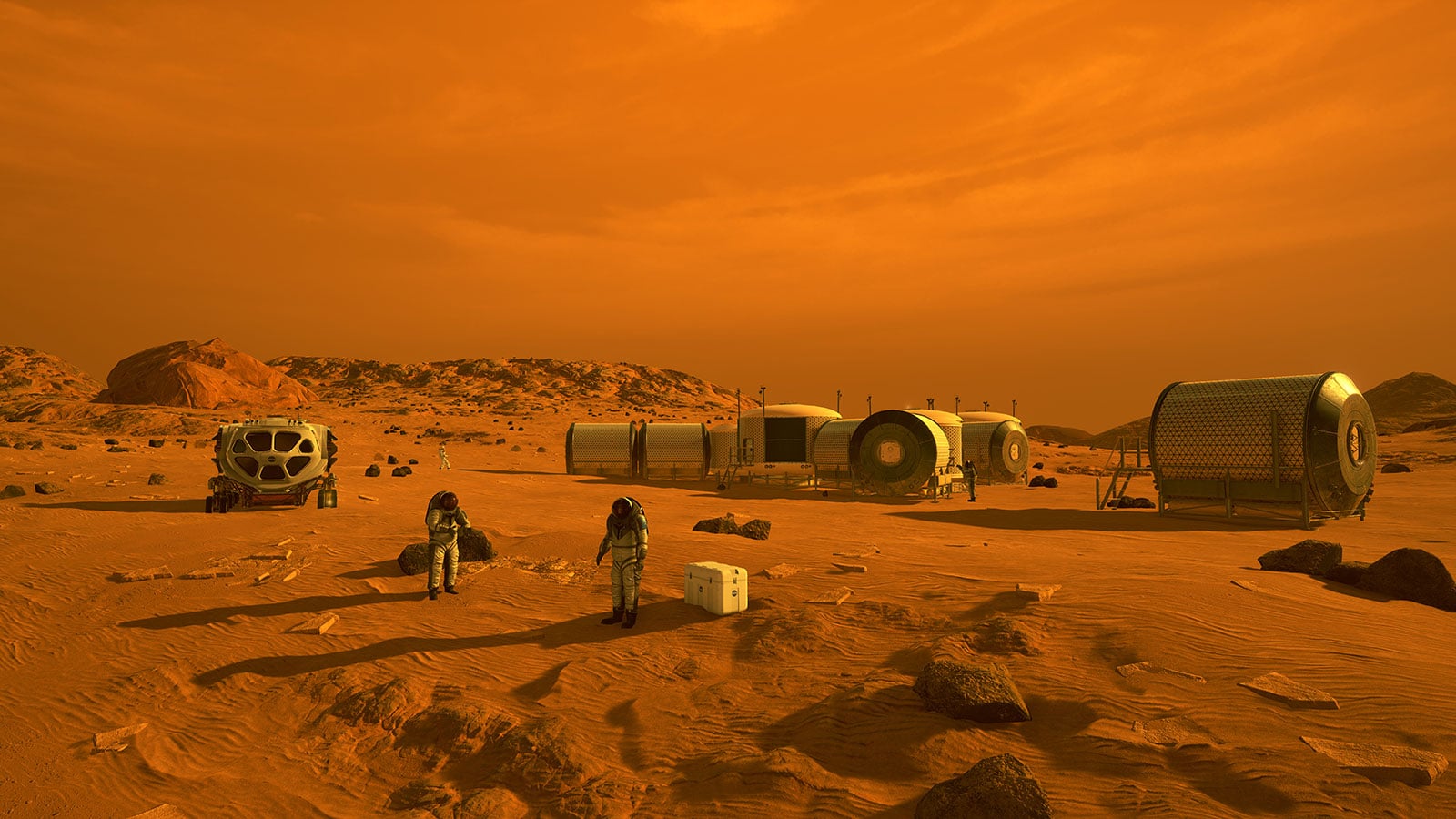
MIT researchers are developing technology that could transform Mars into a fuel station, solving one of the greatest logistical challenges facing human missions to the red planet.
Lanie McKinney, a PhD candidate at MIT, is engineering systems to extract chemicals from Mars' thin atmosphere and convert them into propellant. This approach addresses a fundamental problem in Mars exploration: the fuel required to return astronauts to Earth represents an enormous launch mass that must be transported across interplanetary space at tremendous cost.
The Martian atmosphere consists primarily of carbon dioxide, with traces of nitrogen, argon, and other gases. McKinney's research focuses on in-situ resource utilization, or ISRU, a concept that NASA and space agencies worldwide recognize as essential for sustained human exploration. Rather than launching return fuel from Earth, astronauts could manufacture propellant locally using Martian resources and atmospheric chemistry.
The significance of this work extends beyond Mars logistics. Refueling depots on Mars would fundamentally reshape mission architecture. NASA's current planning for human Mars missions assumes a much heavier initial launch mass because return fuel must be delivered in advance or brought along. Establishing ISRU capability reduces this mass requirement, lowering mission costs and increasing feasibility.
McKinney's technology applies the Sabatier reaction, a well-known chemical process that combines carbon dioxide with hydrogen to produce methane and water. The methane serves as rocket propellant, while the water can be electrolyzed to generate additional hydrogen for the reaction cycle and oxygen for life support or oxidizer needs. This creates a regenerative system that works continuously given sufficient energy and feedstock.
The challenge lies in engineering these processes for Martian conditions. Mars' atmosphere is 95 percent carbon dioxide but exists at surface pressures roughly one percent of Earth's atmosphere. The technology must operate efficiently in harsh cold, extreme temperature fluctuations, dust-laden air, and the radiation environment of Mars. Laboratory work at MIT tests whether these systems can achieve the throughput and reliability required for a crewed mission timeline.
Successful ISRU depots would unlock longer mission durations and larger science payloads. Astronauts would not face the constant fuel anxiety that characterizes earlier Mars mission concepts. They could spend more time conducting geology, searching for subsurface water ice, and preparing infrastructure for eventual settlement.
The technology also applies to lunar missions and asteroid mining scenarios. Any long-term space operation benefits from local propellant production. NASA's Artemis program plans to establish lunar base camps where similar in-situ resource utilization could provide fuel for cargo missions and crew rotations.
McKinney's work represents part of a broader shift in space exploration philosophy. Rather than treating distant worlds as destinations to visit and depart, the space community increasingly views them as locations where sustained operations become possible. Fuel depots on Mars transform the red planet from a destination requiring monumental launch resources into a node in an interplanetary logistics network.
The development pathway involves continued laboratory testing, theoretical modeling, and eventually prototype demonstrations. Progress here influences broader NASA exploration strategy and informs decisions about which technologies receive flight heritage before human crews depend on them. Converting Martian atmosphere into propellant moves from theoretical possibility to engineering reality.