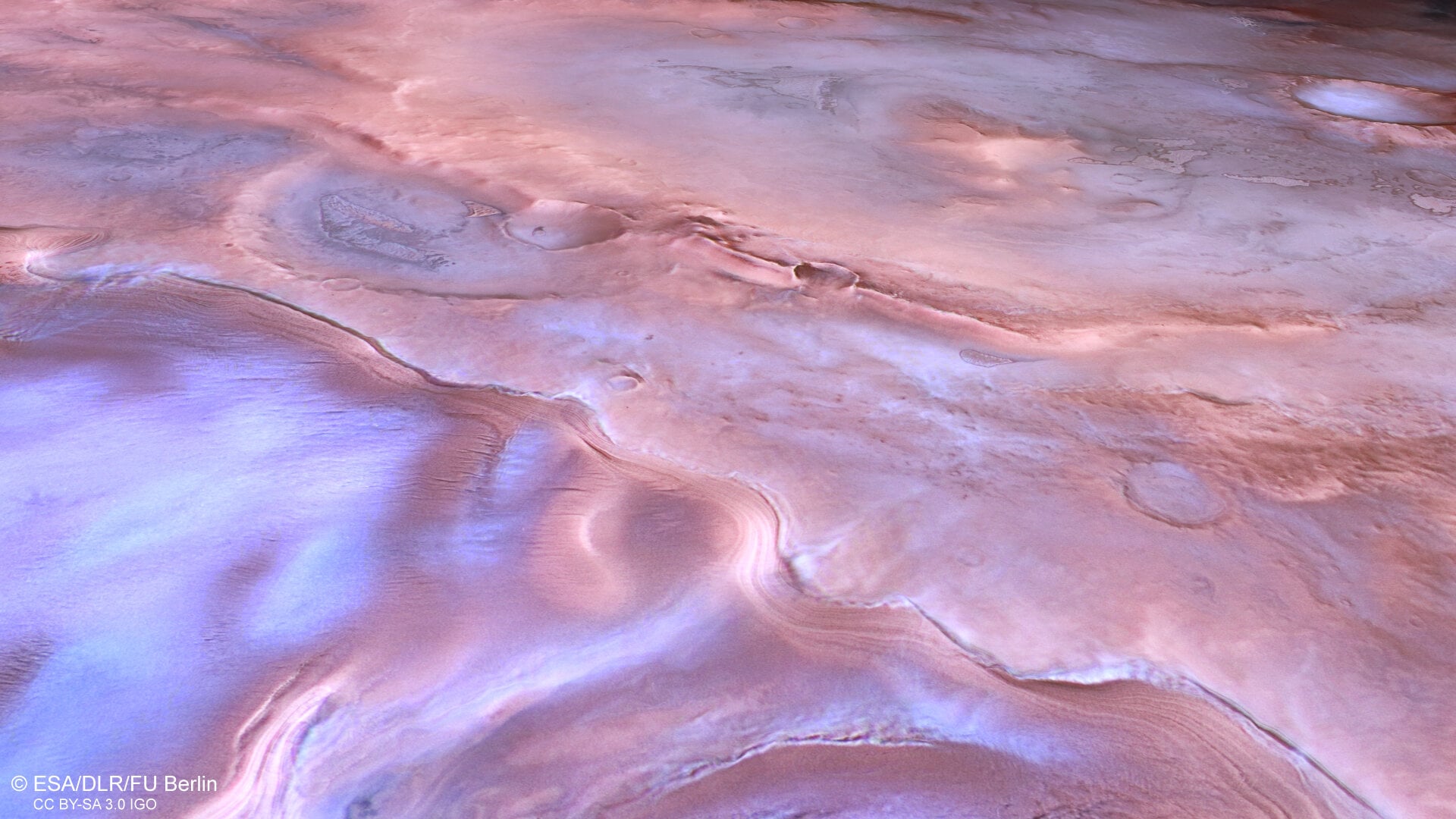
Mars shows far more chromatic diversity than its reputation suggests. New orbital imagery from the European Space Agency's Mars Express spacecraft reveals striking purple and pink hues at Thyles Rupes, a dramatic cliff formation in the planet's southern highlands. These colors diverge sharply from the rusty reds that dominate Mars' surface.
The High-Resolution Stereo Camera aboard Mars Express captured these unexpected tones in a region where dust and frost create optical conditions unlike the rest of the Martian landscape. Iron oxides produce Mars' characteristic reddish appearance across most of the planet's terrain. But at Thyles Rupes and its surrounding glacier, a combination of atmospheric frost and fine particulate matter alters how sunlight reflects from the surface. The result: vivid purples and pinks that reveal the complexity of Martian geology and atmospheric processes.
This discovery matters for planetary science. It demonstrates that Mars' surface composition and mineralogy vary more substantially than simple color observations suggest. Different locations accumulate distinct dust types and mineral deposits. Frost patterns change seasonally. Lighting geometry shifts with orbital position and solar angle. Together, these variables create a palette far richer than the monolithic red world depicted in popular imagination.
The Mars Express orbiter, operated jointly by ESA and the German Aerospace Center (Deutsches Zentrum für Luft- und Raumfahrt), has circled Mars since 2003. Its High-Resolution Stereo Camera generates three-dimensional imagery and color data at resolutions exceeding five meters per pixel. This orbital vantage allows scientists to map mineral distributions, identify potential water-ice deposits, and monitor seasonal atmospheric changes across the entire planet.
Thyles Rupes itself presents geological intrigue. The cliff face rises hundreds of meters above the surrounding terrain. Nearby glaciers, composed primarily of water ice with a layer of protective dust, persist in the cooler southern hemisphere despite Mars' thin atmosphere and harsh surface conditions. These frozen reserves remain targets for future human exploration and scientific investigation. They may contain preserved records of ancient Martian climate conditions locked in ice layers.
The purple-pink hues also carry implications for rover operations and sample selection. Instruments aboard NASA's Curiosity rover and Perseverance rover use similar optical techniques to assess rock and soil composition. Understanding how color variations correlate with mineralogy helps scientists prioritize drilling targets and interpret spectroscopic data. This Mars Express imagery provides ground-truth validation for rover observations and guides strategy for future missions.
The European Space Agency continues expanding Mars science through Mars Express and the ExoMars Trace Gas Orbiter, a collaborative mission with Roscosmos. These platforms collectively monitor atmospheric composition, search for subsurface water and organic compounds, and characterize the full range of Martian surface diversity. Each image strengthens the foundation for eventual human missions by mapping resources, hazards, and scientific opportunities.
The revelation that Mars possesses a purple side challenges simplified narratives about planetary environments. Real worlds contain layered geology, dynamic atmospheres, and optical subtleties invisible from Earth. The more closely scientists examine Mars, the more complex and compelling it becomes.