# Saturn's South Pole Reveals Newly Discovered Atmospheric Decagon
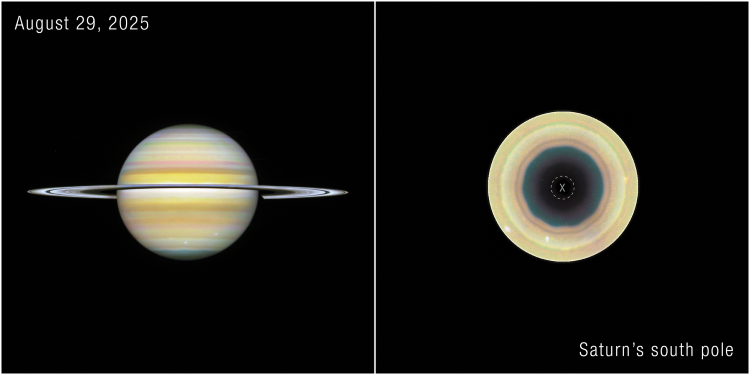
Astronomers using the Hubble Space Telescope have detected an unusual 10-sided wave pattern, called a decagon, embedded in Saturn's southern polar atmosphere. The discovery reveals unexpected complexity in the gas giant's atmospheric dynamics and adds another layer to our understanding of planetary weather systems.
The decagon cuts through multiple atmospheric layers at Saturn's south pole. Agustin Sánchez-Lavega of the University of the Basque Country led the research team that identified this geometric formation in recent Hubble imagery. The pattern joins Saturn's roster of other polarly-centered atmospheric structures, expanding what scientists know about how giant planets organize their atmospheric circulation.
Saturn's atmosphere operates under extreme conditions. Wind speeds exceed 1,100 meters per second at the equator. The planet's rotation period remains difficult to measure precisely because the interior rotates at a different rate than the clouds. This interior-exterior differential rotation influences how atmospheric features form and persist.
Polygonal patterns at planetary poles are not unique to Saturn. Jupiter displays a famous hexagon at its north pole, a stable structure first imaged by the Cassini spacecraft and later confirmed by Hubble. This Jovian hexagon has persisted for decades, with winds reaching 320 kilometers per hour at its boundaries. Similar polygonal formations appear across the gas giants, though their mechanisms of formation and maintenance remain incompletely understood.
Saturn's newly observed decagon differs from Jupiter's hexagon in several respects. The 10-sided pattern emerged more recently than Jupiter's 6-sided structure, which has existed for at least 40 years and possibly much longer. The decagon's discovery raises questions about the timescales on which such features develop and how long they persist. Does Saturn generate new polygonal patterns regularly, or does this represent a rare occurrence?
The research team employed spectroscopic analysis to map the decagon across multiple atmospheric layers. This approach allowed them to determine at what altitude the pattern appears most pronounced and how it interacts with surrounding atmospheric currents. The decagon appears to be a wave phenomenon, suggesting that specific atmospheric conditions at Saturn's south pole favor the formation of 10-sided standing waves.
Understanding these polar atmospheric patterns holds implications for planetary science broadly. Polar vortices and their associated structures influence heat distribution and chemical mixing in planetary atmospheres. On Earth, polar vortices affect ozone depletion and climate patterns. On giant planets, analogous structures may regulate internal heat transport and control where certain chemical species concentrate.
Hubble continues to serve as an essential tool for monitoring solar system weather despite its age. The Space Telescope Science Institute processed the imagery that revealed Saturn's decagon. NASA and ESA jointly operate Hubble. Amy Simon of NASA's Goddard Space Flight Center and Michael Wong of UC Berkeley contributed to the analysis.
Future observations with the James Webb Space Telescope may reveal even finer details of Saturn's polar atmosphere. JWST's infrared sensitivity allows detection of thermal signatures that visible-light observations cannot capture. Combined with ongoing Hubble monitoring, JWST data could illuminate whether Saturn's decagon represents a permanent feature or a transient phenomenon.
Saturn's rings remain its most visually arresting feature, but the planet's atmospheric machinery proves equally complex and worthy of sustained scientific attention.