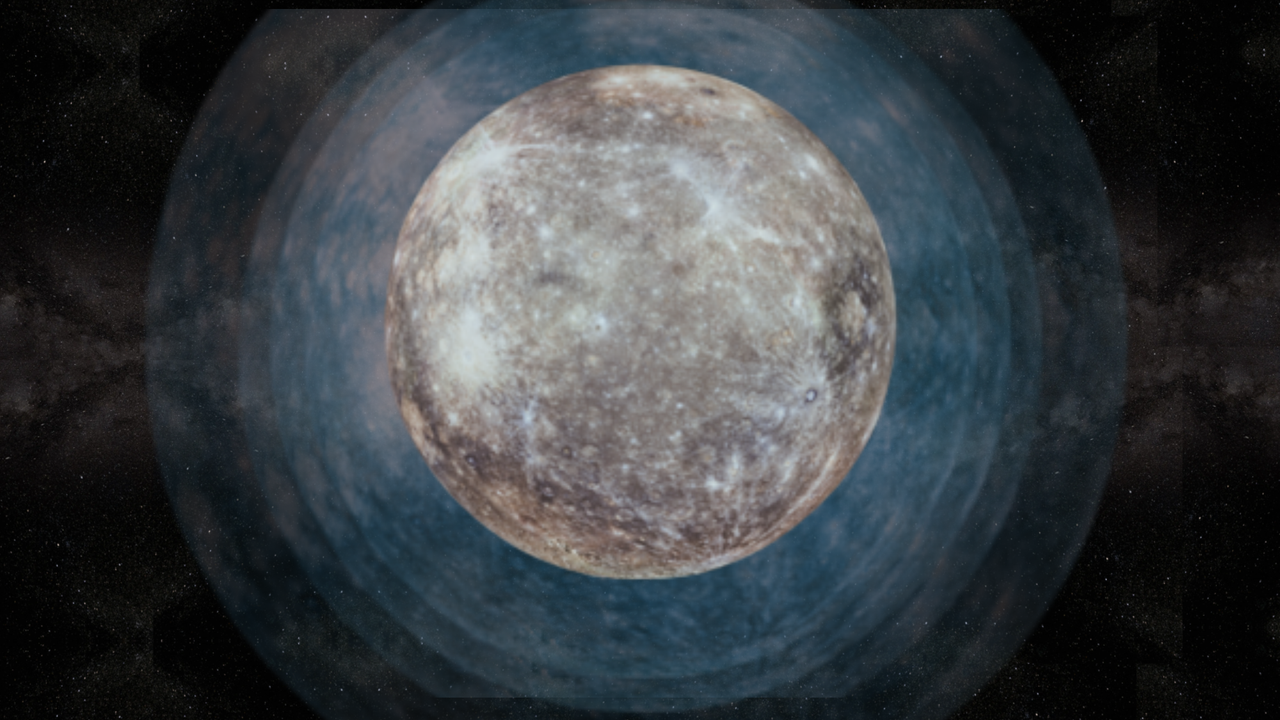
Mercury is contracting at a rate roughly twice faster than planetary scientists previously calculated, according to new analysis of the planet's distinctive surface features. Researchers examining high-resolution images from NASA's MESSENGER spacecraft and the ongoing BepiColombo mission detected evidence that Mercury's radius has decreased by approximately 7 kilometers over geological time, rather than the earlier estimate of 3.5 kilometers.
The planet's wrinkled surface tells this story. As Mercury's iron-rich core cools, the entire planetary body contracts. This cooling creates compressional stress in Mercury's crust, forcing the surface to buckle and fold into long ridges called scarps. Scientists measure these scarps and track their distribution patterns across the planet to calculate how much cooling and contraction has occurred.
The discovery matters because it reshapes our understanding of Mercury's interior structure and thermal evolution. Mercury possesses the largest iron core relative to its size among all terrestrial planets in our solar system. That massive core generates heat through radioactive decay of elements like uranium, thorium, and potassium. How fast that core cools directly reflects the composition and cooling rates of the planet's interior, which informed formation models for the entire inner solar system.
BepiColombo, a joint European Space Agency and Japan Aerospace Exploration Agency mission launched in 2018, continues delivering unprecedented data. The spacecraft's imaging instruments reveal smaller scarps and structural features that earlier missions missed. This improved resolution allows researchers to identify younger compression features alongside ancient ones, creating a timeline of Mercury's contraction across billions of years.
The faster-than-expected contraction rate suggests several possibilities. Mercury's core may be larger than previous models indicated. The planet's thermal conductivity could differ from assumptions, affecting how quickly internal heat dissipates. Alternatively, Mercury might contain higher concentrations of radioactive elements, generating more internal heat that must be shed over time.
Understanding Mercury's thermal state connects directly to planetary habitability research. Planets with active internal heat maintain geological activity longer. While Mercury hosts no life today, the mechanisms driving its cooling apply across rocky planets throughout the universe. Exoplanet researchers use these terrestrial models to interpret observations of distant worlds.
MESSENGER orbited Mercury from 2011 to 2015 and gathered baseline measurements of the planet's gravity, magnetic field, and surface composition. BepiColombo's ongoing investigation builds on that foundation with greater sensitivity. The mission will continue operations for several years, generating data that will refine estimates of Mercury's contraction rate even further.
The wrinkled face of Mercury thus becomes a window into planetary mechanics. Those scarp formations represent billions of years of steady cooling and contraction. Each ridge reflects a moment when internal stress exceeded crustal strength, forcing rock to buckle rather than break. Reading Mercury's wrinkles reveals the story of a small, iron-heavy world slowly surrendering its internal heat to the void.