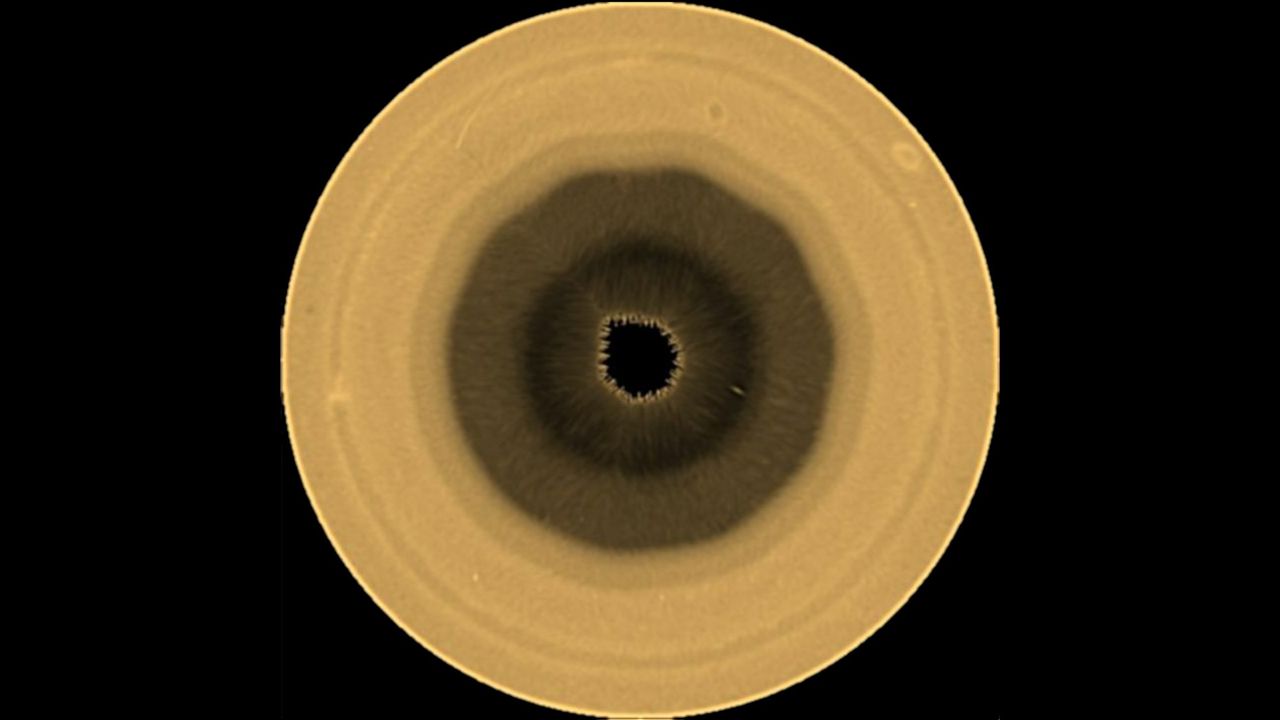
A colossal 10-sided geometric cloud pattern has materialized around Saturn's south pole, marking an unexpected atmospheric phenomenon that challenges scientists' understanding of planetary wind dynamics. Astronomers detected this polygon structure using data from the Cassini spacecraft and ground-based observatories, revealing a system of jet streams arranged in a remarkably precise angular configuration.
The discovery expands on decades of observation of Saturn's atmospheric geometry. In 2006, the Cassini mission first captured imagery of a hexagonal storm system at Saturn's north pole, a feature roughly 15,000 miles across that remains stable and persistent. The newly identified 10-sided structure at the opposite pole presents a fundamentally different puzzle.
Polygon formations on gas giants arise from the interaction of multiple jet streams flowing at different velocities and latitudes. On Jupiter, the Great Red Spot and its surrounding cloud belts follow the planet's atmospheric circulation patterns in predictable ways. Saturn's north polar hexagon defied simple explanations when first observed, forcing planetary scientists to develop complex fluid dynamics models to account for its geometric precision and longevity.
The 10-sided configuration emerging at Saturn's south pole introduces additional complexity. The structure's formation timing, apparent stability, and relationship to the planet's underlying wind field remain subjects of active investigation. Researchers are examining whether this polygon represents a transient weather phenomenon or a quasi-permanent feature like its northern counterpart. The asymmetry between north and south polar structures hints at distinct atmospheric processes operating in each hemisphere.
Understanding these formations carries implications beyond Saturn itself. Gas giants throughout the exoplanet population likely experience similar atmospheric dynamics. Observations of Saturn's polygonal systems provide ground truth for modeling worlds light-years distant, where direct imaging remains technologically constrained. The geometric regularity of these cloud patterns suggests underlying principles of planetary fluid mechanics that govern atmospheres across diverse planetary types.
The Cassini-Huygens mission, which concluded its 13-year Saturn orbital campaign in 2017, left behind an extensive archive of high-resolution imagery and atmospheric data. Current analysis leverages this legacy dataset alongside observations from the Hubble Space Telescope and ground-based facilities. The International Astronomical Union's Minor Planet Center and various university astronomy departments have mobilized resources to track the 10-sided feature's evolution.
The broader context includes Saturn's dynamic storm systems. The planet experiences episodic Great White Spots, massive storm outbreaks that cycle approximately every 30 years. The relationship between these episodic disturbances and the steady polar polygons remains unclear. Some models propose that polar vortex stability and storm genesis operate through connected mechanisms in Saturn's deep atmosphere.
Future observations will rely on continued monitoring through existing telescopes and the capabilities of the upcoming generation of space-based infrared observatories. The James Webb Space Telescope, already conducting Saturn observations, provides unprecedented sensitivity to atmospheric composition and thermal structure. These datasets will help determine whether the 10-sided structure persists, evolves, or dissipates on seasonal timescales.