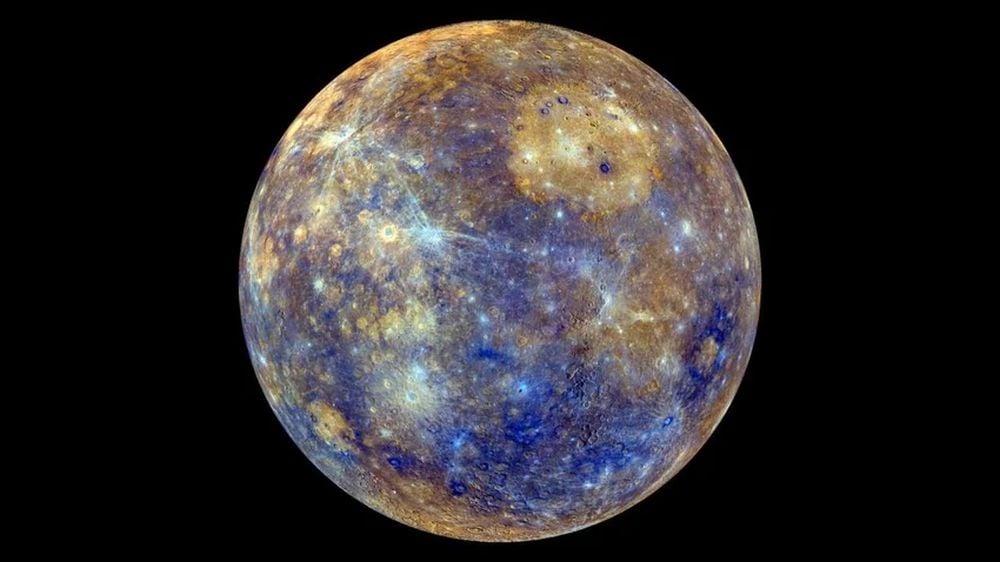
Scientists have cracked a long-standing puzzle about Mercury's geology by using lunar samples to decode the planet's ancient volcanic history. The breakthrough centers on silicon dioxide (SiO2) abundance in Mercury's crust, which serves as a chemical fingerprint for understanding the magma composition and eruption styles that shaped the smallest planet in our solar system billions of years ago.
Mercury's surface tells a violent story written in lava. The planet displays extensive volcanic plains and crustal features that demanded explanation. Previous analysis of Mercury, conducted primarily through NASA's MESSENGER spacecraft during its 2011-2015 orbital mission, revealed tantalizing compositional data but left scientists uncertain about the specific mechanisms that produced the planet's distinctive crust. The fundamental question persisted: what type of volcanism built Mercury's surface?
The research team's approach leverages a principle that works across planetary bodies. Silicon dioxide concentration in crustal material directly correlates with magma characteristics. High SiO2 levels indicate more evolved, silica-rich magmas typical of shield volcanism or effusive eruptions. Lower concentrations suggest more primitive, iron-rich compositions associated with different eruption dynamics. By examining lunar samples collected during the Apollo missions, researchers established a calibration framework for interpreting spectroscopic data from Mercury.
This methodology matters because Mercury's extreme conditions make direct sample collection impractical in the foreseeable future. The planet orbits closer to the Sun than any other, enduring surface temperatures exceeding 430 degrees Celsius. No current spacecraft could land, sample, and return material from Mercury's surface intact. Using lunar analogues, scientists can construct a comparative geochemical model. The Moon, geologically simpler and already sampled, provides a proven reference point for understanding planetary crustal evolution through volcanism.
The findings reveal that Mercury experienced extreme volcanic activity during its early history. This activity proved substantially different from Earth's or the Moon's volcanic regimes. Mercury's unique combination of planetary size, internal heat, and distance from the Sun produced conditions that generated distinctive magma types. The extreme volcanism left Mercury's crust enriched with particular mineral assemblages. Understanding these processes illuminates how small rocky planets cool and differentiate during their formative epochs.
Mercury exploration continues through ongoing analysis of MESSENGER data and preparation for the BepiColombo mission, a joint ESA-JAXA spacecraft that began orbital operations in 2021. BepiColombo's instruments provide new compositional measurements that further refine understanding of Mercury's crustal makeup. As the spacecraft completes its mission mapping campaign, researchers will integrate these observations with geochemical models derived from lunar samples, progressively resolving Mercury's volcanic history.
This research exemplifies how planetary science extracts maximum knowledge from available datasets. When direct sampling remains impossible, scientists leverage samples from accessible worlds and apply comparative geochemistry across the solar system. Mercury's crust, shaped by processes operating under extreme conditions four billion years ago, continues revealing secrets about planetary formation and volcanic dynamics in environments far harsher than anything on Earth.