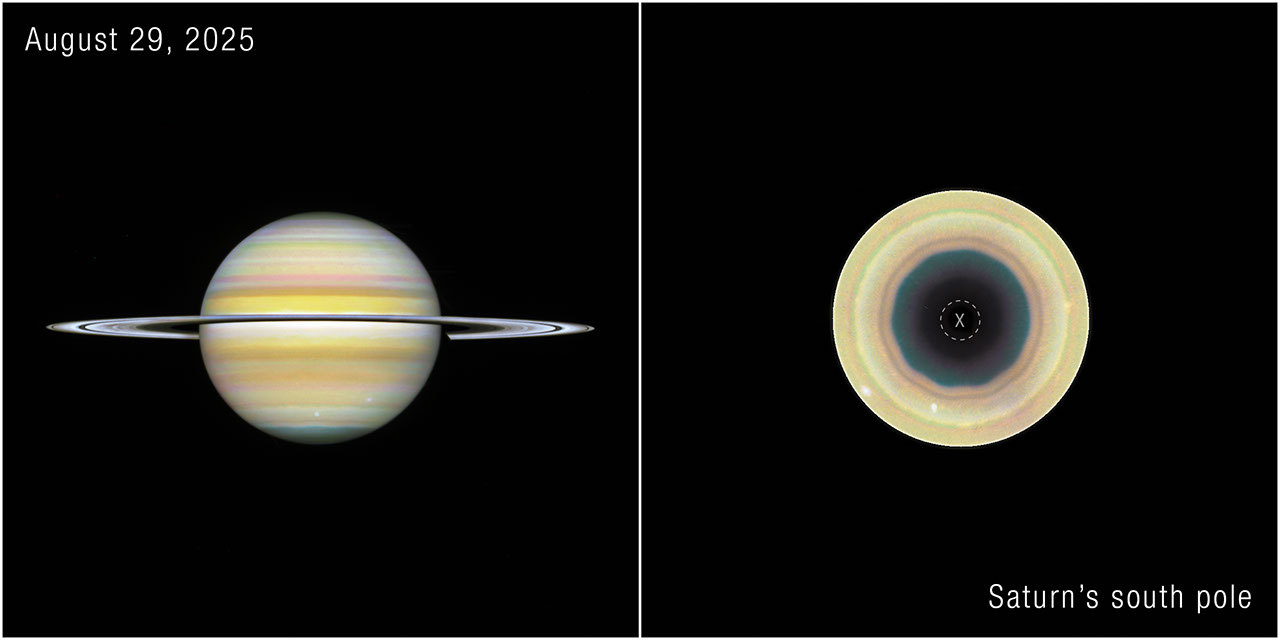
NASA's Hubble Space Telescope has detected an enormous, 10-sided atmospheric wave encircling Saturn's south pole, marking a rare and puzzling addition to the gas giant's known polar weather phenomena. The decagon, as this geometric wave formation is called, represents a fresh atmospheric structure that has captured the attention of planetary scientists studying Saturn's turbulent atmosphere.
The observation extends a decades-long record of polygonal storm systems around Saturn's poles. In 2007, the Cassini spacecraft first imaged a hexagon at Saturn's north pole, a six-sided jet stream feature roughly 32,000 kilometers across. That hexagon persists today, tracked most recently by the James Webb Space Telescope. Now, the discovery of a decagon at the south pole suggests that Saturn's polar dynamics generate wave patterns with varying numbers of sides, each following distinct atmospheric rules.
The new decagon encircles Saturn's southern region with remarkable precision. Unlike transient storm systems that drift and dissipate, these polygonal structures rotate with the planet's deeper atmosphere, driven by internal dynamics and jet streams rather than surface-level forces. The hexagon at the north pole has remained stable across more than a decade and a half of observation. The freshly detected decagon raises questions about how long this 10-sided formation will persist and what mechanism creates these geometric configurations.
Hubble's Wide Field Camera 3 captured the decagon in infrared and ultraviolet wavelengths, revealing details of cloud composition and atmospheric temperature. The imaging confirms that the structure is a genuine atmospheric feature, not an optical artifact. The detection required the space telescope's sensitivity and resolution, capabilities that have made Hubble instrumental in monitoring planetary atmospheres throughout the solar system.
Saturn's polar regions represent extreme laboratories for atmospheric science. Wind speeds in the polar jet streams reach several hundred meters per second. Temperatures plunge to some of the coldest regions in Saturn's atmosphere. Within these extreme conditions, the planet generates organized wave patterns that persist far longer than meteorologists would expect based on Earth's weather systems. The physics underlying these structures remains incompletely understood.
The discovery adds complexity to models of Saturn's atmosphere. Scientists now must explain why the north pole hosts a hexagon while the south pole displays a decagon, and whether additional polygonal structures exist elsewhere on the planet. The Cassini mission provided the first sustained observations of Saturn's poles during its 13-year orbital mission, concluding in 2017. Hubble and JWST have carried forward that work, tracking how these features evolve.
This observation demonstrates how complementary space-based observatories provide overlapping coverage of the outer planets. Hubble's ultraviolet and infrared capabilities combined with JWST's infrared precision create a comprehensive view of planetary atmospheres that single missions cannot achieve alone. The decagon discovery will refine models of gas giant dynamics and may eventually explain fundamental principles governing how planetary atmospheres organize themselves into these extraordinary geometric forms.