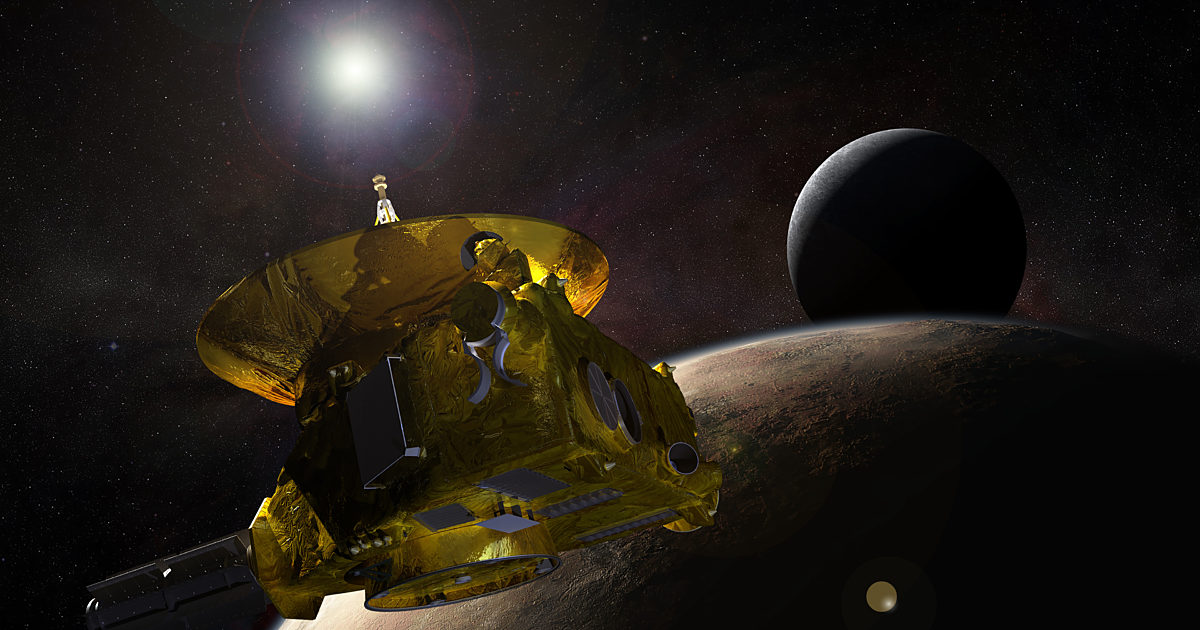
NASA's New Horizons spacecraft carries two instruments that have fundamentally changed how scientists understand the outer Solar System. The Solar Wind Around Pluto (SWAP) instrument and the Pluto Energetic Particle Spectrometer Science Investigation (PEPSSI) work in tandem to detect particles streaming from the Sun and measure the composition of the magnetospheric environment. Now these tools face shutdown, threatening to end a data stream that has proven invaluable since New Horizons flew past Pluto in 2015.
SWAP maps the interaction between the solar wind and planetary atmospheres. The instrument detects how charged particles from the Sun behave when they encounter Pluto's thin atmosphere and other distant bodies. PEPSSI measures energetic particles, revealing the dynamics of magnetospheres and the structure of the space environment surrounding distant objects. Together, they provide a window into physics that operates nowhere else in the known universe.
New Horizons achieved its most celebrated success on July 14, 2015, when it conducted the first close-approach reconnaissance of Pluto. The Kuiper Belt dwarf planet proved far more geologically complex than any model predicted. Mountains of water ice, nitrogen glaciers, and a heart-shaped basin dominated by nitrogen ice astonished the planetary science community. But beyond surface imagery, SWAP and PEPSSI revealed something equally striking: Pluto possesses an extended atmosphere that expands and contracts based on its distance from the Sun, along with a magnetospheric interaction that defies simple classification.
Since the Pluto encounter, New Horizons has continued deeper into the Kuiper Belt. In January 2019, the spacecraft flew past the contact-binary asteroid Arrokoth, revealing a pristine relic from the Solar System's formation 4.6 billion years ago. SWAP and PEPSSI collected data on this distant world's interaction with the solar wind, adding to the growing catalog of how primordial bodies behave in the outer Solar System.
The Kuiper Belt extends from Neptune's orbit to roughly 50 astronomical units from the Sun. Objects in this region preserve conditions from the Solar System's youth. They remain relatively unchanged, offering a geological record locked in ice and rock. New Horizons now operates at the edge of this region, collecting data on the solar wind structure and particle environment in a realm humans have barely begun to explore.
Shutting down SWAP and PEPSSI would eliminate real-time measurements from the most distant spacecraft ever deployed. Engineers propose power cuts to extend New Horizons' primary mission and maintain critical imaging systems. Yet the particle instruments consume modest power relative to their scientific return. The data they generate constrains models of magnetospheres, atmospheric escape, and the interaction between stellar winds and distant bodies.
New Horizons carries sufficient power and fuel to continue operations into the 2030s, potentially reaching farther into interstellar space. The spacecraft's trajectory and instrumentation position it as humanity's forward outpost in the outer Solar System. Losing SWAP and PEPSSI would sacrifice a unique vantage point on physics that exists nowhere else on Earth.
NASA and the mission team must weigh engineering constraints against the irreplaceable nature of outer Solar System science. The decision will shape what humanity learns about the Kuiper Belt and the boundary where our Solar System fades into interstellar space.