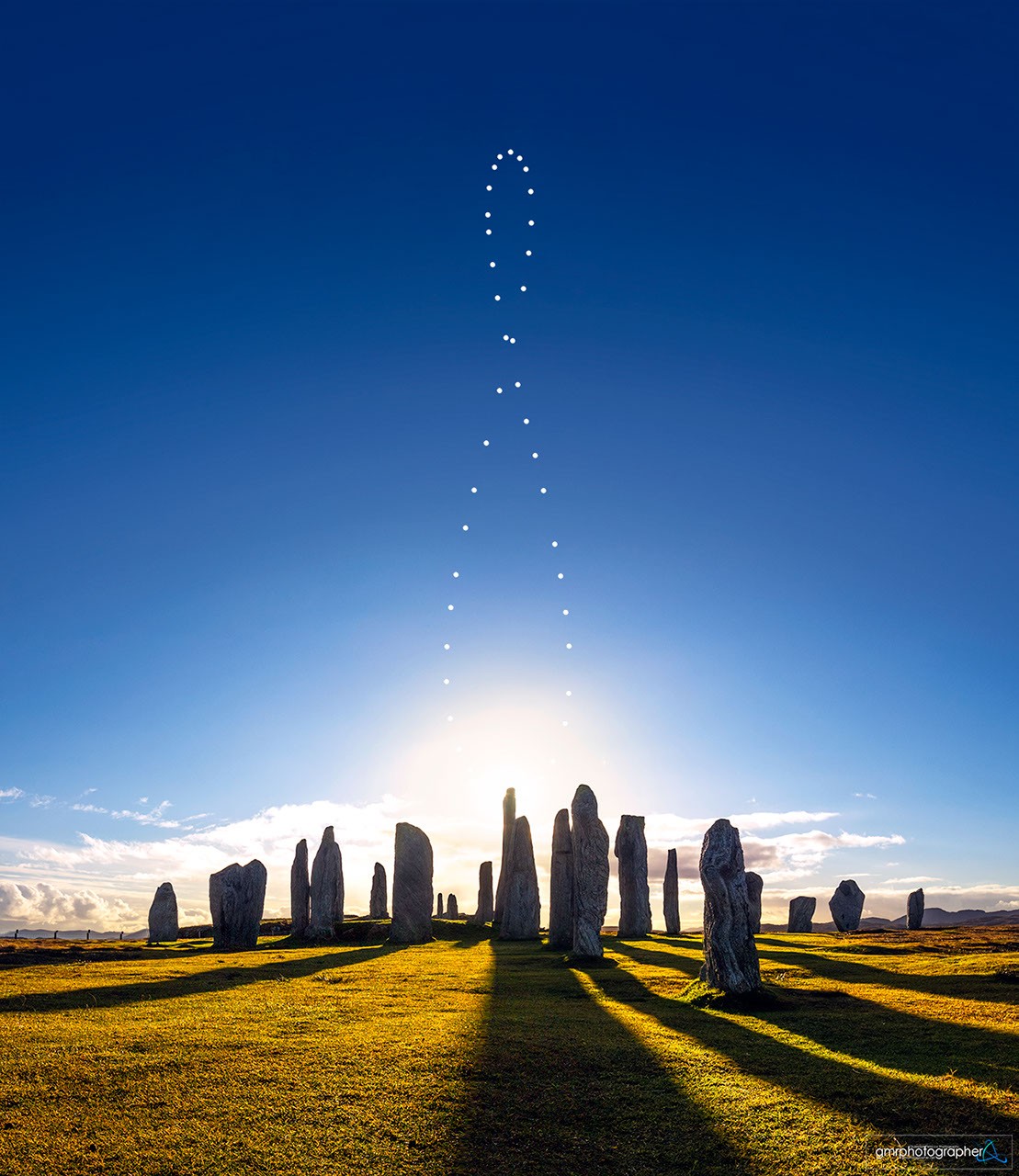
# The Sun's Figure-Eight Path Captured Above Scotland's Ancient Stones
NASA's Astronomy Picture of the Day featured a photograph of an analemma, the figure-eight path the sun traces across Earth's sky when observed from the same location at the same time each day throughout a year. The image captured this celestial pattern above the Callanish Stones, a 5,000-year-old megalithic monument on the Isle of Lewis in Scotland's Outer Hebrides.
An analemma results from two competing astronomical effects. Earth's orbit is elliptical rather than circular, which changes the sun's speed along its path and alters its apparent position in the sky. Simultaneously, Earth's 23.5-degree axial tilt creates seasonal variations in the sun's height above the horizon. Together, these factors produce the distinctive elongated loop when a photographer captures the sun's position on the same calendar date repeatedly over twelve months.
Photographing an analemma requires patience and precision. A photographer must use neutral density filters to capture the sun safely without overexposing the image. They maintain the same camera position, focal length, and time of day across all exposures, then composite the images into a single frame. The resulting pattern reveals the geometric complexity hidden within Earth's orbital mechanics. The sun never traces the exact same path twice. Subtle variations in Earth's orbital parameters and axial tilt create slightly different loops year to year.
The Callanish Stones provide an archaeological anchor for this astronomical observation. Built around 3,000 BCE during the Bronze Age, these 13 standing stones arranged in a circle with radial arms form one of Scotland's most prominent prehistoric monuments. Aligning modern astronomical imagery with these ancient structures creates a poetic connection between how humans have tracked celestial cycles across millennia. The stones themselves may have served as astronomical markers for their builders, tracking solar and lunar events tied to agricultural and ceremonial calendars.
Combining an analemma observation with this historical location emphasizes how fundamental sky-watching has been to human civilization. The Callanish Stones' builders lacked instruments and mathematics to calculate orbital mechanics, yet they oriented their monument to celestial rhythms. Modern photographers using cameras and filters now document the same sky above those same stones, quantifying what earlier observers could only register as seasonal patterns.
The analemma represents one of astronomy's more elegant demonstrations of how apparently simple observations contain layers of physics. The figure-eight shape encodes information about Earth's eccentricity, axial obliquity, and the precession of Earth's orbit. For centuries, astronomers studying analemmas contributed to understanding planetary motion. Today, analemma photographs serve both scientific and artistic purposes, revealing how the sun's apparent motion, when rendered visible across a year, produces a graph of Earth's position and orientation in space.
This particular image from the Callanish Stones region also highlights the practical challenges of observational astronomy in northern latitudes. At roughly 58 degrees north, the Isle of Lewis experiences dramatic seasonal variations in daylight. The sun barely rises above the horizon during winter months, affecting which portions of the analemma a photographer can actually capture from any single location. The resulting images often show incomplete loops, with the southernmost portions hidden below the horizon during winter.