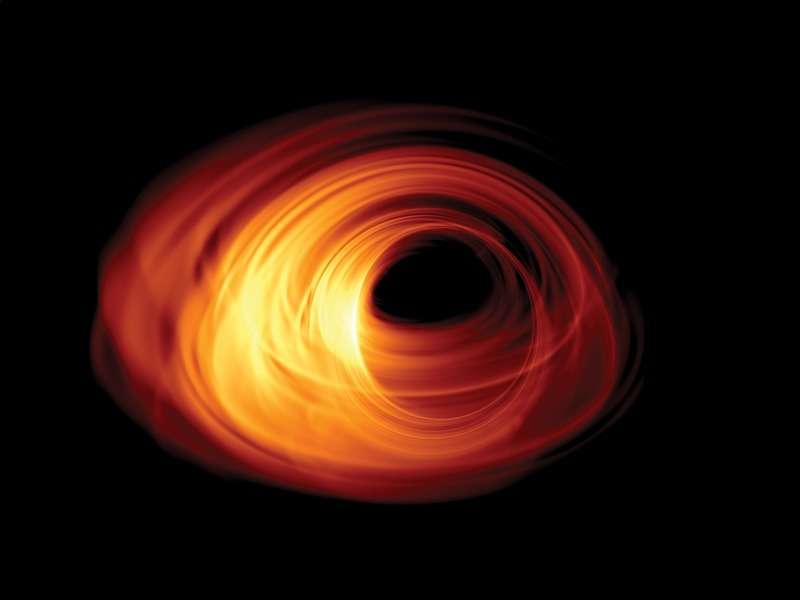
Astronomers have identified environmental conditions that support the leading theory explaining how supermassive black holes formed so rapidly in the early universe. The research focuses on the direct-collapse black hole (DCBH) scenario, a model that addresses a fundamental cosmological puzzle: supermassive black holes billions of times the Sun's mass existed when the universe was less than a billion years old, yet conventional black hole growth timescales cannot account for their swift assembly.
The DCBH scenario proposes that these black hole seeds formed through catastrophic gravitational collapse of massive clouds of pristine hydrogen and helium in the universe's first few hundred million years. Unlike stellar-mass black holes, which form when individual massive stars exhaust their fuel, DCBHs would require entire gas clouds spanning thousands of times Earth's distance from the Sun to collapse directly into black holes without passing through an intermediate stellar phase. The resulting objects, weighing perhaps 100,000 to 1 million solar masses, would provide the seeds from which today's ultramassive black holes grew.
The recent investigation examined the host galaxy environments where DCBHs could plausibly form. Researchers identified specific conditions necessary for direct collapse: extremely metal-poor gas with minimal heavy elements, intense radiation fields that heat clouds and suppress normal star formation, and particular density structures within primordial gas clouds. These conditions appear rare but not impossible in early cosmic history, making the DCBH scenario viable for explaining the observed population of ancient supermassive black holes.
This work carries implications for interpreting observations from the James Webb Space Telescope, which has discovered unexpectedly massive black holes in galaxies dating to the universe's first few hundred million years. The JWST observations have sharpened the puzzle: these black holes grew far too quickly if they started from stellar-mass seeds produced through conventional processes. DCBHs offer a plausible explanation for how nature could manufacture sufficiently massive seeds early enough to enable such rapid growth.
Understanding black hole formation in the early universe illuminates the history of galaxy assembly itself. Supermassive black holes and their host galaxies grow together in locked step, their evolution intertwined through feedback mechanisms where black hole accretion regulates star formation. Resolving how the first black holes formed therefore clarifies how the first galaxies took shape during the cosmic reionization epoch.
The research also suggests observational tests. Future infrared and radio surveys can search for the distinctive signatures of DCBH host environments: metal-poor, intensely irradiated gas clouds showing suppressed star formation despite abundant fuel. Such observations would validate or refine the DCBH scenario and help astronomers construct an accurate narrative of black hole genesis in cosmic history.