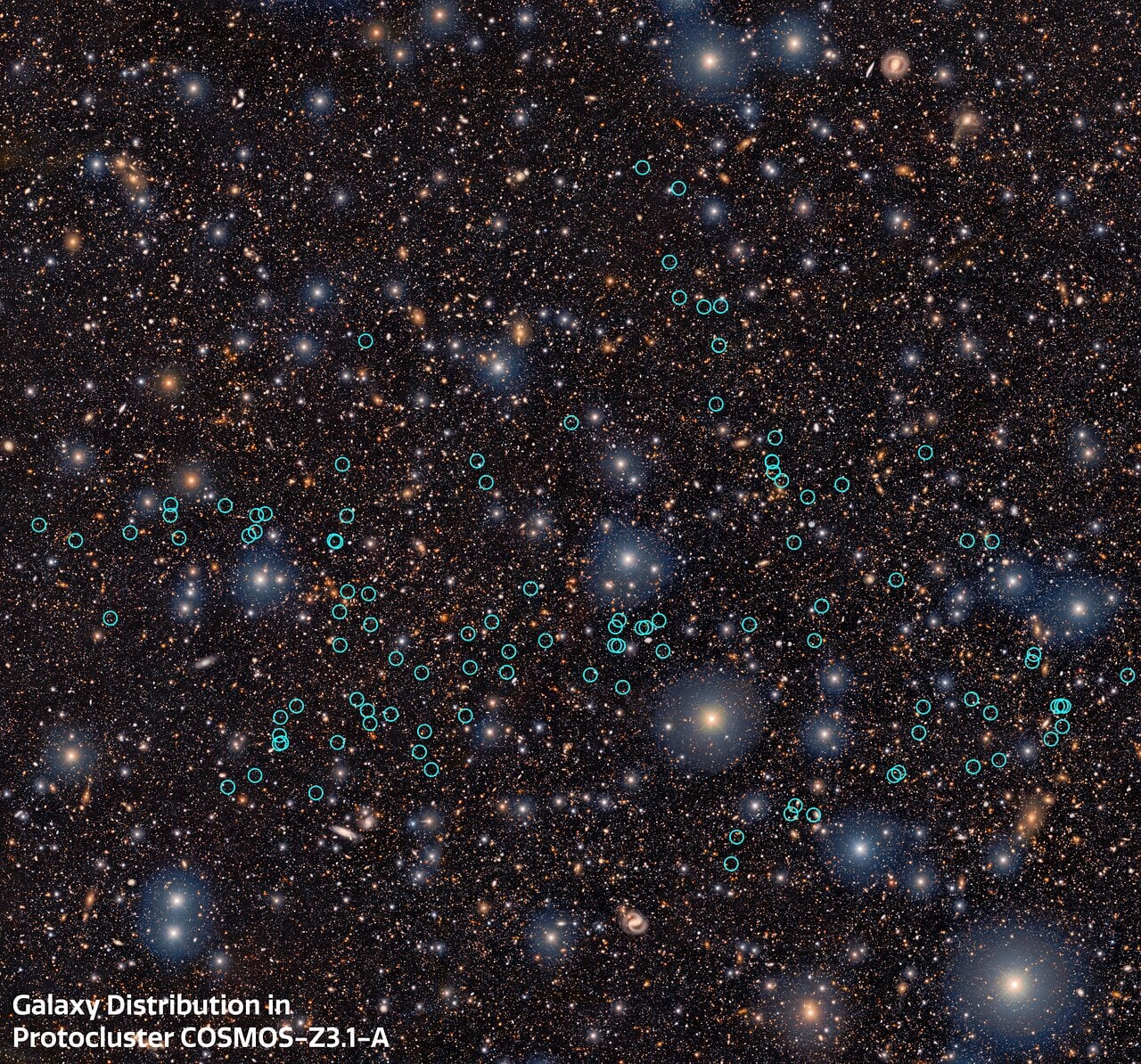
Astronomers using the Dark Energy Camera on the Blanco telescope at Cerro Tololo in Chile have identified a proto-supercluster of galaxies existing less than two billion years after the Big Bang. Named COSMOS-z3.1-A, this structure represents one of the most distant and earliest known examples of such a massive gravitational assembly in the universe.
The discovery emerges from data collected during a large survey of the Southern Hemisphere sky. Proto-superclusters are the seeds of today's largest cosmic structures. They form when gravity pulls together hundreds of thousands of galaxies across distances spanning tens of millions of light-years. Finding one at such an early epoch challenges existing models of structure formation in the young universe.
This proto-supercluster appears abnormally dense for its age. Standard cosmological simulations predict that such massive aggregations should take longer to assemble. The existence of COSMOS-z3.1-A suggests either that gravity works more efficiently in the early universe than previously thought, or that the initial conditions set by the Big Bang contained larger density fluctuations than expected. Both possibilities carry profound implications for understanding cosmic evolution.
The discovery connects directly to the Cosmic Web, the filamentary network of galaxies, dark matter, and empty voids that structures the observable universe on the largest scales. Proto-superclusters represent the building blocks of this web. By studying them at different cosmic epochs, astronomers can trace how gravity organized matter from the nearly uniform distribution observed in the cosmic microwave background radiation into today's complex galaxy networks.
The Blanco telescope and Dark Energy Camera represent major tools for this research. The Dark Energy Camera captures light across a wide field of view with exceptional sensitivity, enabling astronomers to detect faint, distant galaxies that formed when the universe was young. Surveys like the one that revealed COSMOS-z3.1-A systematically scan large portions of the sky, generating catalogs containing millions of objects for analysis.
Identifying distant proto-superclusters requires careful spectroscopic confirmation. Astronomers measure the redshift of multiple galaxies within a candidate structure, determining their distances and confirming they occupy the same region of space and time. This work demands substantial telescope time and computational resources for analyzing the resulting data.
The implications extend beyond pure cosmology. Proto-superclusters represent extreme environments where galaxy formation and evolution operate at maximum rates. The intense gravity and frequent galaxy interactions in these regions influence how quickly galaxies build new stars and merge with neighbors. Understanding these processes in COSMOS-z3.1-A illuminates the physical mechanisms driving galaxy transformation across cosmic history.
Future observations with larger telescopes, including the Vera Rubin Observatory's upcoming Legacy Survey of Space and Time, will discover additional distant proto-superclusters. These discoveries will populate a census of early massive structures, enabling more precise tests of structure formation theories. The existence of COSMOS-z3.1-A already demonstrates that the universe assembled its largest structures earlier and more efficiently than many theorists anticipated.