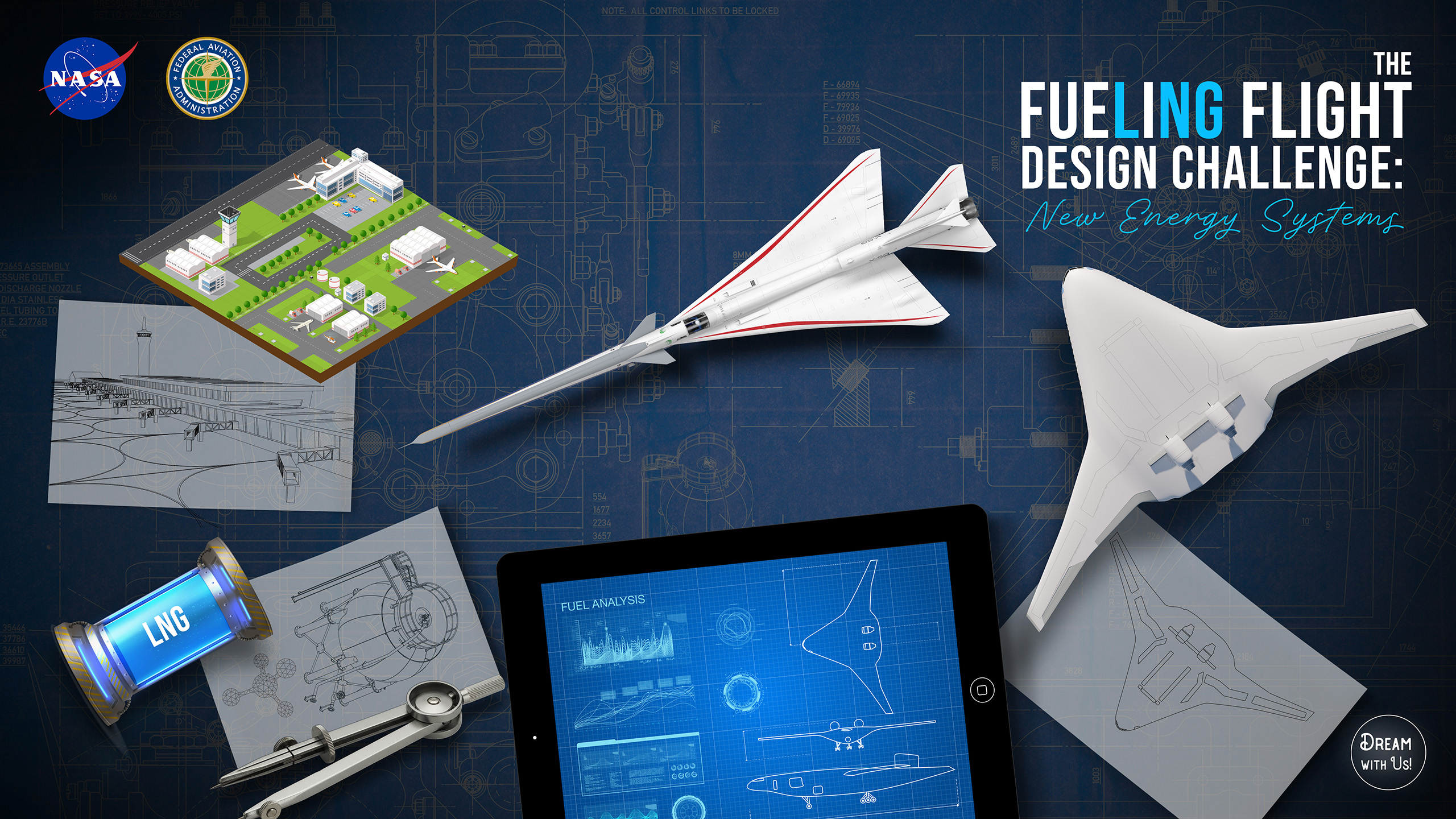
NASA is launching a nationwide middle school design competition for 2026-2027 centered on sustainable aviation technology. The challenge, titled "Fueling Flight Design Challenge: New Energy Systems," invites students to tackle real problems facing the aviation industry as aircraft traffic increases across U.S. airspace.
The competition reflects NASA's broader mission to support the next generation of engineers and scientists while addressing urgent infrastructure challenges. As commercial air traffic grows and the National Airspace System becomes increasingly congested, the aerospace industry faces mounting pressure to develop cleaner propulsion systems and improve operational efficiency. NASA, working alongside the Federal Aviation Administration, universities, and industry partners, has identified innovation in alternative energy systems as critical to aviation's future.
The Design, Build, and Fly program, commonly known as DBF or DWU (Design While U Wait), has operated for decades as a proven pipeline for cultivating student interest in aerospace careers. Middle school participants will work in teams to conceptualize, design, and potentially build prototype solutions addressing the energy and efficiency challenges outlined in the competition parameters. Past iterations of design challenges have pushed students to think about propulsion, aerodynamics, materials science, and systems integration.
This particular challenge targets the emerging field of sustainable aviation fuels and alternative propulsion architectures. As the aviation sector moves toward net-zero carbon emissions and reduced reliance on conventional jet fuel, the industry needs fresh perspectives. Middle schoolers bring unfiltered creativity and fewer preconceived limitations to problem-solving. Many breakthrough innovations come from students willing to question conventional approaches.
The competition structure typically combines rigorous technical requirements with open-ended design freedom. Students must meet specific performance benchmarks while optimizing for factors like weight, power consumption, and operational safety. Judges evaluate designs based on engineering merit, innovation, and practical feasibility. Winners receive recognition, prizes, and invitations to present their work at aerospace conferences and NASA facilities.
Participation requires no prior aerospace experience. Schools provide the framework; students provide the innovation. Teachers guide students through the engineering design process, teaching iteration, testing, failure analysis, and refinement. These soft skills prove as valuable as technical knowledge in engineering careers.
The timing aligns with the aerospace industry's urgent transition timeline. The International Air Transport Association has committed to net-zero emissions by 2050, with interim targets requiring measurable progress by 2030. Hydrogen fuel cells, battery electric propulsion, sustainable aviation fuels, and hybrid-electric systems represent the most promising near-term solutions. Each approach presents distinct engineering tradeoffs that students can explore through competition design work.
By engaging middle schoolers in 2026-2027, NASA plants seeds for the engineers who will actually build these systems a decade from now. Design competitions serve dual purposes. they develop workforce talent while generating innovative solutions that industry participants observe and sometimes adopt. NASA has implemented student concepts in actual research programs.
Schools interested in participating can expect challenge details, technical specifications, and resource materials from NASA in coming months. Registration typically opens several months before the competition year begins. Students gain hands-on experience with computer-aided design software, structural testing, and technical documentation. These skills transfer directly into high school STEM programs and post-secondary aerospace engineering curricula.
The 2026-2027 competition represents NASA's commitment to building a pipeline of talent capable of solving aviation's toughest problems while demonstrating that critical innovation comes from fresh minds asking bold questions about energy, efficiency, and flight.