NASA's DART mission proved that crashing a spacecraft into an asteroid can alter its trajectory. Now scientists propose a radically different approach: using light itself as a weapon against extinction-level threats.
Researchers are exploring diffractive solar sails as a method to deflect dangerous asteroids traveling at speeds exceeding 100 kilometers per second. Unlike DART's kinetic impact, which required a direct collision, solar sails would use reflected and refracted photons from the sun to gradually push asteroids away from Earth's orbit.
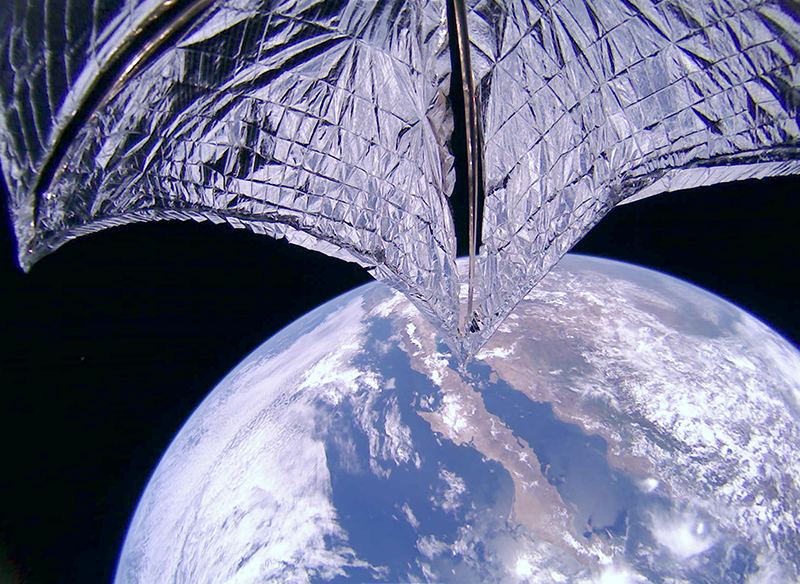
The concept builds on demonstrated solar sail technology. The Planetary Society's Lightsail 2, launched in 2019, proved that spacecraft can harness solar radiation pressure for propulsion. A diffractive solar sail operates on similar physics but applies the principle in reverse, using engineered surface properties to maximize momentum transfer to a target asteroid.
Kinetic impactors like DART remain effective for smaller threats or scenarios where warning time is adequate. DART's 2022 impact on the moonlet Dimorphos showed that a spacecraft traveling at roughly 22,000 kilometers per hour could measurably alter an asteroid's orbit. However, the approach has constraints. An impactor must approach from behind a rapidly moving asteroid, and multiple impacts require multiple missions, consuming time and resources that Earth's planetary defense system might not possess.
Diffractive sails offer different advantages. A sail-equipped spacecraft could position itself between the sun and an incoming asteroid, using reflected and diffracted light to apply continuous, directional force. This method works regardless of the asteroid's velocity or approach vector. Because photons exert force across vast distances, a sail could theoretically alter a killer asteroid's trajectory long before it reaches Earth's vicinity, providing months or years of deflection rather than days.
The physics involves engineering the sail's microstructure to bend and scatter photons in specific patterns. Rather than simple reflection, a diffractive sail would diffract sunlight to maximize pressure on the target. This requires precise control of surface properties at microscopic scales, but materials scientists have made substantial progress in recent years.
The timeline advantage proves critical. A typical near-Earth object moving at 100 kilometers per second covers one million kilometers daily. Once detected, such an object may have only months before impact. DART demonstrated impact capability, but deploying multiple kinetic impactors in sequence takes time. A solar sail mission, launched relatively quickly, could begin deflecting an asteroid immediately upon arrival, applying continuous pressure that accumulates over weeks or months.
Neither approach solves planetary defense alone. DART works best for smaller asteroids or when impact occurs relatively soon before collision. Solar sails excel at long-duration, continuous deflection of larger objects, but require clear line of sight to the sun and sufficient warning time for the photon pressure to accumulate meaningful velocity change.
NASA's Planetary Defense Coordination Office continues developing layered strategies. The space agency has identified roughly 90 percent of kilometer-sized near-Earth objects, the extinction-level threats. Smaller asteroids remain harder to catalog. As detection systems improve and technologies mature, both kinetic impact and photon-based deflection will likely become standard tools in Earth's defense arsenal.