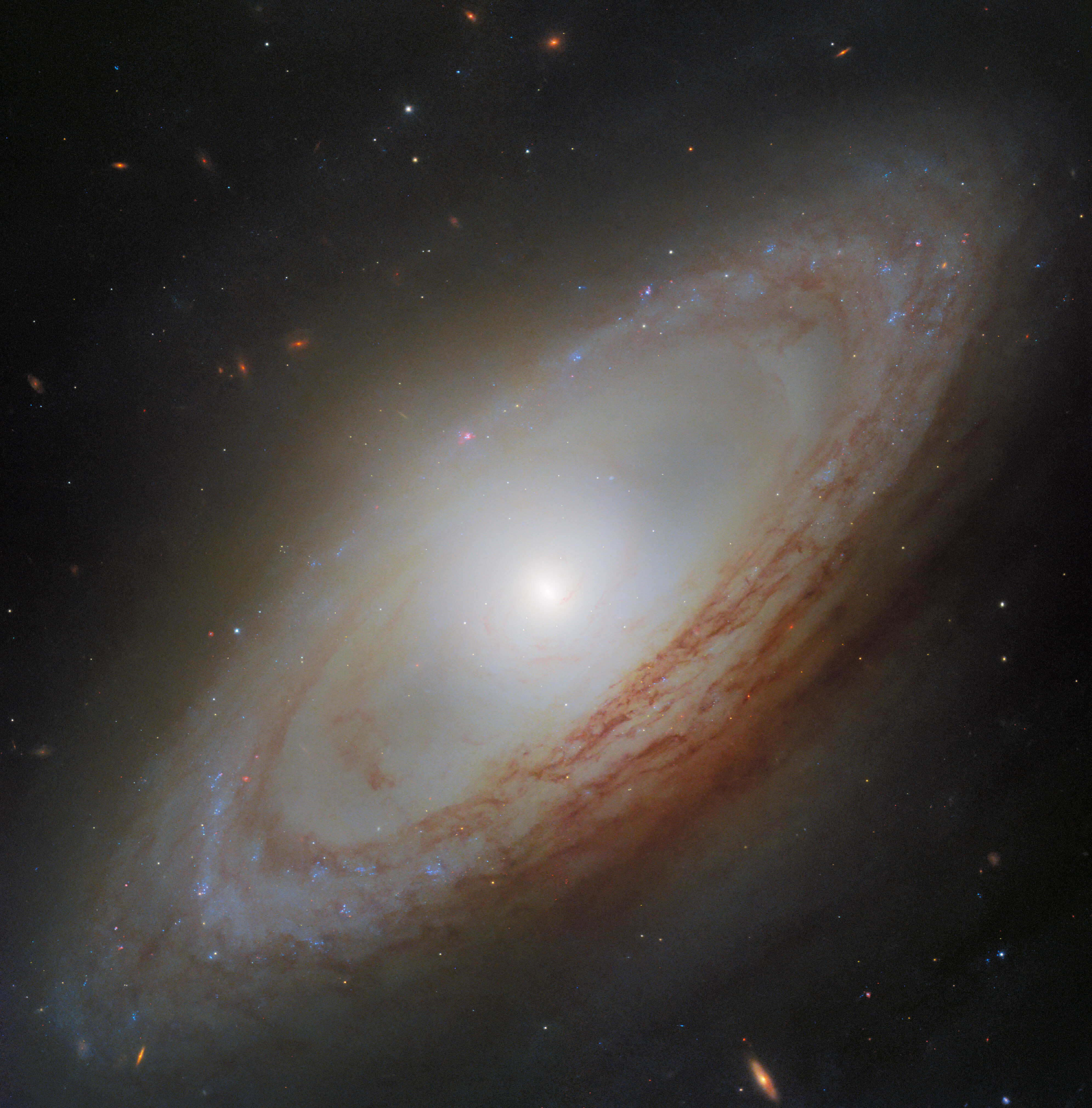
NASA's Hubble Space Telescope has revealed turbulent dynamics hidden beneath the calm exterior of spiral galaxy NGC 4698, located roughly 50 million light-years from Earth in the constellation Virgo. The image, released September 18, 2026, captures what appears to be a well-ordered galactic structure but conceals violent activity at its core.
The "chaotic secret" resides in NGC 4698's central region, where astronomers detected evidence of a supermassive black hole actively feeding on surrounding material. This activity generates powerful jets and radiation that disrupt the orderly motion of gas and stars near the galactic nucleus. Hubble's advanced Wide Field Camera 3 instrument resolved fine details in the galaxy's structure, allowing researchers to map the disruption pattern.
NGC 4698 belongs to the same morphological family as the Milky Way. Both are grand design spiral galaxies, characterized by symmetric arms that wind outward from a central bulge through a thin disk containing stars, gas, and dust. These structures represent some of the universe's most visually striking objects. Yet NGC 4698 demonstrates that visual symmetry masks turbulent physics.
The discovery matters for understanding how supermassive black holes influence galactic evolution. Every large galaxy harbors a supermassive black hole at its center. In NGC 4698, this object actively accretes material at rates that generate jets extending thousands of light-years into space. The outflows from active black holes heat surrounding gas, preventing it from collapsing into new stars. This "feedback" process shapes how galaxies grow and evolve over cosmic time.
Hubble observations identified specific signatures of this black hole activity. X-ray observations from other telescopes revealed energetic particles and hot gas. Optical data from Hubble showed ionized gas clouds arranged in patterns consistent with outflow from the nucleus. The combination of datasets allowed astronomers to reconstruct the violent processes occurring in NGC 4698's core.
This work represents part of Hubble's broader mission to catalog active galactic nuclei and understand the relationship between black holes and their host galaxies. Since its 1990 launch, Hubble has revolutionized astronomy by resolving structures in nearby galaxies that ground-based telescopes could barely detect. NGC 4698 adds to a growing inventory of spiral galaxies exhibiting dramatic core activity.
The findings also provide context for observing our own galactic center. Sagittarius A*, the Milky Way's central black hole, appears dormant by comparison, but likely exhibited similar activity billions of years ago. Studying NGC 4698 reveals what such epochs looked like and how feedback regulated our galaxy's development.
Hubble's continued operation remains vital for this science. Though the James Webb Space Telescope now probes the universe's earliest galaxies, Hubble's ultraviolet and optical capabilities remain irreplaceable for studying nearby galaxy structure and dynamics. NGC 4698's case demonstrates that even familiar-looking galaxies hold secrets requiring sustained observation and analysis to unlock.