# Saturn's Titan Emerges as a Prime Target for Astrobiology and Future Exploration
Titan, Saturn's largest moon, commands renewed scientific attention as researchers and space agencies assess its potential for hosting life and serving as a hub for future exploration. The Cassini-Huygens mission, which concluded its 13-year orbital campaign around Saturn in 2017, transformed our understanding of this enigmatic world. New data analysis and upcoming missions position Titan as one of the most compelling destinations in the solar system.
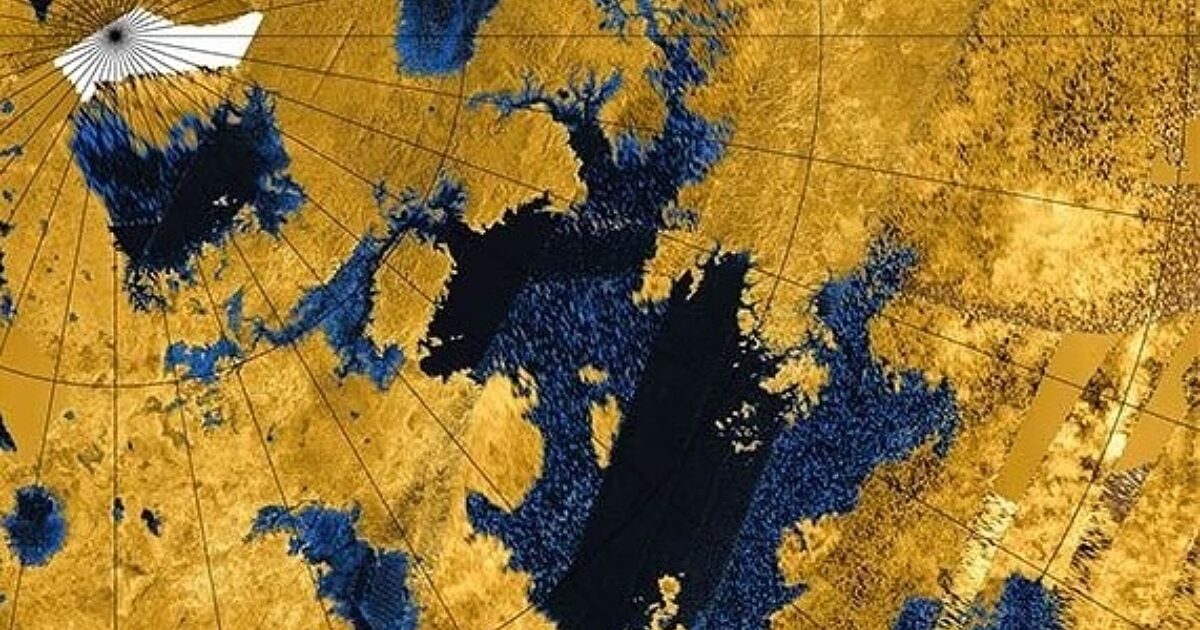
Titan stands apart among planetary moons. It is the only known satellite with a substantial atmosphere, composed primarily of nitrogen with trace methane and other organic compounds. This dense atmospheric envelope creates a complex planetary environment fundamentally different from Earth's neighbors. Surface temperatures plunge to 94 Kelvin (minus 179 Celsius), and methane rain sculpts hydrocarbon lakes and seas concentrated near the polar regions.
The Cassini orbiter and the Huygens probe revealed a world of profound complexity. Huygens descended through Titan's atmosphere in January 2005 and revealed a surface shaped by cryovolcanism, dune fields, and liquid hydrocarbon systems. Radar imaging from Cassini mapped vast methane seas, particularly Kraken Mare near the north pole. The probe's instruments detected organic molecules in the atmosphere and detected evidence of a subsurface water ocean beneath the icy crust. These findings elevated Titan from a curiosity to a world with conditions potentially suitable for exotic forms of life based on different chemistry than Earth organisms.
The astrobiological case for Titan rests on several pillars. The prebiotic chemistry occurring in its atmosphere and on its surface offers insight into chemical processes that may have preceded life on early Earth. Liquid methane and ethane act as alternative solvents to water. A subsurface water ocean provides a potential habitat for life. Organic compounds continuously synthesized in the upper atmosphere rain down on the surface, creating an abundance of chemical building blocks.
NASA and the European Space Agency are now developing Dragonfly, a rotorcraft-lander mission scheduled to launch in 2027 and arrive at Titan in 2034. Dragonfly will conduct the first mobile surface exploration of Titan, hopping between sites of scientific interest across hundreds of kilometers. The mission targets organic-rich regions and areas where cryovolcanic activity may have brought subsurface material to the surface. Instruments aboard will analyze organic compounds, search for biosignatures, and characterize Titan's habitability.
Japan's space agency and China have also expressed interest in Titan exploration. The scientific consensus identifies Titan alongside Jupiter's moon Europa as a top-tier astrobiology target. Europa hosts a subsurface water ocean accessed potentially through linear fractures in its icy shell. Titan offers accessibility through its atmosphere combined with chemical complexity that Europa cannot match.
The coming decade will reshape Titan's role in planetary exploration. Dragonfly's discoveries will determine whether this distant moon warrants investment in sample-return missions or even human-scale exploration infrastructure. For now, Titan represents a natural laboratory where planetary science intersects with the search for life beyond Earth, making it essential to understanding both our solar system and the conditions under which life might emerge elsewhere.