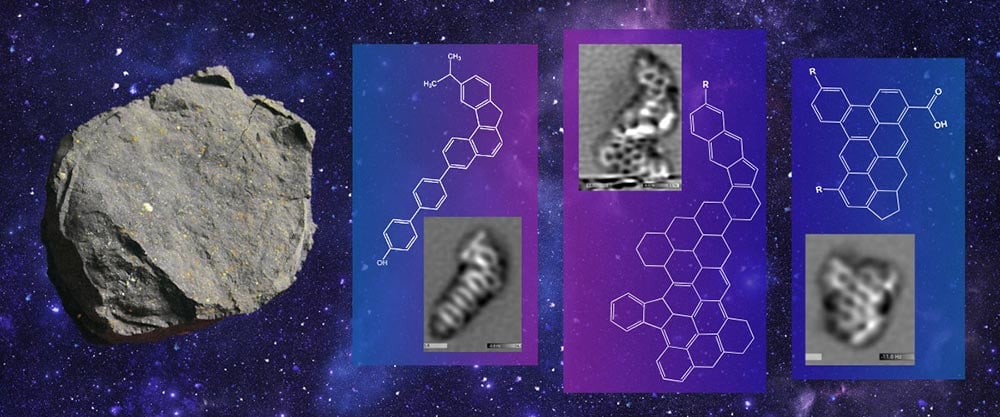
Researchers at the National High Magnetic Field Laboratory and Florida State University have directly imaged hundreds of thousands of complex organic molecules embedded in meteorites, revealing the chemical diversity of carbon-based compounds delivered to early Earth by space rocks.
The team, led by Joseph W. Frye-Jones, used atomic force microscopy (AFM) to visualize individual organic molecules within meteorite samples. Unlike previous analytical methods that identified compounds through indirect chemical signatures, AFM generates direct visual maps of molecular structures at the nanometer scale. The approach represents a departure from traditional mass spectrometry and chromatography techniques that destroy samples or provide only compositional data without spatial context.
Meteorites falling to Earth contain far more than the celebrated "building blocks of life" like amino acids, nucleotide bases, or simple sugars that dominated earlier discussions of panspermia and prebiotic chemistry. The new imaging work demonstrates that these space rocks carry an extensive library of organic molecules beyond those traditionally emphasized in origins-of-life research. The chemical landscape includes aromatic compounds, polycyclic structures, and carbon chains that populate the broader organic inventory of solar system materials.
The significance extends beyond simple catalog-building. Direct visualization of molecular architecture reveals how organic compounds cluster, associate, and orient within meteorite matrices. This spatial information informs models of chemical reactivity and availability during Earth's early epochs. When meteorites delivered these compounds to the young planet between 4.5 and 3.8 billion years ago, their three-dimensional arrangement within rocky carriers affected how readily they participated in subsequent reactions that ultimately generated metabolism and genetic systems.
AFM imaging also permits identification of compound classes that existing detection methods may overlook or mischaracterize. Carbon-based molecules that resist ionization in mass spectrometers or lack chromophores for optical detection become accessible through direct structural imaging. The expanded molecular census changes how scientists conceptualize meteorite chemistry and constrains models of organic synthesis in the interstellar medium and early solar system.
The research builds on established understanding that carbonaceous meteorites, particularly those from the CI and CM parent bodies, preserve pristine samples of solar system chemistry. Missions like Hayabusa2 to asteroid Ryugu and OSIRIS-REx to Bennu have collected fresh samples now arriving in laboratories, complementing meteorite collections assembled over decades. Each sample type offers constraints on the types and abundances of organic molecules present in specific asteroid classes.
Understanding the full molecular inventory of meteorites reshapes discussions of habitability and the chemical foundations available to emerging biospheres. If early Earth received not just amino acids but thousands of distinct organic species, the chemical space available for prebiotic reactions expanded substantially. Laboratory experiments attempting to replicate early Earth chemistry may have underestimated the complexity of reactants present in natural environments.
Frye-Jones and colleagues continue analyzing additional meteorite samples to determine whether molecular diversity varies among meteorite classes and whether certain compounds show clustering or preferential associations. Expansion of AFM methodologies to sample collections worldwide promises to yield increasingly detailed maps of organic chemistry in returned samples from active asteroid missions and meteorite falls.