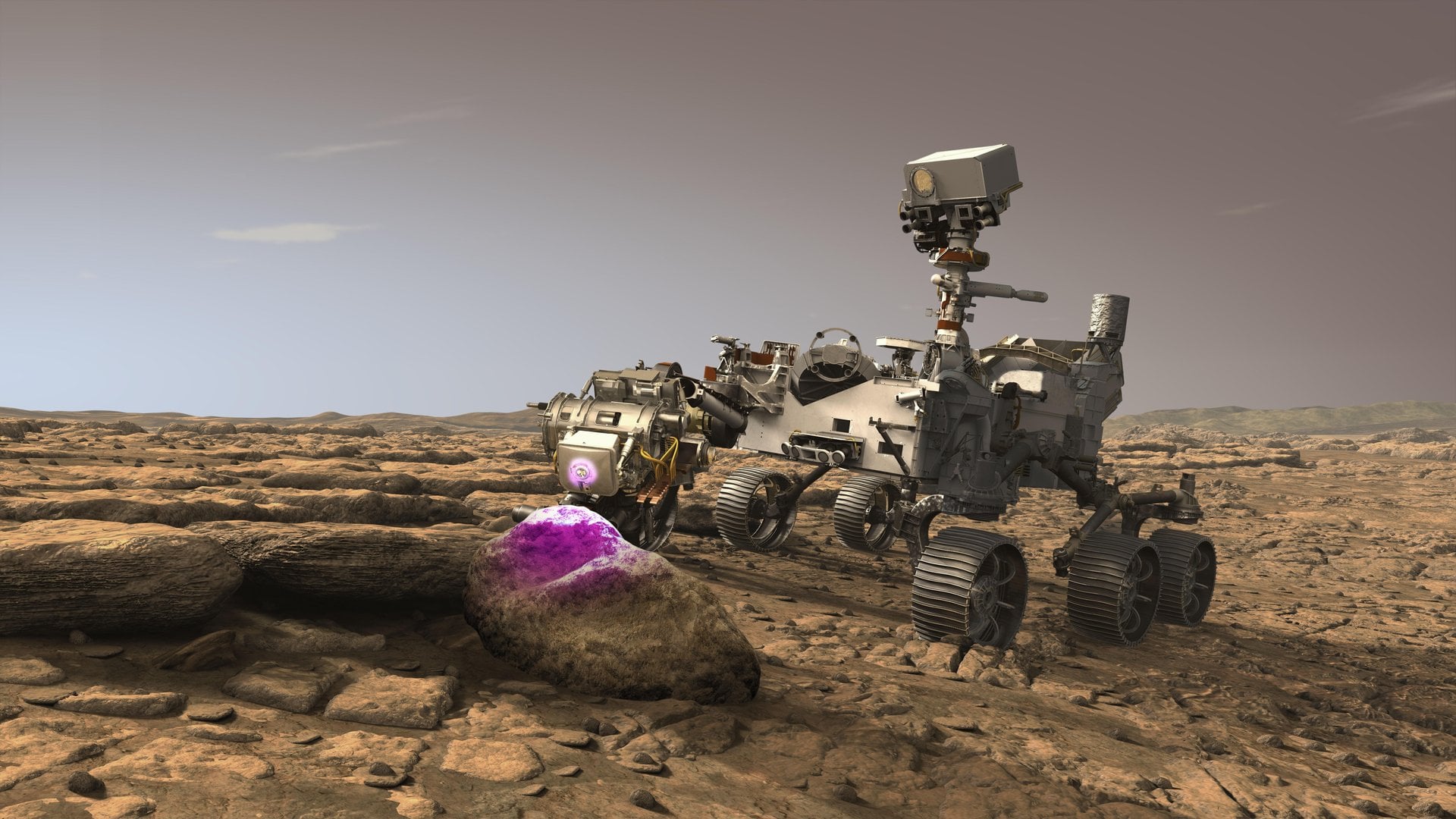
NASA's Perseverance rover and future Mars missions may need to dig deeper than previously thought to find evidence of Mars' watery past. A new geochemical modeling study led by researchers at JAXA (Japan Aerospace Exploration Agency) and the University of Tokyo suggests that carbonate rocks, which form when water interacts with carbon dioxide in the atmosphere, could be buried far beneath the Martian surface rather than concentrated in shallow deposits.
The study tackles a long-standing puzzle in Mars science. Early Mars, roughly 3.5 to 4 billion years ago, had a thicker atmosphere and warmer climate that allowed liquid water to flow across its surface. If water and atmospheric CO2 reacted chemically, they should have produced carbonate minerals in abundance. Yet rovers and orbital instruments have found relatively little carbonate on Mars' exposed surface. This discrepancy became known as the "carbonate problem."
The JAXA and University of Tokyo researchers propose that subsurface burial processes and chemical transformations account for the missing carbonates. Their modeling suggests that carbonates formed early in Mars' history but then migrated downward through groundwater circulation or became altered into other minerals through interactions with acidic fluids underground. Some may have transformed into different carbon compounds that don't show carbonate signatures in spectroscopic observations from orbit.
This finding has direct implications for Perseverance's operations and for selecting drilling sites for future missions. Perseverance carries the PIXL instrument (Planetary Instrument for X-ray Lithochemistry), which can analyze elemental composition of rocks with millimeter precision. The rover also has a drill capable of sampling subsurface material. If carbonates lie deep underground, Perseverance's drilling capability becomes especially valuable for accessing layers that contain the chemical fingerprints of ancient water.
The research also points toward what upcoming missions should prioritize. The ExoMars Rosalind Franklin rover, delayed by Thales Alenia Space but expected to launch in the coming years, includes a 2-meter drill specifically designed to reach subsurface samples. That capability directly addresses the need to access potentially carbonated rock layers at depth. Similarly, any future human missions to Mars will need subsurface access for both scientific sampling and for identifying water resources.
The geochemical modeling used computer simulations of how Martian groundwater would have interacted with different rock types over billions of years. The researchers considered pH levels, mineral solubility, and the chemical composition of fluids that would have existed beneath Mars' ancient surface. Their conclusion strengthens the case that Mars once had the chemical conditions necessary for life, even if evidence of water activity persists mainly in deep, buried deposits rather than visible outcrops.
Understanding carbonate distribution on Mars matters beyond geology. Finding preserved evidence of water-rock interactions helps scientists constrain the timeline of Mars' climate transition from warm and wet to the cold, dry world today. It also informs where to search for biosignatures, the chemical or physical traces of past microbial life. If life existed on Mars when water flowed, the best-preserved evidence may rest in subsurface rocks protected from radiation and oxidation.