# Flying Through Saturn's Rings: What The Cassini Mission Revealed About The Solar System's Most Iconic Feature
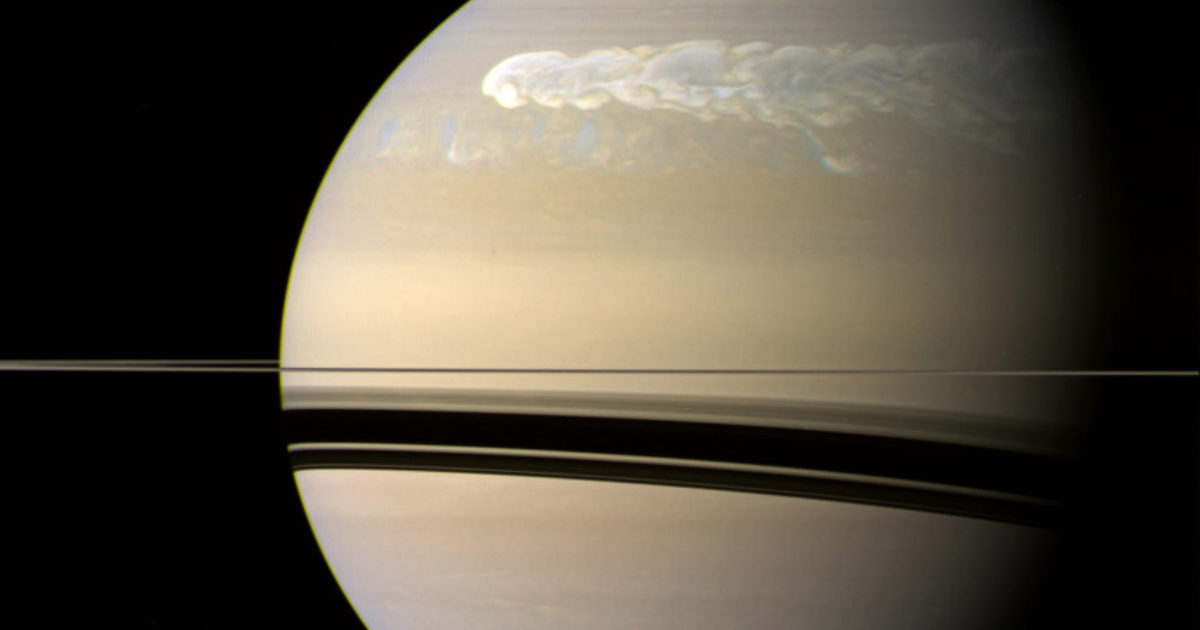
Saturn's rings remain the Solar System's most visually striking feature, yet their intimate structure has remained largely mysterious until spacecraft ventured close enough to observe them directly. The Cassini-Huygens mission, which orbited Saturn from 2004 to 2017, transformed our understanding of what navigation through these rings would actually entail.
Up close, Saturn's rings present a landscape far more complex than telescopic views suggest. The rings consist primarily of water ice particles ranging from dust-sized grains to house-sized boulders, arranged in distinct bands with varying densities and compositions. Cassini's instruments revealed that the rings harbor moonlets and shepherd moons that gravitationally sculpt the ring structure, creating gaps, waves, and density variations across billions of particles.
Flying through the rings would be a hazardous undertaking. At Saturn's orbital distance, a spacecraft traveling at typical velocities would encounter particles at relative speeds exceeding 20 kilometers per second. Even small debris striking a spacecraft at such velocities could cause catastrophic damage. Cassini's Grand Finale mission sequence from 2016 to 2017 took the spacecraft through the narrow gap between Saturn's cloud tops and the innermost ring edge. During these 22 dives, Cassini's sensors recorded particle impacts and detected unexpected density variations, revealing that the rings extend much closer to Saturn's atmosphere than previously calculated.
The rings themselves display surprising diversity. The A ring, the outermost major ring system, contains spiral density waves caused by gravitational resonances with Saturn's moons. The B ring, the brightest and most opaque ring, harbors complex structures and demonstrates unexpected vertical relief. The Cassini Division, the gap separating the A and B rings, contains faint ringlets rather than empty space. Studying these structures has provided astronomers with insights into planetary formation processes and ring dynamics applicable to understanding distant exoplanetary systems.
Cassini's particle detectors and imaging systems captured unprecedented detail about the ring composition. The mission confirmed that water ice comprises the bulk of ring material, though observations suggested organic compounds and silicate minerals also contribute to ring structure. This chemical diversity indicates that Saturn's rings may represent remnants of a destroyed moon or accumulated cometary material captured by Saturn's gravity well billions of years ago.
For future exploration, NASA and ESA continue analyzing Cassini data to refine models of ring behavior and structure. Proposed missions include targeted probes designed to sample ring particles directly and potentially retrieve material for laboratory analysis. These missions would advance our understanding of planetary ring systems and provide comparative data for interpreting ring systems detected around other planets and stars.
The rings of Saturn remain an active laboratory for planetary science. Each observation refines our comprehension of orbital mechanics, particle physics, and planetary system evolution. What appears as a serene, delicate arc from Earth conceals a dynamic realm of gravitational forces, particle collisions, and chemical processes that shaped Saturn and continue reshaping its rings today.