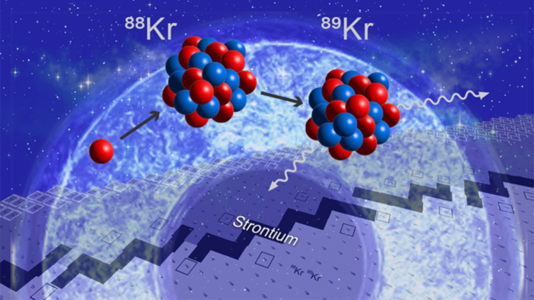
Astrophysicists have long puzzled over anomalous strontium abundances in ancient stars, unable to reconcile observations with existing nuclear reaction models. A new laboratory experiment conducted at Michigan State University's Facility for Rare Isotope Beams (FRIB) has identified the nuclear physics responsible for these chemical signatures, opening a window into the violent cosmic processes that forge heavy elements.
The research, led by graduate student Caley M. Harris and published in Nature Communications Physics, focuses on the rapid neutron capture process, or r-process. This mechanism operates inside neutron star mergers and the most extreme stellar explosions, creating elements heavier than iron through cascading nuclear reactions. Strontium, a moderately heavy element essential to everything from fireworks to medical isotopes, emerges as a byproduct of these cosmic events. Yet when astronomers analyzed ancient stars in our galactic halo, they found strontium levels that deviated from predictions based on standard r-process models.
The FRIB team performed precision nuclear reaction measurements using rare isotope beams to isolate the specific nuclear pathway responsible for strontium production. These experiments directly measured neutron capture cross-sections in isotopes critical to the r-process chain. The facility accelerates unstable isotopes to near light-speed, colliding them with targets and recording the resulting nuclear interactions with unprecedented accuracy. This data fed directly into updated r-process calculations.
The discovery resolves a longstanding tension between observational astronomy and theoretical nuclear physics. Ancient metal-poor stars preserve a record of chemical composition from the early universe, containing the elemental fingerprints of the first neutron star collisions and core-collapse supernovae. These objects served as cosmic laboratories, producing and dispersing the heavy elements we observe today. By identifying which nuclear reactions dominated strontium synthesis in those ancient events, researchers can better reconstruct the conditions in the early cosmos.
This finding extends beyond strontium alone. The same nuclear physics mechanisms that produce strontium affect the creation of other elements across the periodic table. Refining these reaction rates improves our understanding of how copper, zinc, molybdenum, and other heavy elements emerged from the cosmos's first violent instants. Such knowledge proves essential for interpreting spectroscopic data from ancient stars and, by extension, understanding galactic chemical evolution.
The FRIB serves as a cornerstone facility for this work, operated by Michigan State University and funded by the Department of Energy's Office of Science. Its rare isotope beam capabilities enable experiments impossible at conventional nuclear physics laboratories, creating and studying short-lived isotopes that existed only in stellar environments billions of years ago. As the facility continues operating at full capacity, researchers anticipate uncovering additional nuclear physics surprises encoded in stellar abundance patterns.
Astronomers now possess more reliable tools for interpreting the chemical signatures of the oldest stars. Future observations with next-generation telescopes like the James Webb Space Telescope will benefit from these refined nuclear reaction rates, allowing more precise dating of stellar populations and better constraints on the cosmic timeline of heavy element production.