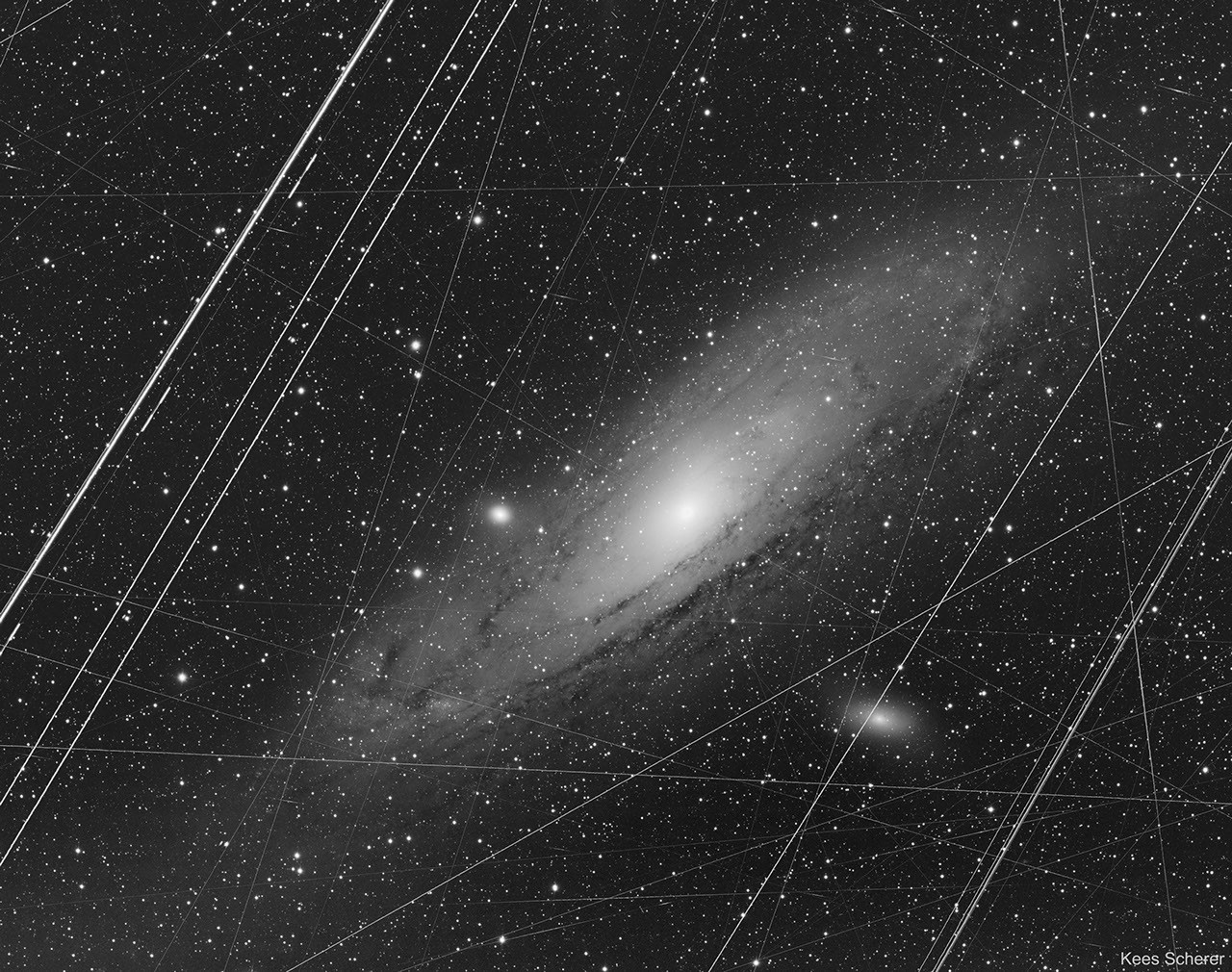
The Astronomy Picture of the Day series has released a comparison image of the Andromeda Galaxy showing how digital post-processing transforms astronomical observations. The featured image presents the same celestial view in two states: raw observational data and enhanced version following standard astrophotography techniques.
Andromeda, formally designated Messier 31 or M31, remains the nearest large galaxy to the Milky Way at roughly 2.5 million light-years distant. Despite this proximity in cosmic terms, capturing its full structure and faint outer regions demands both powerful telescopes and careful image processing. The before-and-after comparison illustrates the gap between what telescopes initially record and what astronomers present for public consumption.
Raw astronomical images from ground-based or space telescopes contain significant limitations. Atmospheric distortion affects ground-based observations. Instrumental artifacts introduce noise and uneven illumination. The faintest structures blend into background noise. Standard post-processing addresses these challenges through techniques including noise reduction, contrast enhancement, color balancing, and dynamic range adjustment. These methods recover details present in the original data but obscured by technical constraints.
The Andromeda comparison demonstrates why professional astronomers apply such processing. The unprocessed version appears dim and lacks structural detail. The enhanced version reveals the galaxy's magnificent spiral arms, dust lanes, and the bright central bulge containing millions of stars. The outer halo becomes visible, showing how Andromeda's gravitational influence extends far beyond its luminous disk.
This processing debate carries real weight in modern astronomy. Critics occasionally argue that enhanced images misrepresent reality. Professional astronomers counter that processing simply makes visible what their instruments actually detected. The raw data itself contains all the information in the final image. Processing merely allocates that information to visible wavelengths and brightness levels that human eyes can perceive. Without such techniques, most astronomical observations would remain scientifically valuable but visually incomprehensible.
The Andromeda Galaxy holds particular importance for understanding galactic structure and evolution. Its proximity allows detailed study impossible for more distant galaxies. Astronomers examine its stellar populations, dust distribution, star formation regions, and interaction with its satellite galaxies. Andromeda also serves as a crucial comparison point for understanding our own Milky Way. The two galaxies will eventually merge in roughly 4.5 billion years, making their current properties especially relevant for modeling galactic collisions.
NASA's Astronomy Picture of the Day, hosted by the Goddard Space Flight Center, has published daily images since 1995. Each entry pairs high-quality imagery with explanation from professional astronomers. The series reaches millions of observers globally, making it one of the most-accessed NASA resources. Today's Andromeda comparison exemplifies how APOD educates the public about both astronomical objects and the methods astronomers use to study them.
The before-and-after format serves educational purposes beyond simple aesthetics. It demonstrates scientific transparency. Viewers see exactly what raw observations contain and understand the technical steps required to extract meaning from those observations. This honesty about methodology builds public understanding of how modern astronomy actually works.