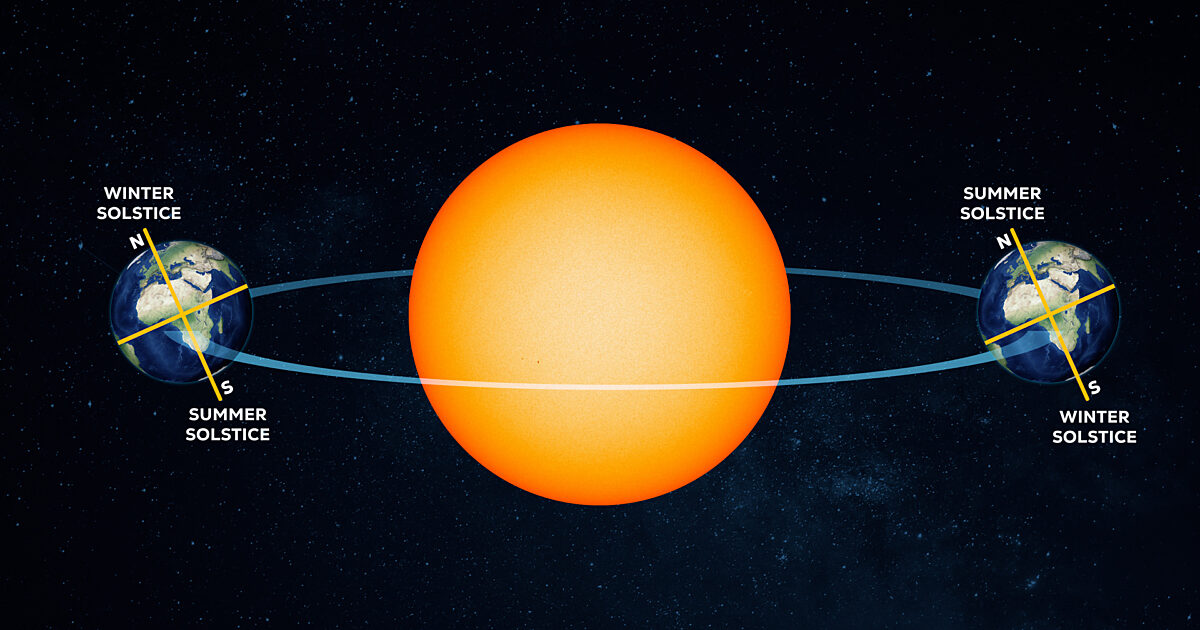
# How Earth's Tilted Axis Shapes Our Seasons and Celestial Milestones
Earth's 23.5-degree axial tilt orchestrates the planet's seasonal dance and produces the solstices and equinoxes that mark the astronomical calendar. This tilt, locked at nearly the same angle for billions of years, remains the fundamental engine driving temperature variations across the globe and determining when days lengthen or shorten.
The mechanics are straightforward. As Earth orbits the Sun over 365.25 days, the tilt ensures that different hemispheres receive varying amounts of solar radiation throughout the year. When the Northern Hemisphere tilts toward the Sun, that region experiences summer. Simultaneously, the Southern Hemisphere tilts away, entering winter. This relationship reverses six months later.
The summer solstice marks the moment when a hemisphere reaches its maximum tilt toward the Sun. In the Northern Hemisphere, this occurs around June 20 or 21. The winter solstice, occurring around December 21 or 22, marks the opposite extreme, when that hemisphere tilts farthest from the Sun. On these dates, one location receives the year's longest day and the other experiences its shortest.
The equinoxes fall between these extremes. The vernal equinox, arriving around March 20 or 21 in the Northern Hemisphere, occurs when Earth's axis points neither toward nor away from the Sun. The autumnal equinox follows around September 22 or 23. On both equinox dates, day and night last approximately 12 hours worldwide, a consequence of the Sun crossing the celestial equator.
This predictable cycle shaped human civilization for millennia. Ancient cultures aligned monuments to solstices and equinoxes, tracking these events for agricultural planning and religious observance. Stonehenge in England, Chichen Itza in Mexico, and Machu Picchu in Peru all demonstrate how cultures used celestial geometry to mark seasonal transitions essential for survival.
The axial tilt itself remains a subject of scientific inquiry. Most evidence suggests a Mars-sized body collided with proto-Earth roughly 4.5 billion years ago, imparting the angular momentum that created the tilt. Without this cataclysmic event, Earth would likely rotate perpendicular to its orbital plane, eliminating seasons entirely. Temperatures would stabilize near the equator while poles froze permanently.
Planetary scientists studying exoplanets now recognize that axial tilt profoundly influences habitability. Planets with minimal or extreme axial tilts show less stable climates. Earth's tilt creates a Goldilocks climate zone across latitudes, supporting biological diversity from tropics to temperate zones.
The precision of Earth's axial tilt also enables accurate timekeeping. Astronomers use solstices and equinoxes as reference points for celestial measurements. The ecliptic, the plane of Earth's orbit, defines the zodiac constellations through which the Sun appears to travel annually.
These celestial events continue to anchor human culture and scientific understanding. Ancient wisdom and modern astronomy converge at the solstices and equinoxes, reminding us that Earth's position in space directly determines the rhythm of seasons and the conditions sustaining all life.