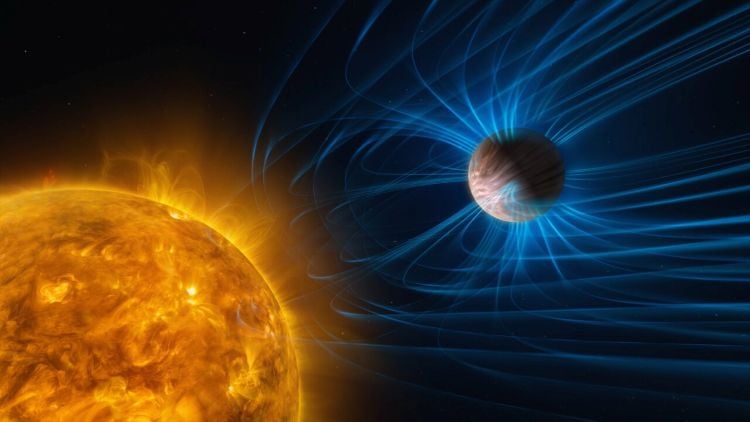
The Square Kilometre Array, one of the most powerful radio observatories ever built, will soon gain the capability to detect magnetic fields surrounding distant exoplanets. This breakthrough represents a fundamental shift in how astronomers evaluate which alien worlds might harbor life.
For decades, exoplanet hunters focused on a simple criterion: planets orbiting within a star's habitable zone, where liquid water could exist on the surface. The discovery of thousands of exoplanets revealed a more complex reality. Many stars, particularly smaller red dwarfs that host numerous exoplanets, unleash far more stellar radiation than our Sun does. This radiation batters any planets in their orbitable zones, stripping away atmospheres and exposing surfaces to dangerous particle streams.
Earth's magnetosphere shields our planet from this solar onslaught. The magnetic field deflects the solar wind, protecting the atmosphere and any surface life from ionizing radiation. Without a magnetic field, even a planet in the habitable zone becomes a barren wasteland. Venus, despite orbiting in the Sun's habitable zone, lost its atmosphere partly because its lack of a strong magnetic field left it defenseless against solar wind erosion.
The SKA, a next-generation radio array being constructed in South Africa and Australia through collaboration between the Square Kilometre Array Organization and member nations, will revolutionize exoplanet characterization. The observatory consists of thousands of small radio dishes working in concert, creating unprecedented sensitivity across radio frequencies. This capability allows detection of the faint radio emissions that magnetic fields produce through interaction with stellar winds.
Radio telescopes detect magnetized environments through cyclotron radiation, the energy released when charged particles spiral along magnetic field lines. On Jupiter, auroral radio emissions trace the planet's powerful magnetic field. The SKA's sensitivity will extend this detection method light-years across space, identifying magnetic fields around exoplanets orbiting distant stars. By measuring a distant world's magnetic field strength, astronomers can assess its atmospheric retention capacity and radiation protection.
The implications reshape habitability criteria. A superhabitable exoplanet candidate near a violent star with a strong magnetic field suddenly becomes more promising than a bland habitable-zone world orbiting a more aggressive star without field protection. The SKA transforms magnetic field detection from theoretical possibility to observational reality.
Construction of the SKA proceeded through its mid-2020s phases, with early science operations beginning within the decade. Other facilities like LOFAR and the VLA provide pathfinding data, but the SKA's collecting area and sensitivity exceed these precursors by orders of magnitude.
This capability arrives precisely when exoplanet characterization demands it. Future missions including the James Webb Space Telescope and upcoming ground-based extremely large telescopes will provide atmospheric compositions and surface temperatures. The SKA fills the critical gap: revealing the magnetic shield that determines whether those attractive conditions persist or succumb to stellar assault.