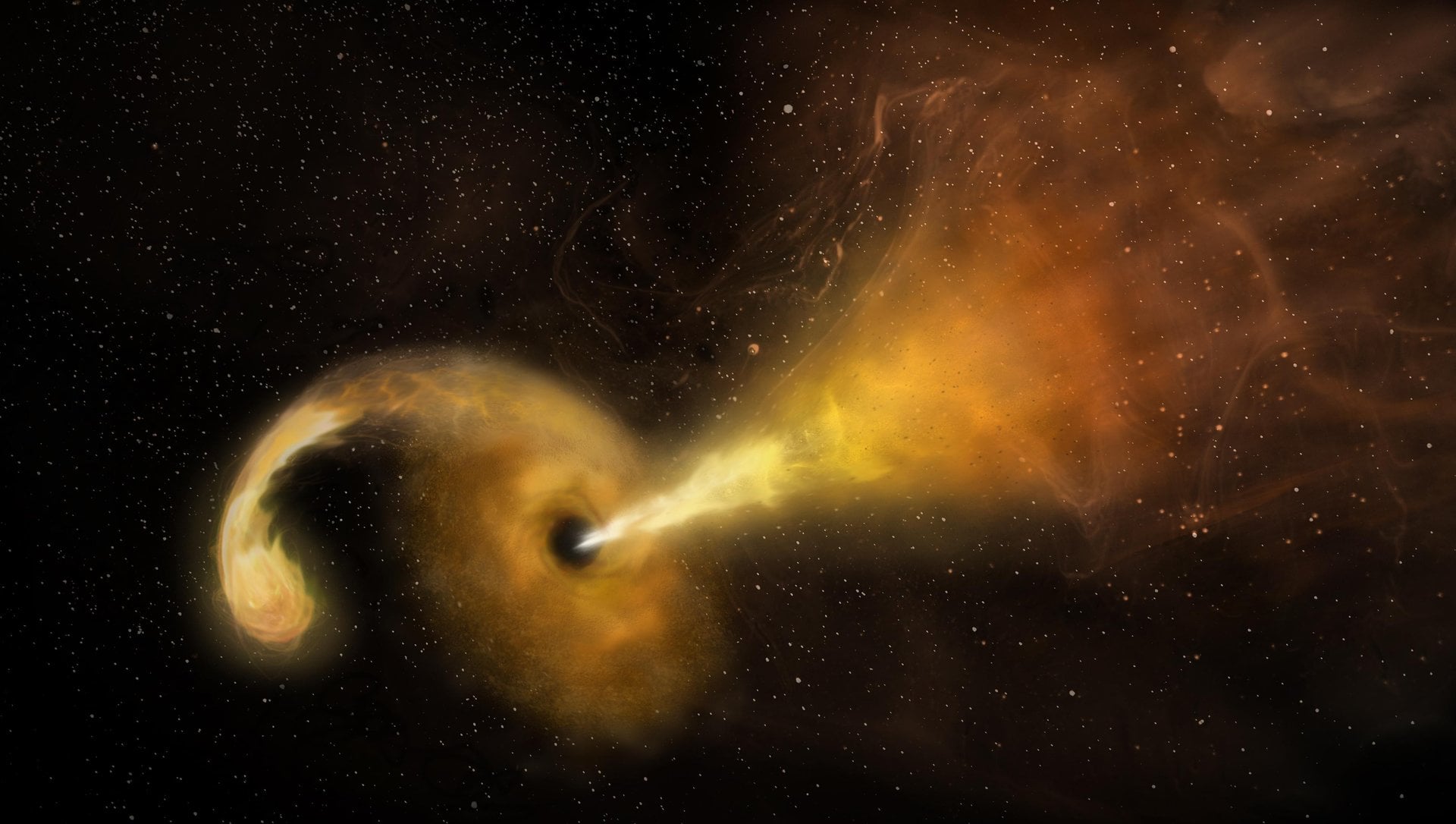
Black holes across a vast range of sizes produce jets in fundamentally the same way, according to new research comparing the behavior of stellar-mass and supermassive black holes. Both types launch high-energy ionized material from their poles when conditions align properly, revealing a universal mechanism that operates regardless of the black hole's mass.
Stellar-mass black holes, typically 5 to 20 times the Sun's mass, generate jets by consuming material from companion stars in binary systems. Supermassive black holes, which contain millions to billions of solar masses at galaxy centers, produce jets through tidal disruption events. When a star wanders too close to a supermassive black hole's intense gravitational field, the black hole tears it apart, consuming the stellar material and launching jets in the process.
The jets themselves represent some of the most violent phenomena in the universe. Material accelerates to near light speed and streams outward in narrow, collimated beams from the black hole's rotation axis. These jets carry enormous energy across astronomical distances, sometimes extending millions of light-years from their source and shaping the structure of entire galaxy clusters.
What makes this comparison striking is that despite their vastly different feeding mechanisms, both types of black holes require similar physical conditions to produce jets. Accretion disks must form around the black hole, and magnetic fields must achieve sufficient strength to launch material outward. The similarity suggests that jet formation follows universal principles rooted in how gravity, rotation, and magnetism interact at black holes' event horizons.
This research has profound implications for understanding black hole physics. It demonstrates that the physics governing black holes operates independently of scale. A stellar-mass black hole consuming a companion star follows the same fundamental rules as a supermassive black hole demolishing an entire star in a tidal disruption event. This universality allows astronomers to study stellar-mass black holes in our galaxy as laboratories for understanding the most extreme objects in the universe.
Tidal disruption events provide particularly valuable opportunities for this work. They occur relatively rarely but can be detected across cosmological distances when X-ray observatories like NASA's Chandra or radio telescopes survey the sky. Each event offers a temporary laboratory where astronomers can observe a supermassive black hole's accretion and jet-launching behavior over months or years.
The findings also inform interpretations of observations from major astronomical facilities. The Event Horizon Telescope recently produced the first direct image of a black hole's shadow, revealing the supermassive black hole M87 and its jets. Understanding how jets form helps interpret such observations and predictions about what telescopes should detect.
Future surveys will likely identify more tidal disruption events, particularly with new facilities like the Vera C. Rubin Observatory coming online. Each event provides another data point for comparing how stellar-mass and supermassive black holes behave. The consistency between these different scales of black holes strengthens the theoretical framework physicists use to model extreme gravity and may eventually yield insights into whether even larger or smaller black holes follow the same rules.