# Early Galaxies Held Neutral Gas Just 700 Million Years After Big Bang
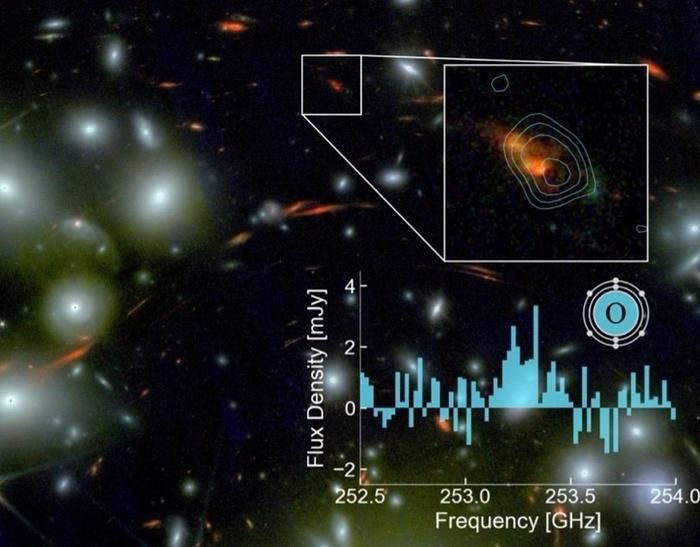
Astronomers have detected neutral hydrogen gas in four galaxies that existed only 700 million years after the Big Bang, pushing back the timeline for when neutral gas became abundant in the young universe. The discovery, made using the Atacama Large Millimeter/submillimeter Array (ALMA), reveals that star-forming galaxies in the cosmic dawn retained significant quantities of neutral hydrogen far earlier than previous observations suggested.
The observation targets four galaxies, including A1689-zD1, observed through ALMA's ground-based telescope array in Chile. These observations matter because they constrain when the universe's "cosmic reionization" ended. In the first few hundred million years after the Big Bang, the universe filled with neutral hydrogen gas. Ultraviolet radiation from early stars and galaxies gradually ionized this gas, transforming the universe from opaque to transparent around one billion years post-Big Bang. This transition remains one of astronomy's unsolved puzzles.
Assistant Professor Yoshinobu Fudamoto from Chiba University led the research. His team detected direct signatures of neutral hydrogen in galaxies during what astronomers call the "cosmic dawn." Finding neutral gas at this epoch tells us these galaxies had not yet fully contributed to reionizing their surroundings. The presence of this gas also indicates these early galaxies possessed active star formation while maintaining substantial neutral hydrogen reserves.
ALMA detects the neutral hydrogen through the 21-centimeter line, a radio emission signature produced when neutral hydrogen atoms undergo a specific quantum transition. This detection method works even across cosmic distances because ALMA observes radio wavelengths that stretch across the expanding universe. The redshift of these distant galaxies pushes the 21-centimeter line into frequency ranges ALMA can measure.
Previous studies relied on indirect proxies to infer neutral hydrogen content in early galaxies. Direct detections remained rare because neutral hydrogen is intrinsically faint at high redshifts. The new observations represent a breakthrough in directly measuring neutral gas in the epoch of reionization, a period when the universe transformed fundamentally.
These four galaxies tell us that massive star-forming systems existed and accumulated neutral hydrogen reserves during the universe's first 700 million years. The data suggests that reionization did not proceed uniformly. Some regions retained neutral gas longer than others, creating a patchy ionization front that gradually consumed the neutral hydrogen throughout the universe.
Understanding when and how reionization completed shapes our models of galaxy formation, the first stellar populations, and the universe's metal enrichment history. Early massive stars produced heavy elements that seeded subsequent generations of galaxies and eventually enabled rocky planets and life.
Future observations with next-generation telescopes like the James Webb Space Telescope and upcoming facilities will map neutral hydrogen populations across larger samples of early galaxies. These surveys will determine whether the four newly detected galaxies represent typical early star-formers or outliers. The answers will refine our understanding of how the young universe transitioned from a neutral fog to the transparent cosmos we observe today.