# Strange Galaxies in the Early Universe Were Shaped by Weird Stars
The James Webb Space Telescope and other modern observatories have revealed something unexpected about the early universe. Galaxies that formed when the cosmos was less than a billion years old look fundamentally different from their modern counterparts, and astronomers now understand a key reason why: the stars that built them were bizarre.
Researchers at the University of Utah launched a survey called the Treasury of Extremely Massive Stars to understand how primordial stellar populations shaped galactic evolution. These early stars operated under completely different rules than the stars we observe today. They were more massive, burned hotter, lived faster, and died younger. Some exhausted their fuel in mere millions of years before exploding as supernovae.
These explosive deaths mattered enormously. When massive stars explode, they inject tremendous energy into their host galaxies. They also seed the cosmos with heavy elements forged in their cores. The stellar feedback from this era fundamentally altered galactic structure, morphology, and the rate at which subsequent stars could form.
The first stars ignited roughly 100 million years after the Big Bang. They were composed almost entirely of hydrogen and helium, lacking the heavier chemical elements that modern stars contain. This primordial composition made them chemically different from anything in today's galaxies. Their structure, their internal physics, and their eventual deaths all proceeded along different pathways than contemporary stellar evolution.
The University of Utah team used nearby galaxies as laboratories. By studying extremely massive stars in galaxies close enough for detailed observation, they created an observational analog of what the early universe might have looked like. These local analogs provide crucial data about how massive star populations reshape their surroundings through radiation, winds, and supernova explosions.
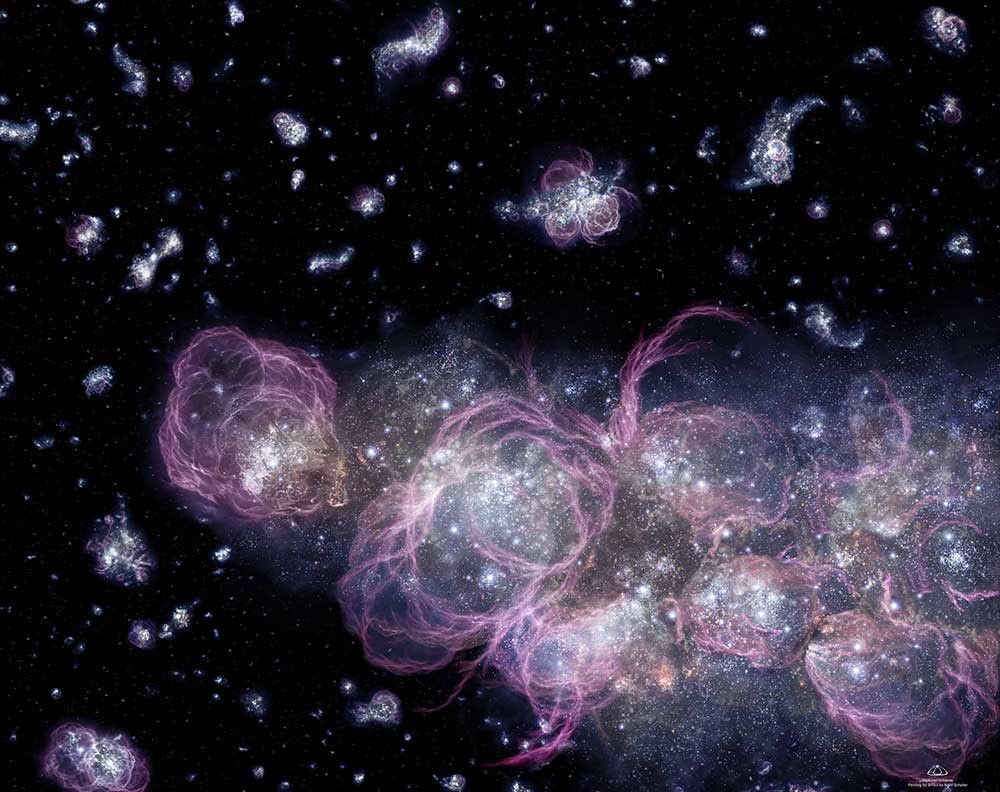
JWST observations have shown that early galaxies often appear elongated, clumpy, or disorganized compared to the grand spirals and ellipticals we see nearby. These morphological differences weren't random. The intense stellar feedback from generations of massive stars turbulently reorganized galactic gas. Star formation patterns changed. Galactic rotation curves shifted. Over cosmic time, this influenced whether galaxies would eventually settle into stable configurations or remain chaotic.
Understanding this connection matters for multiple reasons. First, it explains why the universe looked the way it did during its first billion years. Second, it reveals the physical mechanisms that drove galactic assembly during cosmic dawn. Third, it helps astronomers interpret JWST observations of the most distant, earliest galaxies yet detected. When astronomers observe a warped or clumpy galaxy at redshift 10 or higher, they can now understand that morphology reflects the influence of an unusual stellar population, not necessarily something exotic about galaxy formation itself.
The Treasury survey continues examining local stellar populations that mimic early universe conditions. Each observation adds detail to how massive stars orchestrated galactic transformation during the cosmos' youth. This detective work turns JWST's distant observations into readable stories about how the universe evolved from nearly featureless to structured in its first billion years.