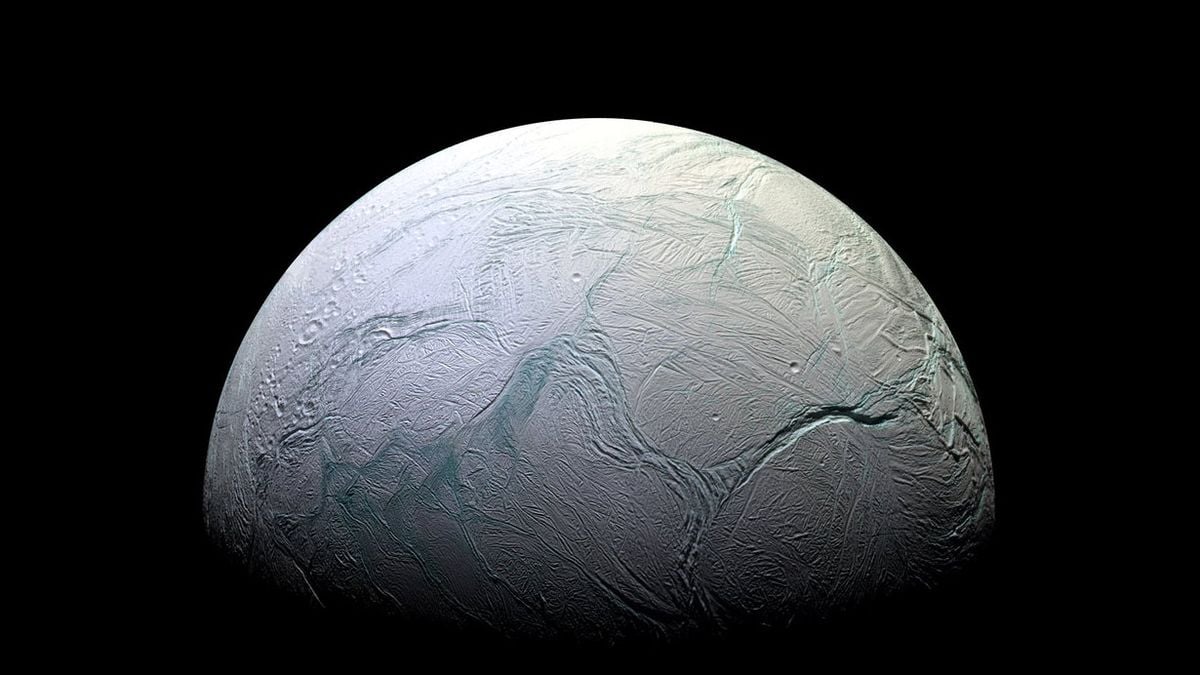
A groundbreaking analysis from Freie Universität Berlin suggests that detecting microbial life on Saturn's moon Enceladus requires far less sophisticated instrumentation than planetary scientists previously believed necessary.
The research fundamentally reshapes expectations for future astrobiology missions to this ocean world. Enceladus harbors a subsurface water ocean beneath its icy crust, making it one of the most promising targets in the solar system for finding extraterrestrial life. NASA's Cassini spacecraft, which orbited Saturn from 2004 to 2017, collected compelling evidence of this hidden ocean through observations of water-rich plumes erupting from the moon's south polar region.
The Berlin team's findings emerge from two separate studies analyzing how biosignatures—chemical markers of biological activity—could be detected in Enceladus's plume material. Biosignatures include organic molecules, metabolic byproducts, and isotopic ratios that differ between biological and non-biological processes. The key insight centers on the abundance and detectability of these markers in the plume's composition.
Previous mission architecture concepts relied on highly sensitive mass spectrometers and other advanced analytical instruments to parse subtle chemical differences. These designs drove up spacecraft cost and complexity substantially. The new research demonstrates that simpler instruments could produce definitive results because Enceladus plumes concentrate biosignature compounds at detectable levels. The density of life-related chemistry appears orders of magnitude higher than scientists anticipated from theoretical models.
This finding opens pathways for more economical and faster mission development. NASA and ESA, the European Space Agency, both maintain active planning efforts for Enceladus reconnaissance. The Enceladus Orbiter concept, currently under study, would conduct multiple close encounters with the plume region. If instruments can be simplified without sacrificing detection capability, such missions could launch sooner and operate within tighter budgetary constraints.
The research also informs sensor selection for sample-return missions. Direct collection and analysis of Enceladus material in Earth laboratories remains the gold standard for astrobiology, but orbital remote sensing becomes increasingly viable if plume chemistry offers robust biosignature abundance.
Enceladus presents unique advantages over other ocean worlds like Europa, Jupiter's moon with its own subsurface ocean. The active plumes extend material directly into space, eliminating the need to drill through kilometers of ice. A spacecraft need only position itself in the plume's trajectory and activate onboard analytical instruments.
The Cassini mission revealed amino acids and complex organic compounds in Enceladus's plumes during its final years of operation. These discoveries, combined with evidence of hydrothermal vents on the ocean floor, suggest conditions suitable for life chemistry. The new Berlin studies suggest that if life exists in that ocean, plume sampling will reveal its presence more readily than the scientific community expected.
These findings carry implications beyond Enceladus. Europa, Neptune's moon Triton, and exoplanet systems with accessible ocean worlds may all benefit from revised astrobiology detection methodologies. The work suggests that life-detection missions could operate with engineering margins that enable more ambitious exploration programs.