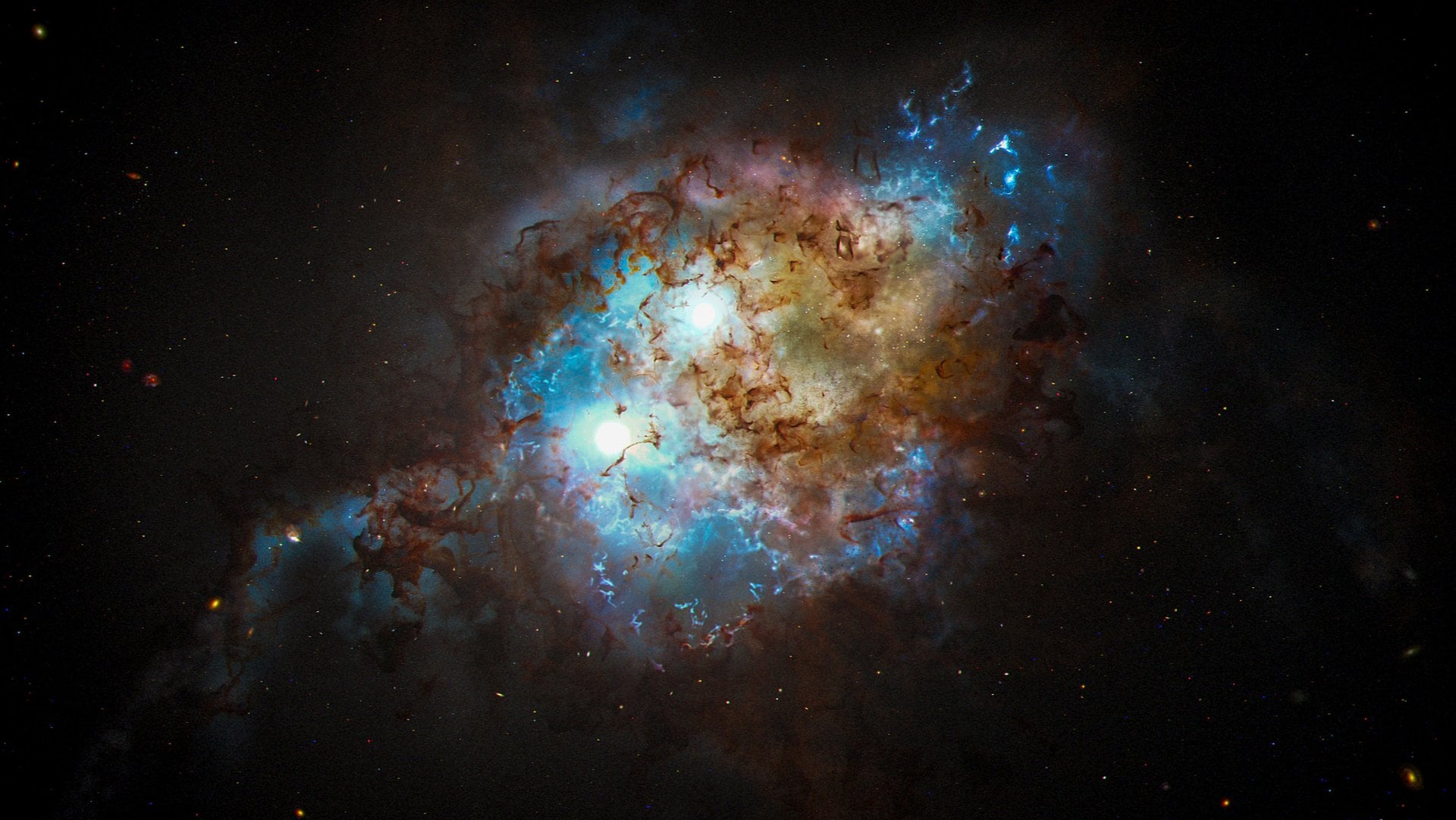
Astronomers have developed a new technique for measuring the distance between paired quasars, a breakthrough from University of Alberta researchers that simplifies a previously complex observational challenge. The method offers a faster, more reliable way to gauge these cosmic separations, which carry implications for understanding how galaxies evolve and merge.
Quasars are active galactic nuclei powered by supermassive black holes consuming material at extraordinary rates. When two galaxies collide and merge, their central black holes eventually pair up, producing quasar pairs that shine with intense brilliance across billions of light-years. These systems represent a critical phase in galaxy assembly and evolution, yet measuring the actual spatial distance between them has proven difficult using traditional methods.
The new approach addresses a fundamental problem in extragalactic astronomy. Previous techniques required extensive follow-up observations and complex calculations to determine whether quasar pairs were physically connected or simply aligned by chance. The separation measurement mattered because it revealed whether astronomers were observing a genuinely merging system or an optical illusion created by projection effects on the sky.
University of Alberta researchers identified a more direct way to calculate these distances using observable properties of the quasars themselves. The method relies on analyzing specific characteristics of each quasar's light and structure rather than depending on indirect inference from background data. This streamlines the measurement process considerably.
The implications extend beyond simple catalog building. Understanding quasar pair separations contributes to models of how supermassive black hole binaries form, interact, and eventually merge. Such mergers produce gravitational waves detectable by instruments like LIGO and Virgo. When LIGO announced the first confirmed detection of gravitational waves in 2015, it validated decades of theoretical predictions about merging black holes. Quasar pairs offer a crucial laboratory for studying the precursor stages before gravitational wave merger events occur.
This research also refines our understanding of galaxy mergers themselves. When two galaxies collide, their structural dynamics change fundamentally. Material streams inward, triggering bursts of star formation and feeding the central black holes. Quasar pairs probe this critical transitional epoch in cosmic history, roughly 2 to 10 billion years ago. By measuring their separations more accurately, astronomers build better models of how major galactic transformations unfold.
The technique proves particularly valuable for observatories with limited observing time. Space-based telescopes like the Hubble Space Telescope and the James Webb Space Telescope operate under intense scheduling pressure. A faster, more accurate distance measurement method reduces the observation time needed per target, freeing telescope hours for other investigations.
University of Alberta researchers have created a practical tool that observatories worldwide can adopt immediately. The method does not require specialized equipment or novel instrumentation. Astronomers can apply it to existing datasets, potentially unlocking distance measurements from quasar pairs already cataloged but previously analyzed with conventional approaches.
This work represents the kind of methodological refinement that accelerates progress across observational astronomy. As surveys like the Vera C. Rubin Observatory's Legacy Survey of Space and Time catalog hundreds of thousands of quasars, improved measurement techniques become increasingly valuable. The simpler approach reduces analysis bottlenecks and enables faster processing of large datasets. The result is clearer vision into how the universe's largest gravitational systems evolve.