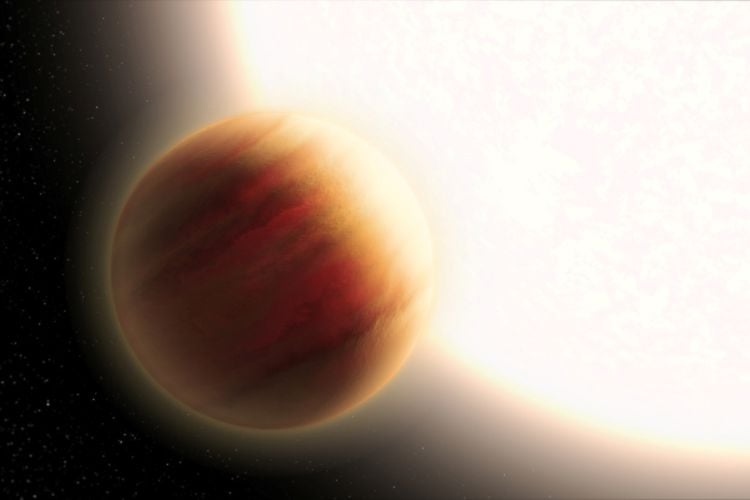
Astronomers have identified an extraordinary exoplanet system that will fundamentally alter how they observe one of the universe's most enigmatic objects. TOI-1355 b, a hot Jupiter discovered orbiting an F-type star approximately 430 light-years from Earth, will pass behind its host star from Earth's perspective in 2033, vanishing from telescopic view for years.
The planet represents one of the shortest-period hot Jupiters known to science. Hot Jupiters challenge conventional planetary formation theory because they orbit their host stars at distances measured in just hours or days, not years like Jupiter in our solar system. TOI-1355 b falls into this category of extreme worlds, yet its orbital characteristics reveal something even more unusual: the orbit appears significantly eccentric, meaning it traces an oval rather than a circle around its star.
This eccentricity matters profoundly. An eccentric orbit causes the planet to swing closer and farther from its star periodically. Current orbital mechanics calculations indicate that when TOI-1355 b reaches perihelion, its closest approach, it will pass directly behind the host star from Earth's viewpoint. The 2033 date marks when this alignment occurs, after which ground-based and space-based telescopes will lose direct observational access to the planet for an extended period.
The discovery emerged from data collected by NASA's Transiting Exoplanet Survey Satellite (TESS), which identifies exoplanets by detecting the tiny dips in starlight when planets transit in front of their host stars. TESS has revolutionized exoplanet discovery since its launch in 2018, identifying thousands of candidates orbiting distant suns. TOI-1355 b represents one of its more peculiar finds, with orbital characteristics that defy easy explanation.
The planet's impending disappearance from view creates an observational deadline for astronomers. The remaining years before 2033 offer a critical window to gather data on the planet's atmosphere, composition, and orbital dynamics. Transit spectroscopy, which analyzes light passing through an exoplanet's atmosphere during transit, remains the primary tool for characterizing distant worlds. Once the planet's orbital geometry changes, these measurements become impossible from Earth.
Hot Jupiters themselves remain puzzles in planetary science. Their existence near their host stars suggests they migrated inward from more distant orbits where they originally formed, a process called planetary migration. The presence of such a highly eccentric orbit in TOI-1355 b hints at dynamical interactions within the system, possibly involving other unseen planets that gravitationally perturbed this gas giant into its current path.
The James Webb Space Telescope, operational since 2022, provides unprecedented capability to study exoplanet atmospheres in infrared wavelengths. JWST observations of TOI-1355 b before 2033 could reveal atmospheric composition, temperature profiles, and wind patterns, data that will define our understanding of this world before its disappearance from view. Such observations inform broader theories about planetary formation and evolution across the galaxy.
After 2033, the planet will not remain permanently invisible. Its eccentric orbit will eventually carry it back to a position where transits occur again from Earth's perspective, but that could require decades or longer. The astronomical community faces a rare opportunity: a deadline to study an exoplanet thoroughly before observational conditions change dramatically.