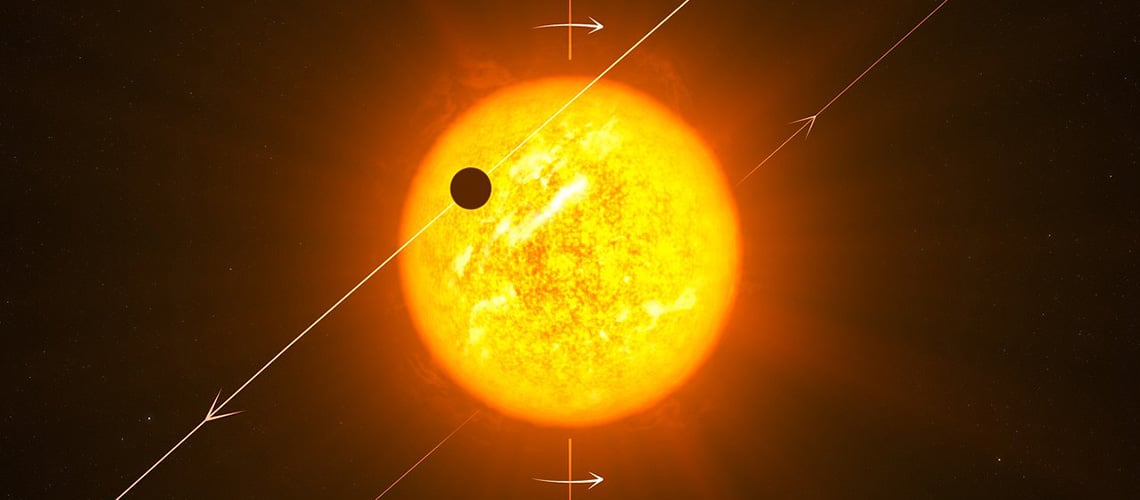
Astronomers have discovered the first exoplanet confirmed to orbit backward around its parent star, overturning a fundamental assumption about planetary systems. The sub-Neptune, orbiting a red dwarf star, travels in retrograde motion opposite to the star's rotation, a finding that reshapes how scientists understand planetary formation and migration across the galaxy.
The discovery comes from research led by Yann Carteret, a PhD student at the University of Geneva, and published in Astronomy & Astrophysics. This marks the first confirmed case of such extreme orbital misalignment in an exoplanet system. In our solar system, all eight planets orbit the Sun in orderly alignment, with orbital inclinations under seven degrees and rotation directions matching the Sun's motion. This orderliness led astronomers to assume most planetary systems followed similar patterns. This discovery demolishes that assumption.
The red dwarf host star and its backward-orbiting sub-Neptune represent a system shaped by violent dynamical processes. Retrograde orbits typically result from gravitational interactions between multiple planets, stellar encounters, or past collisions that knocked planets into reversed orbits during the early chaos of system formation. The sub-Neptune's unexpected trajectory reveals that planetary systems can undergo dramatic reshuffling after initial formation.
Sub-Neptunes occupy a crucial gap in planetary science. These worlds fall between Earth-sized rocky planets and gas giants, yet our solar system contains no direct analog. Understanding their orbital mechanics becomes essential for mapping the diversity of planetary architectures across the Milky Way. The retrograde motion suggests formation scenarios far more complex than simple disk accretion models predict.
Red dwarf stars host the majority of exoplanet discoveries. These cool, low-mass stars offer advantages for detection methods, particularly the transit technique where planets cross in front of their star from Earth's perspective. Finding extreme orbital configurations around red dwarfs indicates that the chaos and complexity of planetary system formation occurs universally, regardless of star type or mass.
The detection itself required precision spectroscopy and careful analysis of star-planet interactions. Retrograde orbits leave distinctive signatures in stellar light, measurable through Doppler shifts as the star wobbles due to planetary gravity. The backward-orbiting sub-Neptune's gravity pulls its host star in directions opposite to the star's natural spin, creating detectable patterns that set it apart from normally aligned systems.
This discovery carries profound implications for exoplanet demographics and system stability. If significant populations of exoplanets occupy retrograde orbits, it suggests planetary migration and orbital chaos remain far more common than previous models indicated. Such systems may eventually become unstable, with planets ejected into space or sent spiraling into their stars. Understanding the timescales of such processes becomes crucial for estimating how many exoplanet systems remain habitable over billions of years.
The finding also accelerates the need for comprehensive orbital surveys of known exoplanet systems. Carteret's team demonstrated that retrograde configurations exist in nature, meaning systematic searches targeting orbital misalignment signatures could uncover additional examples. Each discovery provides data points for refining formation models and understanding the physics that governs how planetary systems assemble and evolve.