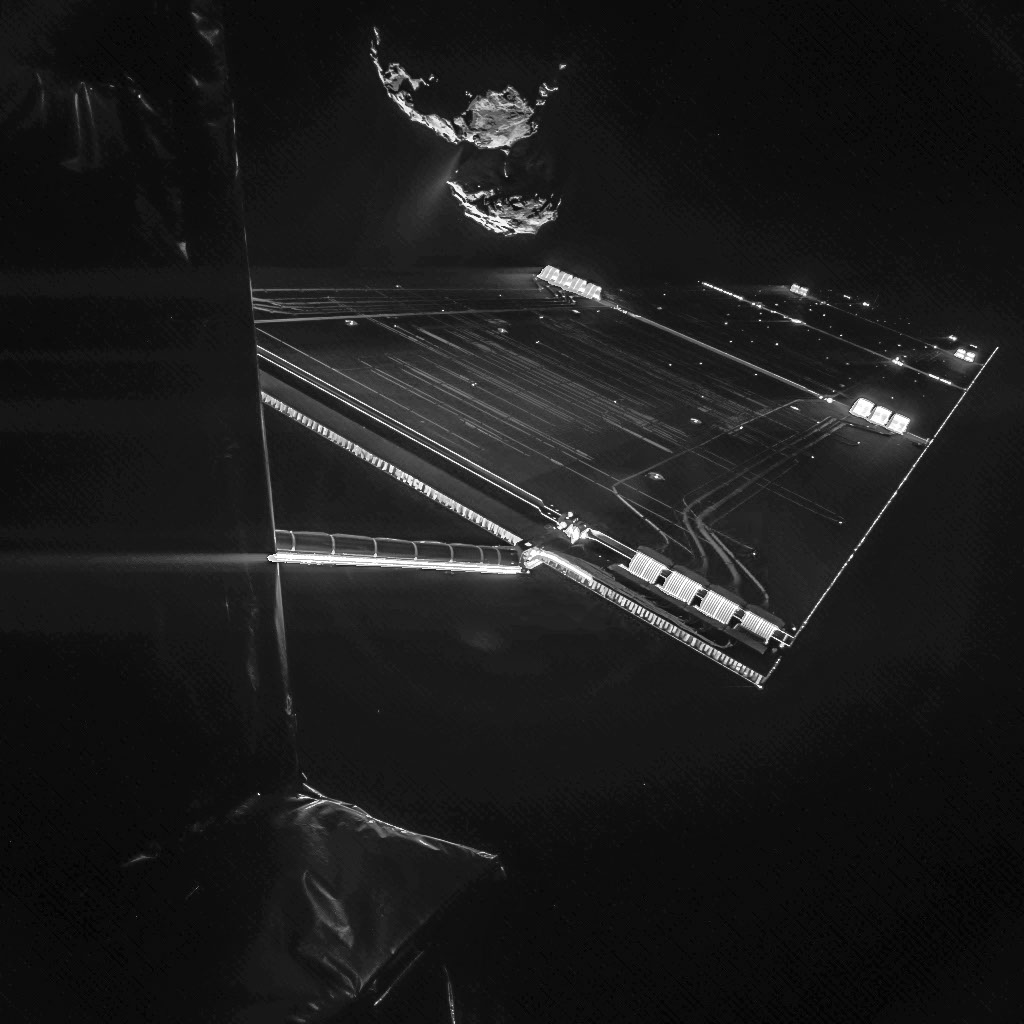
The European Space Agency's Rosetta spacecraft captured a self-portrait that has become iconic in planetary exploration, showcasing the probe against the backdrop of Comet 67P/Churyumov-Gerasimenko during its historic mission between 2014 and 2016.
Rosetta's selfie represents far more than a simple snapshot. The image documents one of humanity's most audacious feats of space exploration. The ESA's Rosetta orbiter traveled for ten years before reaching the comet, eventually deploying the Philae lander to touch down on 67P's surface. That selfie provided direct visual confirmation of Rosetta's proximity to the comet nucleus, evidence of the spacecraft's operational status, and a compelling demonstration of the technological prowess required to rendezvous with a tiny, fast-moving object hurtling through the solar system.
The photograph itself was obtained using Rosetta's Optical, Infrared and Thermal Imaging Instrument (OSIRIS). The camera captured the spacecraft's ten-meter solar panels and body set against the irregular, boulder-strewn terrain of 67P. The comet's nucleus appears dark and cratered, shaped by billions of years of cosmic collisions and solar weathering. This perspective, taken from roughly 10 kilometers above the comet's surface, illustrates the stunning achievement of orbital mechanics and autonomous spacecraft navigation.
Rosetta's mission fundamentally transformed our understanding of comets. Before the spacecraft arrived, scientists relied on remote observations and debris analysis. Rosetta changed that by delivering instruments to examine the comet's composition directly. The mission revealed that 67P contains organic compounds, water ice with an isotopic signature different from Earth's oceans, and complex dust structures. These findings carry profound implications for theories about how water and organic chemistry arrived on Earth.
The Philae lander, deployed from Rosetta, became the first spacecraft to touch a comet nucleus, though it experienced an unexpectedly soft surface and bounced twice before lodging in a shadowed crater. Even with limited solar power, Philae transmitted crucial data about subsurface composition and gas emissions. Rosetta continued orbiting 67P, mapping its nucleus, tracking outgassing phenomena, and monitoring seasonal changes as the comet approached perihelion.
The mission concluded in September 2016 when ESA intentionally crashed Rosetta into the comet, a controlled descent that allowed final measurements of the nucleus before the spacecraft's demise. That deliberate ending preserved the integrity of 67P as a scientific object and marked a respectful conclusion to one of humanity's greatest robotic voyages.
Rosetta's selfie endures because it captures a threshold moment in exploration history. The image marks humanity's transition from studying comets from afar to understanding them through direct contact. Every orbit of 67P, every measurement transmitted across 300 million miles of space, depended on technologies and navigation techniques developed specifically for this mission. The photograph serves as a testament to international scientific collaboration and the relentless human drive to answer fundamental questions about our solar system's composition and history.