Scientists have identified seven distinct phases that describe how meteorites transform as they plunge through Earth's atmosphere, according to research published in Meteoritics & Planetary Science. The study examined video recordings and photographs of 75 meteorite falls.
The analysis reveals that melting and fragmentation, not evaporation, control how much material rocks lose and how quickly they slow down. "We used to think that solid rocks would evaporate from the enormous heat and brilliant light generated in the air collision," said Dr. Peter Jenniskens of the SETI Institute and NASA Ames Research Center. "We found instead that first melting and then fragmentation controls how a rock loses mass."
The journey begins in Phase 1 when the atmosphere becomes dense enough for incoming rocks to generate a shock wave, producing the streak of light known as a meteor. Phase 2 intensifies brightness as the meteor enters denser air. Some meteors show repeating brightness changes that reveal rotation rates, with documented examples rotating once every 0.5 to 5 seconds.
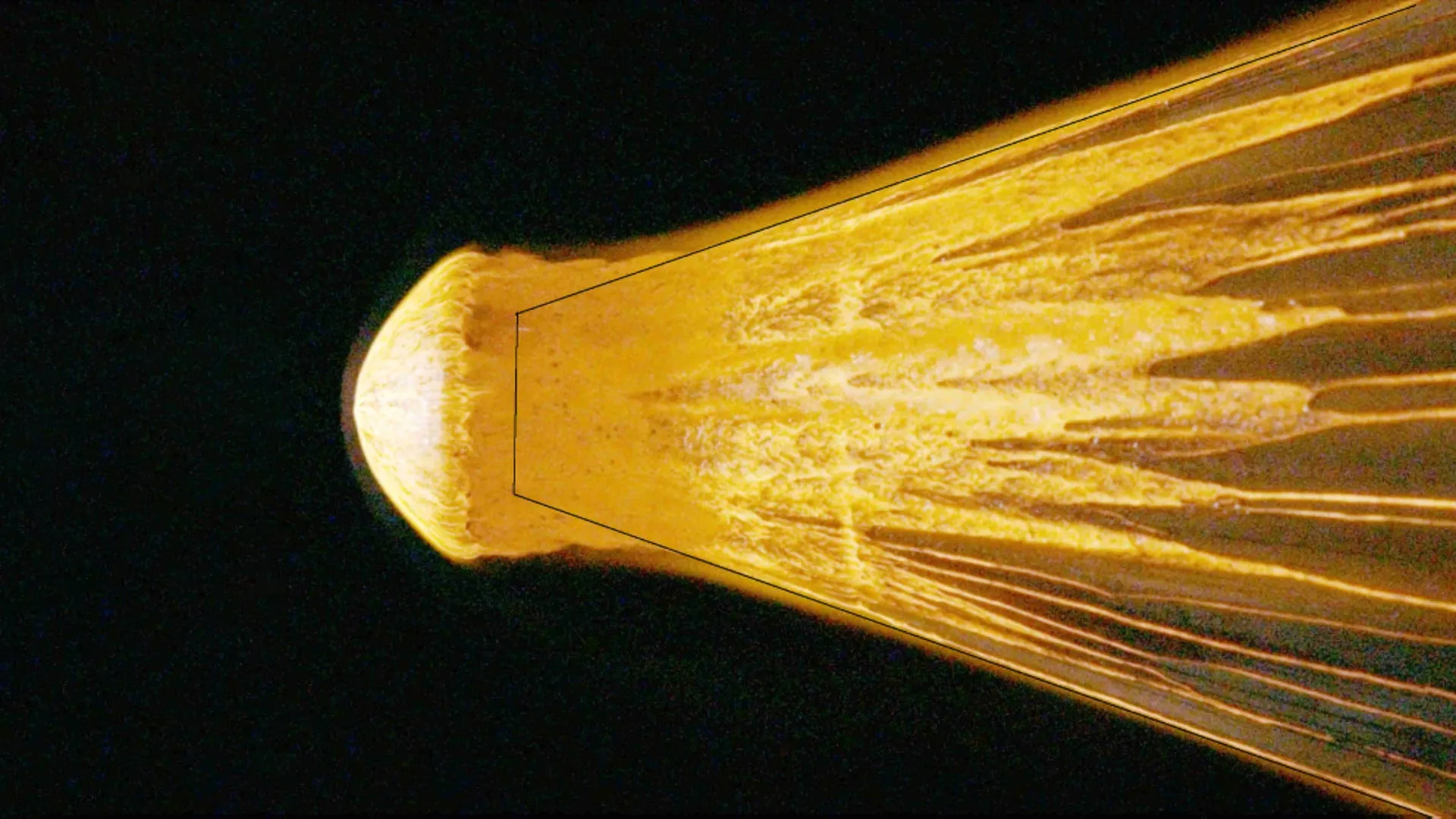
By Phase 3, the meteor becomes a fireball, and melting becomes the dominant process removing material. Molten droplets strip from the surface and evaporate. Phase 4 begins around 60 kilometers altitude, where melting reaches stable balance. Melting alone can remove as much as 40 percent of the original rock's mass.
Phase 5 brings fragmentation as increasing air pressure fractures the rock at surprisingly low pressures, about one-fifth the strength of recovered meteorites. The researchers found that heating and cracks from previous space collisions may weaken rocks enough to explain this early breakup.
The shape of the surviving rock influences where fragments land. "Our modeling shows that as long as the back of the space rock remains intact, that rock pulls a vacuum in its wake into which fragments tend to flow," says co-author Darrel Robertson of NASA Ames. "Those small meteorites fall in a narrow strip on the ground."
Phase 6 occurs when the rear portion breaks apart, producing a bright flare and scattering fragments at greater speeds. Phase 7 completes the descent as remaining pieces slow below the speed needed for visible light production. A fusion crust forms on their surfaces before they land as meteorites.
The research offers clues about larger asteroids. "Asteroids up to tens of meters in size are also solid rocks because they tend to spin faster than do the larger rubble pile asteroids," Jenniskens said. "The 20-m diameter asteroid that caused the airburst over Chelyabinsk, Russia, in 2013 went through the same phases."