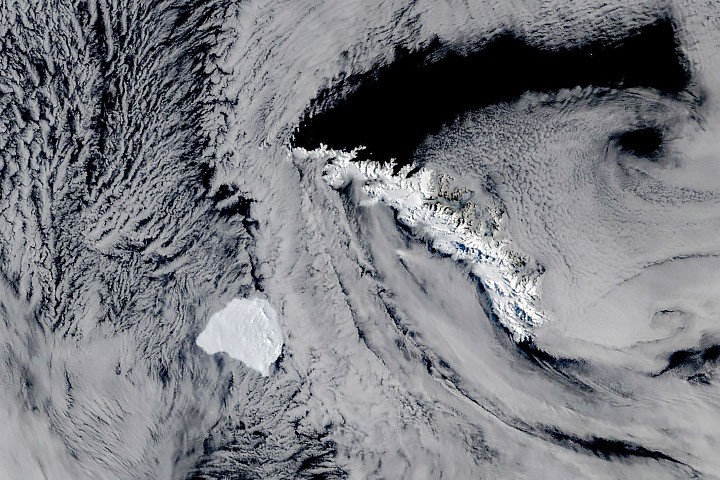
NASA satellites tracked the colossal Antarctic iceberg A-81 as it completed a rapid transit across the Weddell Sea, only to encounter an abrupt slowdown upon reaching the continental shelf surrounding South Georgia Island. The iceberg's deceleration marks a critical phase in its drift pattern, revealing how underwater topography constrains the movement of massive ice formations in the Southern Ocean.
A-81 separated from the Antarctic ice shelf and entered the Weddell Sea as one of several giant icebergs calved from Antarctica in recent years. The berg traversed the open water with surprising speed, driven by ocean currents that push massive ice blocks northward and eastward from their Antarctic origin. NASA's satellite monitoring systems, which include instruments aboard the Landsat, Sentinel, and other Earth observation platforms, tracked A-81's position and velocity throughout its journey.
The iceberg's encounter with South Georgia's underwater topography altered its trajectory significantly. Continental shelves function as underwater barriers that redirect and slow drifting ice. A-81 grounded on the shelf surrounding South Georgia, a British Overseas Territory located roughly 1,300 kilometers northeast of the Antarctic Peninsula. The shelf's shallow waters and complex bathymetry created drag forces that decelerated the iceberg's northward progression.
This phenomenon holds relevance for oceanographers studying how giant icebergs influence Southern Ocean circulation and regional ecosystems. As A-81 stalls near South Georgia, freshwater from its melting contributes to local water column stratification. The berg's presence affects nutrient cycling and can create unique ecological niches for marine organisms. Historical precedent exists. The famous iceberg B-15, which calved from the Ross Ice Shelf in 2000, grounded on the Ross Sea shelf and persisted for years, becoming a research focal point for scientists examining glacial discharge impacts on Antarctic marine biology.
NASA's cryosphere monitoring capabilities provide real-time tracking of these events through synthetic aperture radar and optical imagery. SAR instruments penetrate cloud cover that frequently obscures Antarctic and Southern Ocean waters, enabling continuous surveillance regardless of weather conditions. This data feeds into models that predict iceberg drift patterns and assess their potential hazards to maritime shipping and Antarctic research stations.
A-81's slowdown near South Georgia demonstrates how remote ice-ocean interactions regulate the planet's freshwater budget and heat distribution. Giant icebergs represent massive repositories of cold, fresh water. Their drift pathways and eventual melting zones determine where this freshwater enters the ocean, influencing thermohaline circulation patterns that drive global ocean currents.
The grounding of A-81 also illustrates the dynamic nature of Antarctic ice discharge. Unlike smaller icebergs that melt within months, giant bergs can persist for years, traveling thousands of kilometers. Their movements reflect both climate-driven changes in Antarctic mass loss and the physical oceanography of the Southern Ocean itself. Continued satellite monitoring will reveal whether A-81 remains grounded, continues drifting, or fragments as wave action and tidal forces act upon it in coming months.