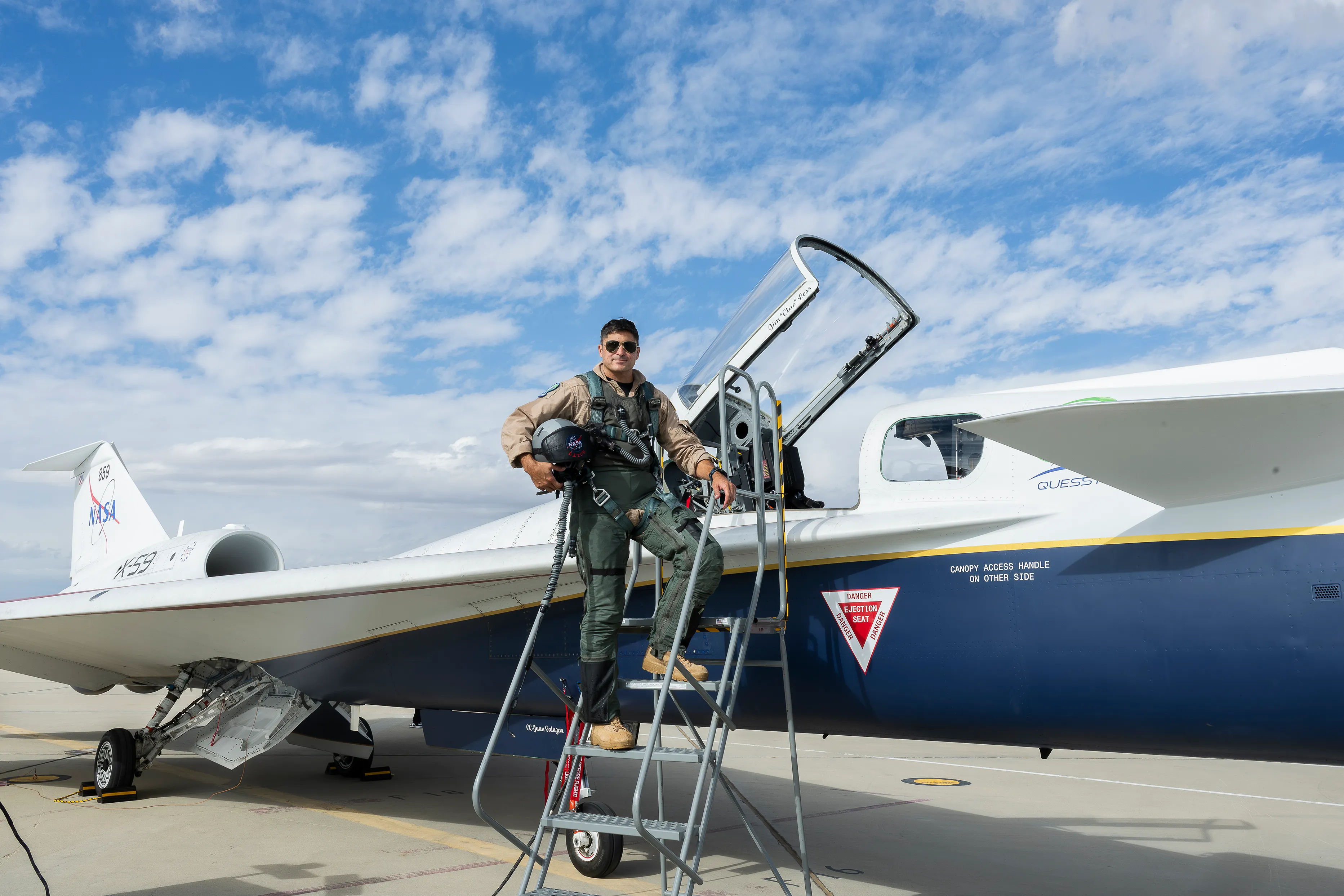
# NASA Test Pilot Mike Lippert Begins Flying X-59 Quiet Supersonic Research Aircraft
NASA test pilot Mike Lippert has begun flying the X-59, the agency's experimental quiet supersonic aircraft designed to demonstrate that commercial aircraft can travel faster than sound without generating the disruptive sonic booms that have limited supersonic flight over populated land for decades.
Lippert conducted his first flight in the X-59 on October 21, 2026, following the aircraft's successful test program that began with its inaugural flight in November 2025. The aircraft achieved supersonic speeds on June 5, 2026, marking a critical milestone in the development of technologies that could revolutionize long-distance air travel.
The X-59 represents a collaboration between NASA and Lockheed Martin, developed under NASA's Aeronautics Research Mission Directorate. The aircraft incorporates novel aerodynamic shaping and advanced acoustic engineering to produce a sonic "thump" instead of a traditional boom. Traditional supersonic aircraft generate two pressure shock waves, one at the nose and one at the tail, that coalesce into a loud sonic boom audible across wide areas below the flight path.
The X-59 uses a long, slender fuselage with an inverted V-shaped tail and specially designed intake ducts to manage shock waves. Rather than allowing them to merge, the aircraft's shape separates pressure disturbances into multiple smaller events spread across time. When perceived on the ground, these pressure fluctuations sound significantly quieter, potentially reducing perceived noise to levels around 75 perceived noise decibels or lower. A traditional sonic boom registers around 130 decibels.
Lippert's entry into the X-59 test program reflects NASA's progression toward its ultimate goal: demonstrating quiet supersonic flight over populated areas. The agency plans to conduct flights over cities including Miami, Houston, Los Angeles, and New York to gather community response data on the reduced noise levels. This community feedback will provide the Federal Aviation Administration with essential information to develop regulations permitting supersonic flight over land.
The current Federal prohibition on supersonic flight over the United States exists precisely because of sonic boom noise complaints dating back to the 1960s. Overturning this restriction requires concrete evidence that new aircraft can operate supersonically at acceptable noise levels. The X-59 data represents the first opportunity to gather that evidence.
Armstrong Flight Research Center, located at Edwards Air Force Base in California, serves as the X-59's home base. The facility has conducted NASA's most significant aircraft research since the Bell X-1 broke the sound barrier in 1947. Armstrong's expertise in high-speed flight, instrumentation, and telemetry systems made it the natural choice for X-59 operations.
The aircraft's successful progression through its test flight program validates the quiet supersonic technologies developed over more than two decades of research. Lockheed Martin's aerodynamic innovations have proven effective in actual flight conditions, not merely in wind tunnels or computer simulations. Lippert's piloting experience with experimental aircraft positions him to evaluate the X-59's handling characteristics and provide feedback for continued development.
The implications extend beyond commercial aviation. Military applications, scientific missions, and emergency response operations all stand to benefit from supersonic flight capabilities unrestricted by noise concerns. Success with the X-59 opens pathways for future aircraft designs incorporating quiet supersonic technology.