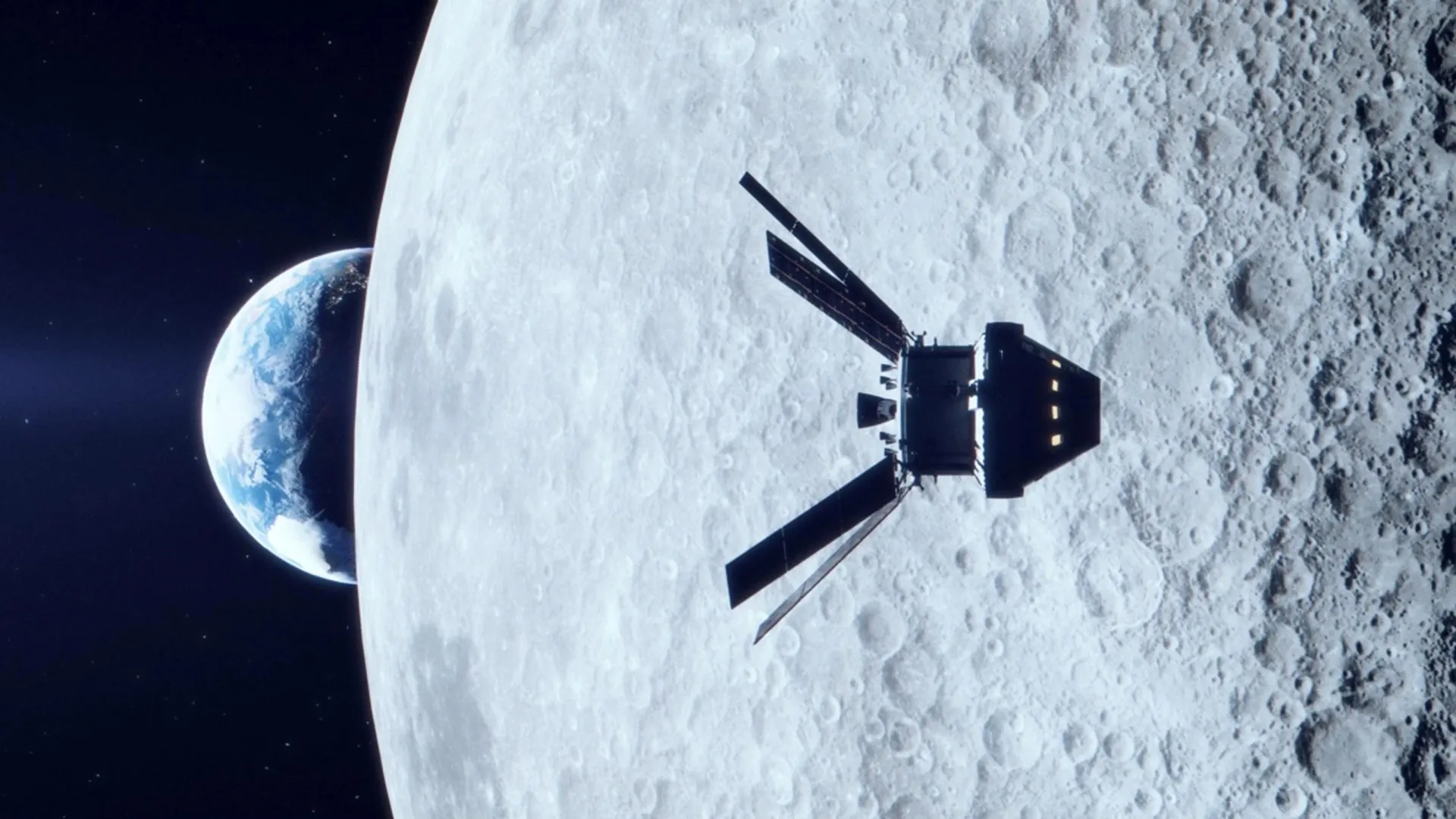
NASA's Artemis I mission collected radiation measurements near the Moon using experimental detectors made from lithium fluoride crystals aboard the Orion spacecraft. Scientists from the Institute of Nuclear Physics of the Polish Academy of Sciences (IFJ PAN) in Cracow embedded several dozen of these detectors, along with nearly 600 thermoluminescent crystal detectors, inside two human-shaped mannequins during the uncrewed mission in late November and early December 2022.
The lithium fluoride detectors work by recording microscopic damage caused by radiation particles. When charged particles strike the crystals, they create defects called color centers. When illuminated with blue light, these altered regions glow red, allowing researchers to identify the paths of individual particles under a microscope. This approach eliminates the chemical etching step required by traditional plastic detectors.
The research team developed new calibration and analysis methods to interpret the tracks, accounting for the unpredictable nature of cosmic radiation arriving from multiple directions and at varying energies. Prof. Pawel Bilski of IFJ PAN stated that "after applying a series of corrections and developing software to appropriately remove the background interfering with the measurements, our results differed by no more than 15% from those obtained using conventional track detectors across the entire overlapping range of energy deposition values."
The measurements revealed a counterintuitive finding. Although radiation doses near the Moon exceed those in low Earth orbit, the difference is smaller than expected. Low-energy protons trapped in Earth's Van Allen radiation belts account for much of the radiation exposure in orbit, but these belts do not extend to the Moon. Near the Moon, galactic particles with high energy contribute substantially to radiation exposure, and their energy distributes almost uniformly through the body rather than concentrating at shallow depths as Van Allen belt protons do.
The detectors measure only a few millimeters in size, making them practical for astronauts to wear during future missions. The findings appear in the journal Radiation Measurements.