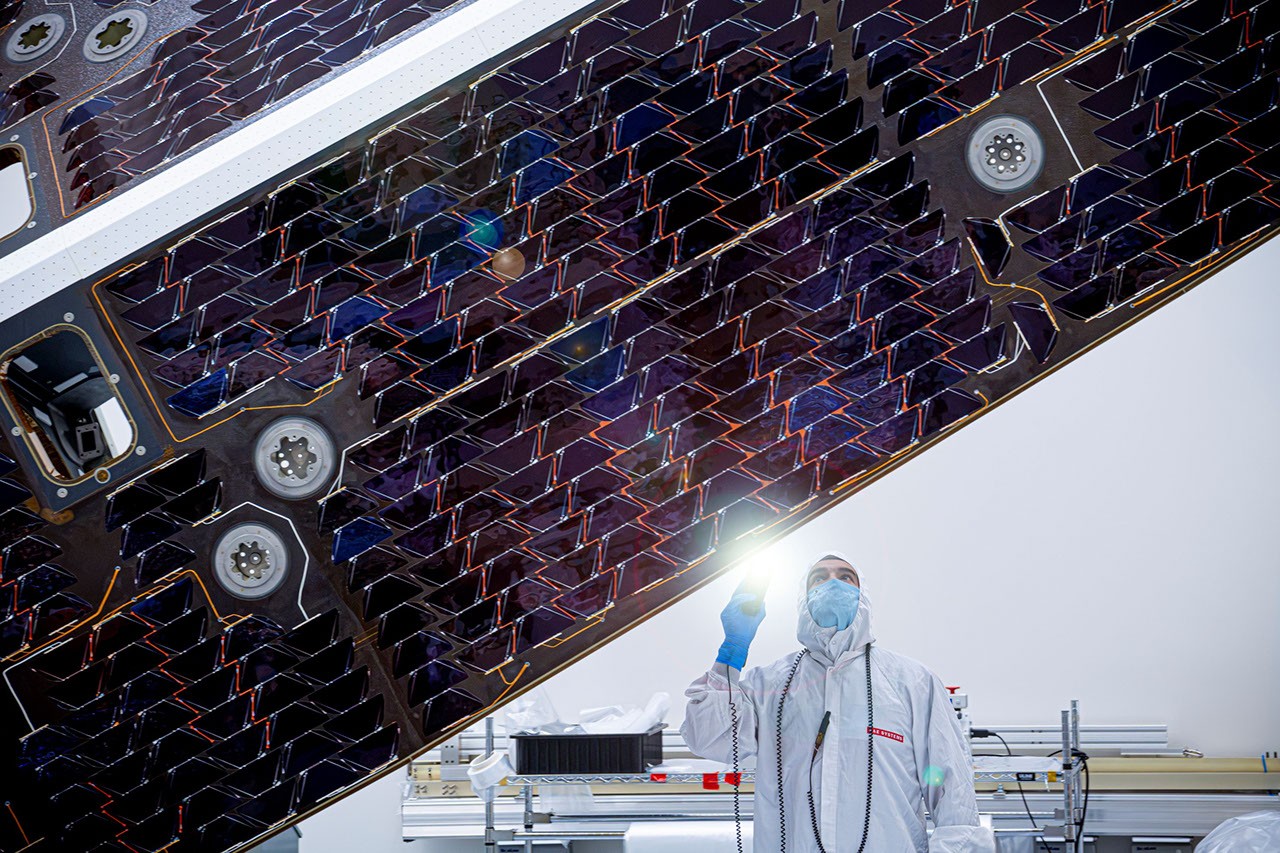
NASA's Near-Earth Object Surveyor spacecraft entered a critical manufacturing phase this summer as technicians at BAE Systems Space & Mission Systems in Boulder, Colorado inspected the mission's large sunshade and its newly installed solar cells. The inspection represents a major milestone in the assembly of hardware designed to detect and characterize asteroids that could pose threats to Earth.
The sunshade structure itself was manufactured by Applied Aerospace in Stockton, California, before traveling to SolAero Technologies in Albuquerque, New Mexico in January, where engineers outfitted the apparatus with solar cells. Those cells now power the spacecraft's instruments and systems. The July inspection at BAE Systems verified that the solar arrays met specifications and could withstand the thermal and mechanical stresses of launch and operation in space.
NEO Surveyor represents NASA's next major step in planetary defense. The mission will observe near-Earth asteroids in infrared wavelengths, allowing scientists to measure their size, composition, and trajectory with far greater precision than ground-based telescopes can achieve. This data feeds directly into NASA's Planetary Defense Coordination Office, which uses asteroid catalogs to identify potential impact hazards decades or centuries in advance.
The spacecraft's sunshade performs a specific function critical to infrared astronomy. By blocking direct sunlight, the sunshade allows the mission's infrared instruments to detect faint thermal signatures from distant asteroids. Without adequate thermal control, the spacecraft's own heat would overwhelm the detectors. The sunshade's large surface area and the solar cells that power the spacecraft represent engineering challenges that demand precision manufacturing and rigorous quality assurance.
NEO Surveyor builds on the success of earlier asteroid survey missions. NASA's NEOWISE mission, which operated from 2009 to 2024, discovered thousands of previously unknown asteroids and refined estimates of their sizes. NEO Surveyor will accelerate this work, identifying smaller asteroids and objects closer to Earth's orbit with infrared sensitivity that ground-based radar and optical surveys cannot match.
The mission aligns with NASA's broader commitment to planetary defense strategies endorsed by Congress and international partners. In 2022, NASA successfully tested the Double Asteroid Redirection Test, or DART, proving that a spacecraft could alter an asteroid's trajectory through kinetic impact. NEO Surveyor provides the reconnaissance capability that future deflection missions would depend on. By cataloging near-Earth objects, NASA and its partners can prioritize which asteroids warrant closer study or potential mitigation efforts.
The inspection of solar cells and sunshade assembly marks progress toward NEO Surveyor's launch window, scheduled for the mid-2020s. Subsequent integration steps will attach the infrared instruments, guidance and control systems, and communication hardware. Once fully assembled and tested, the spacecraft will undergo final environmental validation before shipment to the launch facility.
This incremental assembly process, overseen by NASA's Planetary Science Division, distributes manufacturing tasks across specialized contractors. Each organization brings expertise in specific subsystems. This modular approach enables quality control at each stage and reduces risk of late-stage failures that could delay launch. The careful inspection work underway in Boulder represents how planetary defense infrastructure takes shape through meticulous engineering and rigorous testing protocols.