Giovanni Cassini's discovery of Iapetus on October 25, 1671 marked a watershed moment in planetary astronomy. Working from the Paris Observatory with a refracting telescope, Cassini identified Saturn's eighth-largest moon orbiting within the Saturnian system, expanding humanity's knowledge of the outer solar system decades before the telescope had revealed Jupiter's Galilean moons or Saturn's rings to the wider scientific community.
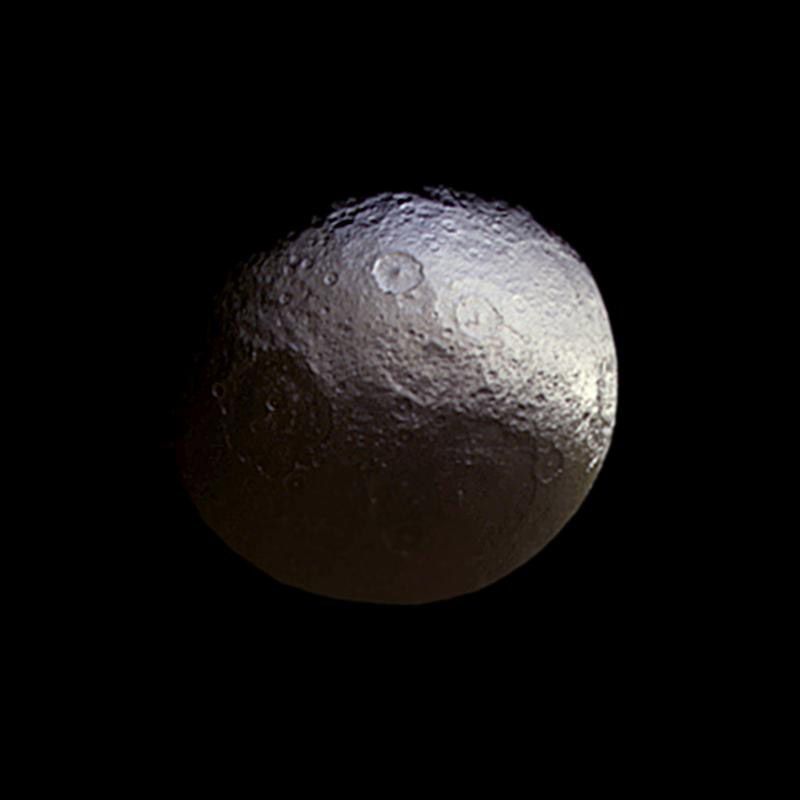
Iapetus stands apart among Saturn's moons for its bizarre coloration and orbital characteristics. The moon displays a stark two-toned appearance, with one hemisphere dramatically darker than the other, earning it the nickname "yin-yang moon." This distinctive contrast results from a massive equatorial ridge and uneven material distribution across its surface. The dark material coating Iapetus's leading hemisphere may originate from collisions with dust and debris, or from cryogenic processes involving darker compounds. Modern observations from the Cassini spacecraft have revealed Iapetus possesses a 20-kilometer-high equatorial ridge running nearly pole-to-pole, a feature unlike any other known moon in the solar system.
Cassini's discovery expanded the known Saturnian system from the four moons visible to Christiaan Huygens, who observed Titan in 1655, to a more complex architecture of orbiting bodies. Working methodically through telescopic observation, Cassini would eventually discover four additional Saturnian moons: Rhea, Dione, Tethys, and Enceladus. His systematic approach to planetary astronomy established protocols for cataloging celestial objects that persist in modern practice.
The discovery reflected broader shifts in 17th-century astronomy. The telescope had transformed observation from naked-eye limit to detailed surface examination. Cassini's work at Paris Observatory, one of Europe's premier research institutions, demonstrated that systematic investigation of planetary systems revealed layers of complexity previously hidden from human view. His observations contributed to the growing understanding that Earth represented one example among countless worlds, fundamentally reshaping philosophical assumptions about cosmic order.
Iapetus retained scientific curiosity through the centuries. When the Cassini-Huygens spacecraft reached Saturn in 2004, its instruments provided unprecedented detail about Iapetus's geology, mass, and composition. The spacecraft determined Iapetus possesses a diameter of 1,469 kilometers and maintains a highly inclined, eccentric orbit around Saturn. Its unusual orbital characteristics suggest a complex history, possibly involving capture or migration from elsewhere in the early solar system.
The moon's distinctive features make it a priority target for future exploration. The equatorial ridge, the hemispheric color contrast, and its orbital peculiarities present open questions about formation and evolution. Scientists have proposed future missions to Iapetus could advance understanding of planetary system formation and the processes that shaped Saturn's retinue of moons.
Cassini's October 25 observation represents more than a historical footnote. It exemplifies how patient observation with available tools expands cosmic knowledge. From a 17th-century telescope to the Cassini spacecraft's sophisticated instruments, humanity's investigation of Iapetus illustrates the continuity of scientific inquiry across centuries, each generation building on the discoveries of predecessors.