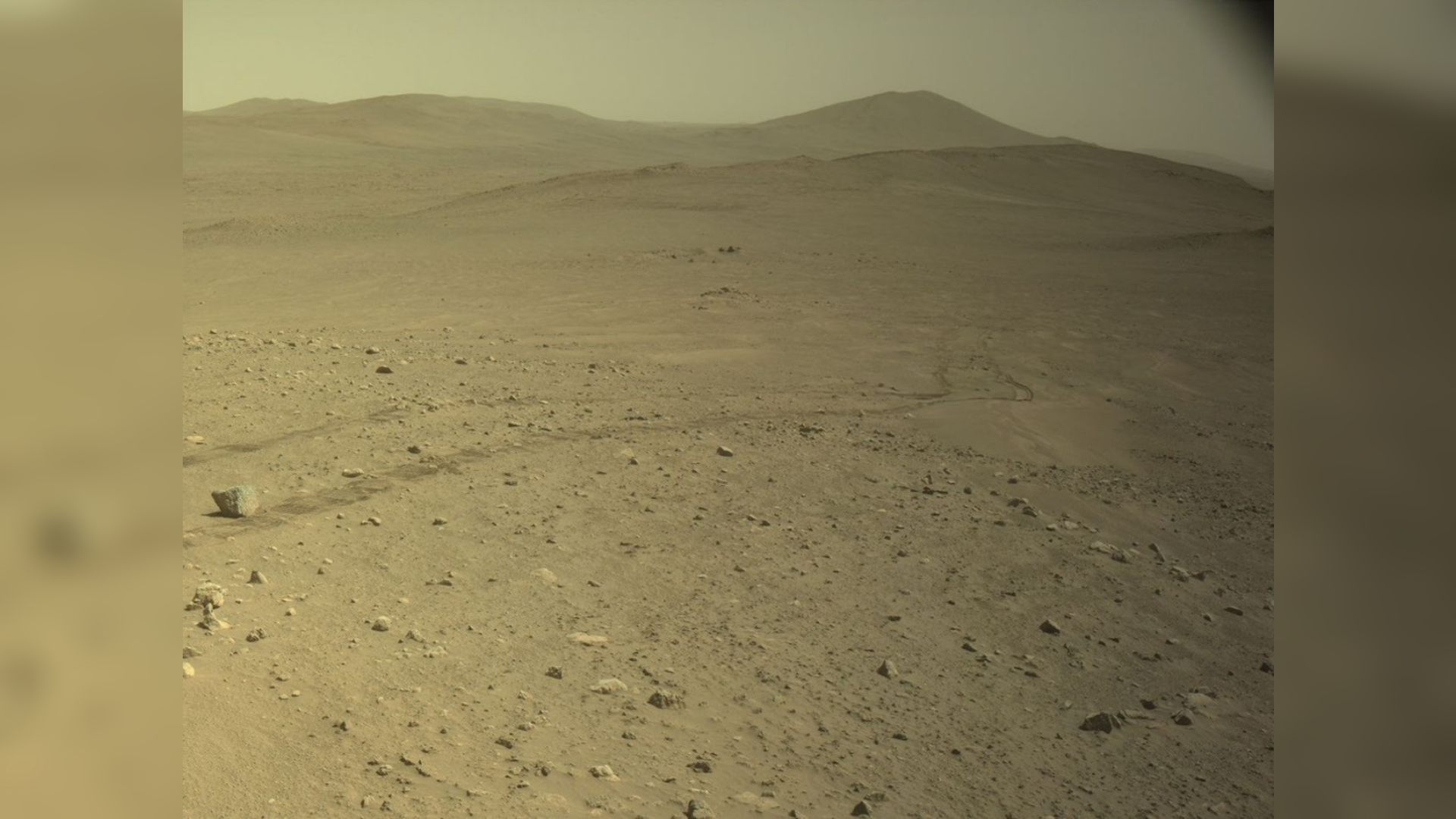
NASA's Perseverance rover has left a physical record of human exploration etched across the Martian landscape. Tire tracks visible in recent orbital imagery document the rover's journey across Jezero Crater, marking more than four years of scientific investigation on the Red Planet.
The tracks themselves serve as more than mere evidence of passage. They reveal the rover's weight distribution, suspension geometry, and how Martian soil responds to mechanical stress. Engineers at NASA's Jet Propulsion Laboratory use these impressions to refine mobility predictions and improve rover design for future missions. Each mark tells a story about terrain compatibility and operational constraints.
Perseverance arrived at Mars in February 2021 as the centerpiece of NASA's Mars 2020 mission. The rover carries ten scientific instruments, including the RIMFAX ground-penetrating radar, multiple spectrometers, and a drill capable of extracting rock samples for return to Earth. Its primary objective involves investigating whether Jezero Crater ever harbored microbial life by searching for biosignatures in ancient rock layers.
The rover's traversal across Jezero reveals the region's geological diversity. The crater floor contains olivine-rich rocks, hydrated minerals, and layered deposits that suggest interaction with water billions of years ago. Perseverance's wheels, which have endured significant wear from sharp volcanic rock, document every kilometer traveled while the rover collects data on radiation, dust composition, and subsurface geology.
These visible tracks connect to the broader Mars Sample Return campaign. Perseverance collects cylindrical rock samples and stores them in a special carousel. A future sample retrieval lander, currently in development by NASA and the European Space Agency, will touch down near Perseverance's location to retrieve these samples for transport to Earth. The tire tracks marking Perseverance's route effectively chronicle the path of humanity's most ambitious effort to study another planet's past habitability.
From orbital vantage points, instruments like the High Resolution Imaging Science Experiment (HiRISE) aboard NASA's Mars Reconnaissance Orbiter capture these tracks in stunning detail. HiRISE has photographed Perseverance throughout its mission, creating a photographic record of exploration that complements the rover's own data collection.
The rover has traversed approximately 30 kilometers since landing, climbing onto Jezero's central peak and investigating diverse geological formations. Each footprint and tire track represents problem-solving in real time. Perseverance's route planning accounts for terrain steepness, rock size, and predicted mechanical stress. When obstacles emerge, the rover's autonomous navigation systems recalculate paths without waiting for commands from Earth.
These tracks will persist on Mars long after Perseverance ceases operations. Lacking substantial wind and weather, the Martian surface preserves evidence of passage with minimal degradation. Future rovers and eventual human missions will traverse similar terrain, potentially using Perseverance's tracks as reference points for navigation and site selection.
The image of these tire marks represents a milestone in planetary exploration. They embody the persistence required to operate machinery on an alien world, the scientific methodology driving that operation, and humanity's expanding reach across the solar system.