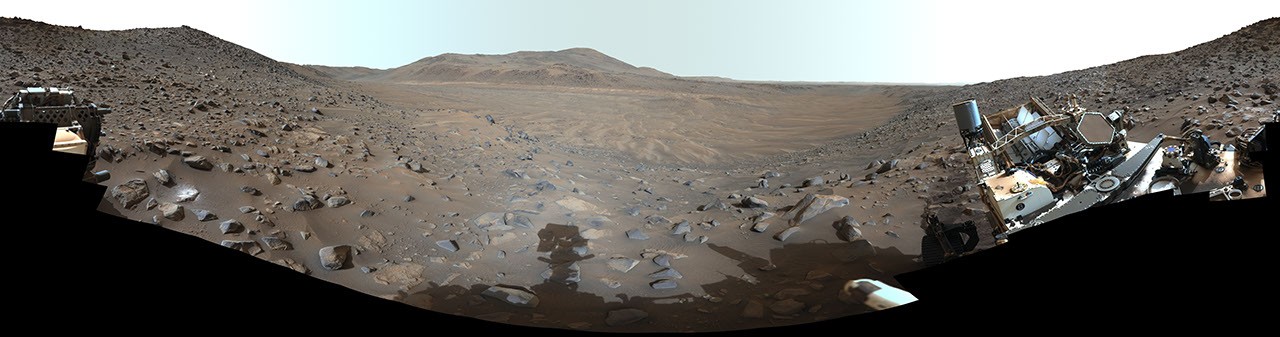
NASA's Perseverance rover has captured a sweeping 360-degree panorama of Neretva Vallis, a wind-carved valley within Jezero Crater on Mars. The rover's Mastcam-Z instrument stitched together 217 individual images on May 20, 2024, during sol 1,155 of the mission, revealing a dusty, barren landscape that tells a vastly different story from billions of years past.
Today, Neretva Vallis appears as a desolate Martian terrain, shaped by eons of wind erosion and dust storms. But the geological record embedded in this valley's rocks and sediments preserves evidence of ancient water flow. Billions of years ago, a river channel cut through this terrain, delivering fresh water into Jezero Crater. That ancient river system represents one of the most compelling clues that Mars once harbored conditions suitable for liquid water, and potentially, life.
Perseverance entered Jezero Crater in February 2021 with a dual mandate. The rover collects samples and deposits them in sealed tubes cached on the Martian surface for retrieval by future missions, part of the Mars Sample Return campaign. Simultaneously, Perseverance investigates whether Mars ever supported microbial life, a question that hinges on understanding the planet's hydrological history.
Neretva Vallis sits at the northwestern rim of Jezero Crater, where the ancient river delta intersects with the crater floor. This location offers Perseverance a window into Mars' wetter past. The delta deposits contain clay minerals and other hydrated materials that form in the presence of liquid water. By analyzing these rocks in detail, Perseverance's scientific instruments help reconstruct the climate and environmental conditions that prevailed when this river flowed.
The Mastcam-Z camera suite represents a technological leap forward in Martian imaging. The instrument combines high-resolution color imaging with zoom capabilities, allowing the rover team to inspect geological features at distances up to 100 meters with unprecedented clarity. The 217-image mosaic from May 20 demonstrates the power of this approach. Each frame captures fine textural details and color variations that reveal mineralogical composition and weathering patterns.
Perseverance's journey through Jezero Crater has become a geological odyssey. The rover traverses terrain that scientists selected for its scientific richness, moving between locations that preserve different chapters of Mars' early history. Each panorama, each rock analysis, each soil sample adds another piece to the puzzle of Mars' transformation from a potentially habitable world to the cold, dry planet we observe today.
The dust visible in this panorama presents both challenge and opportunity. Dust accumulation degrades solar panel efficiency and covers rocks that Perseverance needs to study. Yet the dust itself carries information. Its composition and distribution patterns reveal wind patterns, atmospheric processes, and interactions between the Martian surface and its thin atmosphere.
NASA's long-term strategy extends beyond Perseverance's current operations. The samples Perseverance collects will eventually return to Earth via the Mars Sample Return mission, enabling laboratory analysis far more sophisticated than any rover-mounted instrument can achieve. These samples will help answer fundamental questions about Mars' early habitability and whether organic compounds preserved in Martian rocks contain biosignatures of past life. Neretva Vallis, captured in dusty detail by Mastcam-Z, represents one location where those answers may emerge.