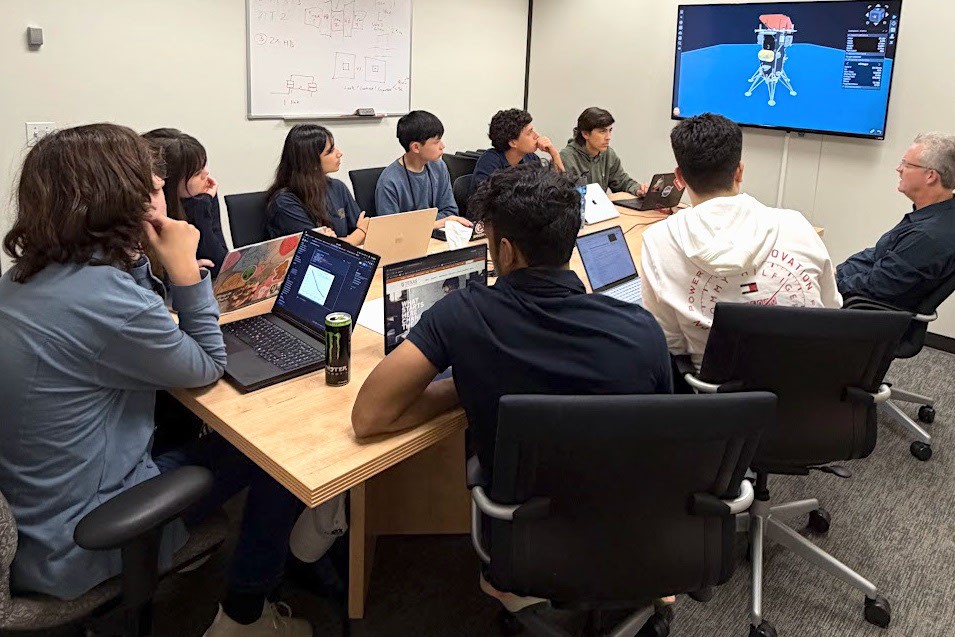
# NASA SEES Interns Tackle Real-World Challenges in Lunar Exploration
High school students enrolled in NASA's STEM Enhancement in Earth Science (SEES) Internship Program at the University of Texas Center for Space Research are working alongside NASA scientists and industry professionals to solve authentic problems in lunar exploration. The summer 2026 cohort includes the SEES Mission Architecture Tool for Research, Integration, and eXploration (MATRIX) team, which operates within a framework designed to prepare young researchers for careers in aerospace and planetary science.
The SEES program represents NASA's commitment to building the next generation of space exploration talent through hands-on experience rather than classroom theory alone. Interns work in small, focused research teams mentored by practicing NASA engineers, university scientists, and professionals from aerospace companies. This structure mirrors how actual space missions operate, giving students insight into the collaborative nature of exploration work.
MATRIX, the specific team in the summer 2026 cohort, focuses on mission architecture. This discipline examines how space missions fit together as systems. The work involves assessing technologies, resources, timelines, and costs necessary to accomplish lunar objectives. Students on such teams learn to think about problems at the scale that JPL (Jet Propulsion Laboratory) and other NASA centers approach them: not as isolated engineering challenges, but as interconnected components that must work together to succeed.
The location matters. The University of Texas Center for Space Research sits within one of the nation's leading institutions for planetary research. UT Austin hosts researchers working on active NASA programs and serves as a training ground for aerospace professionals. By placing SEES interns there, NASA creates direct pipelines between student researchers and established research infrastructure.
This internship model addresses a documented challenge in STEM education. Many high school students, particularly those from underrepresented backgrounds, lack exposure to real scientific work. Textbooks show the final results of research, not the messy process of asking questions, gathering data, and iterating through solutions. SEES interns experience that reality firsthand. They encounter genuine technical obstacles. They present findings to mentors with decades of experience. They revise their approaches based on expert feedback.
For lunar exploration specifically, the timing aligns with NASA's Artemis program. Artemis aims to return humans to the Moon and establish sustainable presence there. This requires advances in landing systems, habitation technology, resource utilization, and surface operations. Every technical challenge demands fresh thinking. Students working on mission architecture contribute ideas unconstrained by decades of prior assumptions. Their youth becomes an asset.
The internship also serves institutional goals. NASA faces a persistent shortage of engineers and scientists qualified to work on deep-space missions. The agency cannot simply hire experienced professionals for every position. Building a talent pipeline early, during high school, creates a larger pool of capable candidates by the time they reach college and career stages. SEES interns who perform well often return as summer employees during college years. Some eventually join NASA as full-time staff or move into aerospace industry roles.
The MATRIX team's work in summer 2026 will produce tangible outputs. These may include design studies, feasibility analyses, technology assessments, or operational concepts relevant to lunar missions. The team's findings could inform NASA planning or feed into broader mission architecture discussions. Even if the specific work does not directly influence a particular mission, it trains problem-solvers and demonstrates to students that their contributions matter.
By embedding high school researchers within professional teams tackling real lunar exploration challenges, NASA transforms internships from resume-building exercises into laboratories where the next generation of space engineers learns what the work actually demands.