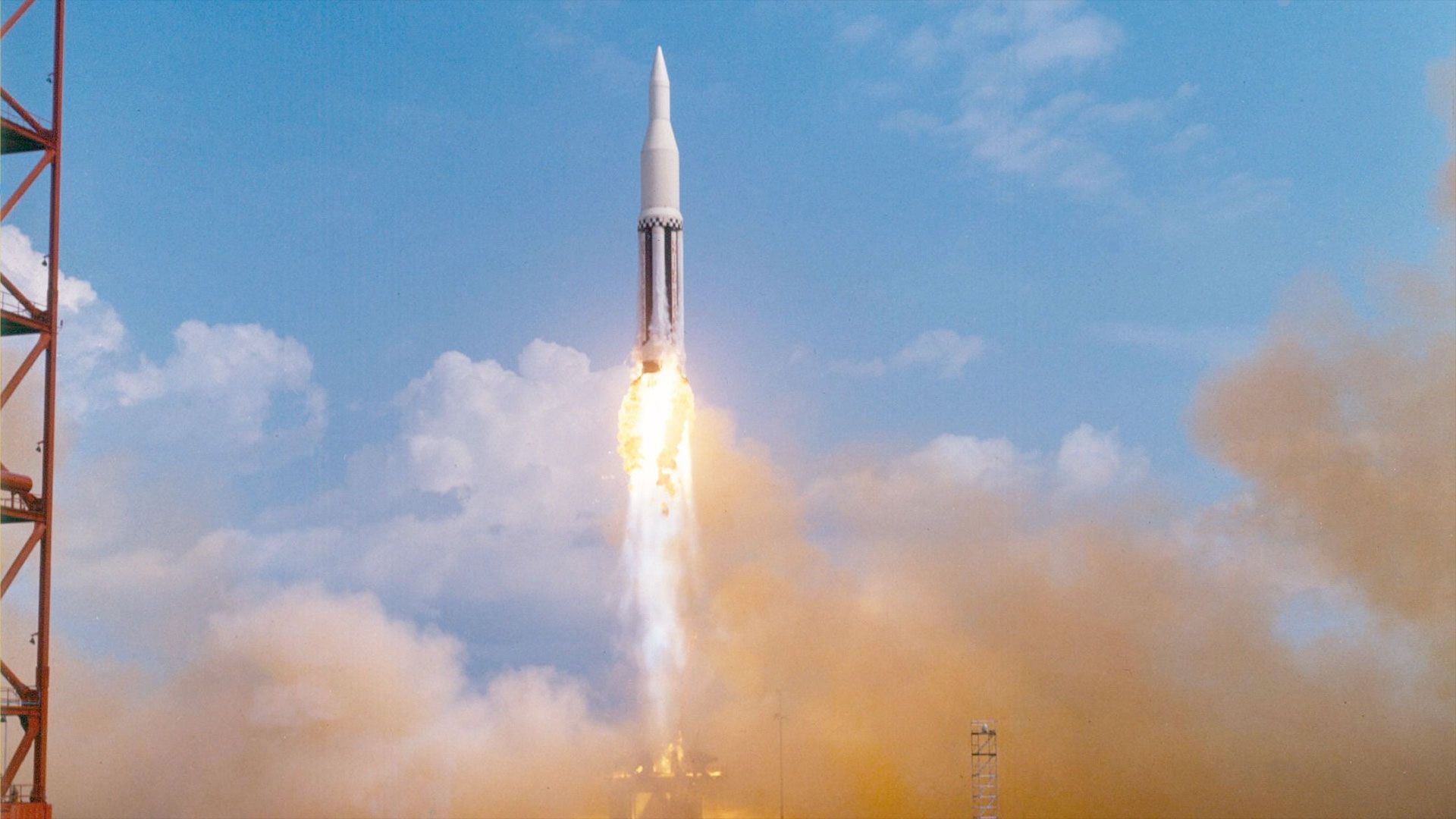
NASA's Saturn I rocket lifted off from Cape Canaveral on October 27, 1961, marking the first test flight of a vehicle that would become foundational to American spaceflight. The uncrewed launch from Florida established the developmental pathway for the Saturn rocket family, culminating in the Saturn V that carried Apollo astronauts to the moon less than a decade later.
The Saturn I represented a transitional design. Engineers at the Marshall Space Flight Center, led by Wernher von Braun, clustered eight H-1 engines around a single fuel tank to create the first stage. This clustering approach proved both innovative and efficient, allowing NASA to leverage existing engine technology while achieving the thrust necessary for heavy-lift operations. The first stage burned RP-1 kerosene and liquid oxygen, producing 1.5 million pounds of thrust.
That inaugural flight, designated SA-1 (Saturn-Apollo 1), achieved several critical objectives. The rocket successfully reached altitude, validating the structural design and engine clustering concept. Engineers gathered telemetry data on vibration, acceleration, and aerodynamic performance that informed subsequent Saturn designs. The test flight operated without a payload; the focus centered entirely on booster performance and stage separation dynamics.
The Saturn I program ran ten uncrewed test missions between 1961 and 1965. Each flight incrementally advanced rocket capability, testing upper stages, navigation systems, and eventually Apollo spacecraft components. By the time the program concluded, Saturn I had proven itself reliable enough to support early Apollo missions including the flights of the Apollo Lunar Module.
But the Saturn I's true legacy rested on its role as the stepping stone to Saturn V. The larger Saturn V, standing 363 feet tall, would produce 7.5 million pounds of thrust and lift 130 tons to low Earth orbit. The F-1 engines powering the Saturn V's first stage derived from technologies and testing protocols established during Saturn I operations. Every system, from gimbal controls to fuel management, benefited from lessons learned on earlier flights.
The October 1961 launch occurred during the height of the Space Race. Soviet cosmonaut Yuri Gagarin had completed his orbital flight just seven months earlier, and American officials faced mounting pressure to demonstrate rapid progress in spaceflight capability. The Saturn I test flight showed that NASA possessed both the engineering expertise and the industrial infrastructure to build rockets of unprecedented scale.
The vehicle's success also validated von Braun's vision for a family of rockets rather than a single monolithic design. This modular approach allowed NASA to build upward incrementally, reducing technical risk and spreading development costs across multiple platforms. The Saturn I served civilian space applications beyond Apollo, launching Skylab components and supporting early Earth orbit experiments.
The path from October 1961 to the moon landings of 1969 ran directly through Saturn I's test flights. Engineers refined staging procedures, verified thermal protection systems, and developed launch operations protocols that evolved into the sophisticated procedures supporting Saturn V. Without Saturn I's successful demonstration of clustered-engine technology and stage separation, the rapid acceleration toward lunar missions would have faced substantially greater technical obstacles.
The first Saturn I launch represented more than a single test flight. It demonstrated American commitment to systematic, progressive rocket development and established the technical foundation for the most powerful rocket ever flown successfully.