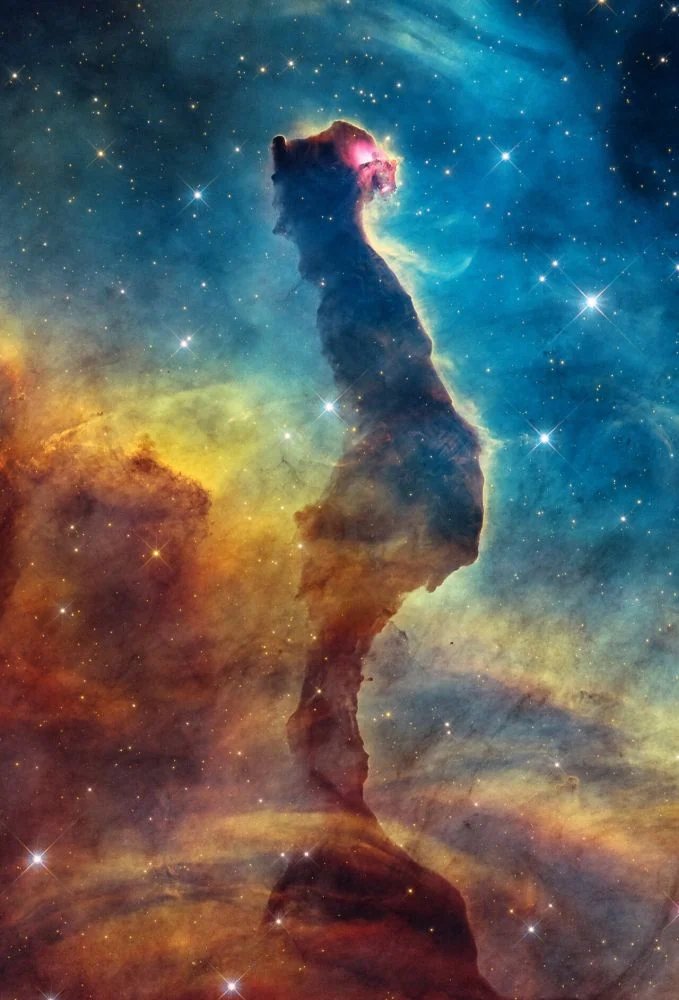
The Hubble Space Telescope and James Webb Space Telescope both imaged the Cat's Head Nebula, a star-forming region within the larger Carina Nebula located 7,500 light years away. The nebula gets its name from its appearance: a dense pillar of gas and dust shaped like a cat's head turned around, with a bright star resembling an eye.
Hubble captured the region in visible light, revealing ionized gas in different colors representing sulphur, oxygen, and hydrogen. JWST observed the same area in near and mid-infrared wavelengths, showing different aspects of the structure.
The Cat's Head sits within the Carina OB1 association, home to some of the most massive stars in the Milky Way. Eta Carinae, a stellar system at the heart of the region, contains two stars with combined luminosity over 5 million times greater than the Sun. Radiation and stellar winds from these massive stars carve and shape the nebula's gas and dust.
The pillar resists stellar radiation for now, but photoevaporation occurs along its edges where UV radiation ionizes gas. Stellar feedback from the massive stars drives arcs and filaments visible in both images and affects ongoing star formation.
JWST's infrared perspective reveals background stars and galaxies shining through less dense regions. Its mid-infrared image highlights carbon molecules and warm dust, showing what may be an infant star embedded in thick dust to the right of the head itself.
By comparing observations across different wavelengths, astronomers study how stellar radiation and wind influence star formation. Star formation ranks among JWST's main science themes. The two telescopes together show how gas, dust, metallicity, and stars of varying sizes and ages interact in ways that remain difficult to predict with current theories.