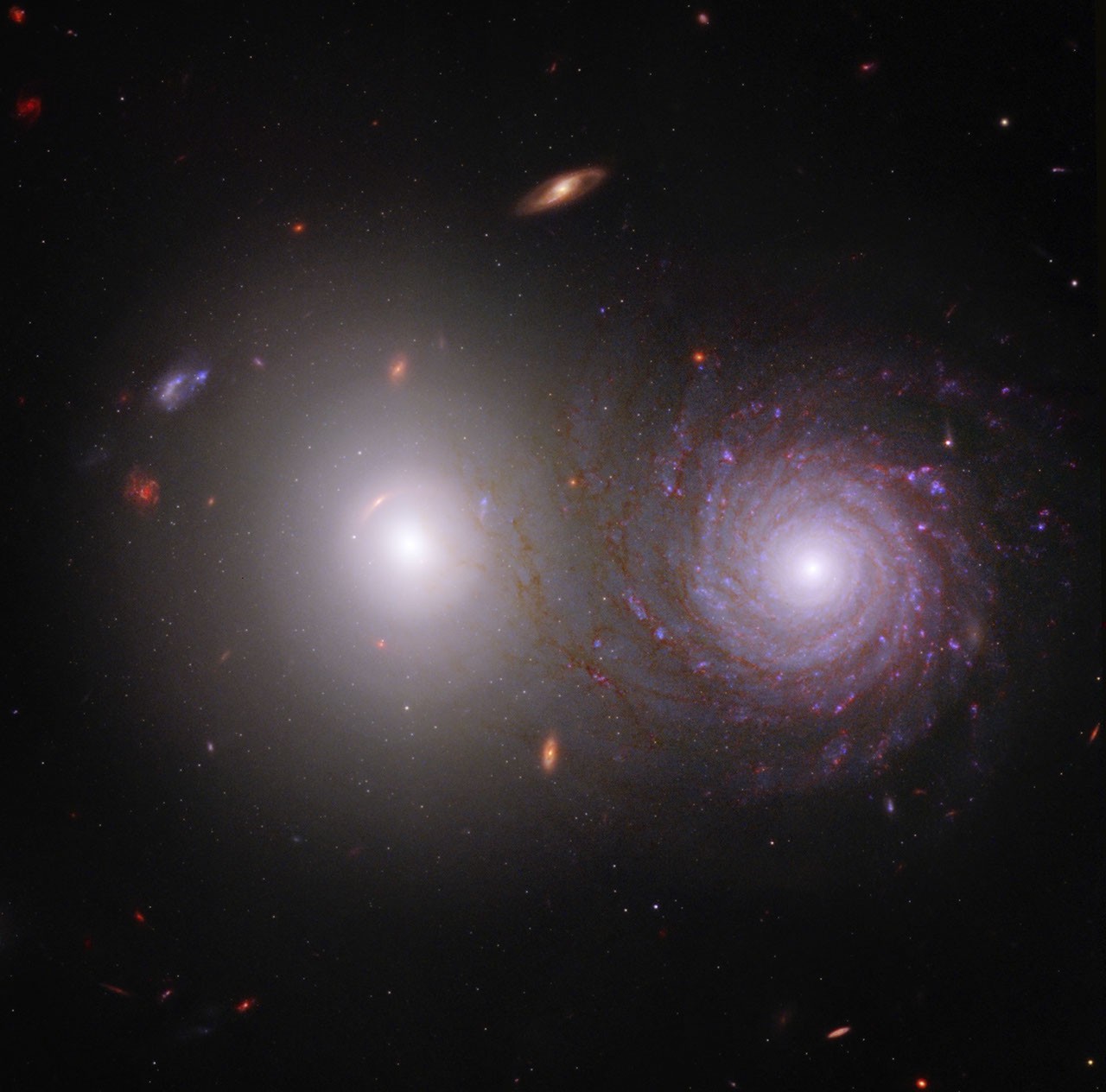
# Gravitational Lensing Through Galaxy Overlap Reveals Dust Hidden Across the Cosmos
Two galaxies aligning perfectly from Earth's vantage point create one of astronomy's rarest optical events. When this occurs, the closer galaxy acts as a natural lens, bending light from the distant one behind it. This gravitational phenomenon offers astronomers a powerful tool to study cosmic dust that would otherwise remain invisible across billions of light-years.
NASA scientists are leveraging these coincidental alignments to map dust distribution in distant galaxies with unprecedented precision. The overlapping configuration creates what researchers call a "cosmic zoom lens." Light traveling from the background galaxy bends around the foreground galaxy's mass, magnifying and distorting the distant object. This gravitational lensing effect reveals details about dust clouds that standard observations cannot detect.
Dust represents a critical but poorly understood component of galaxy evolution. These microscopic particles form from stellar remnants and chemical elements, scattering light and obscuring views into star-forming regions. Dust also plays a role in planet formation and shapes how galaxies evolve over cosmic time. Yet mapping dust on galactic scales across the universe remains difficult because dust absorbs and scatters visible light, rendering direct observation challenging.
The overlapping galaxy technique bypasses this limitation. As light from the background galaxy passes through dust in the foreground galaxy, the dust creates subtle absorption patterns in the magnified image. Astronomers can then reconstruct the dust's three-dimensional structure by analyzing how it dims and distorts the background light. This allows researchers to determine dust density, composition, and distribution with far greater accuracy than conventional methods permit.
NASA's Space Telescope Science Institute has coordinated efforts to identify and study these rare alignments. Instruments like the Hubble Space Telescope and the James Webb Space Telescope provide the resolution needed to detect subtle dust patterns in overlapped galaxies. JWST's infrared capabilities prove particularly valuable since dust emits strongly in the infrared spectrum, allowing scientists to pierce through obscuring material that visible-light telescopes cannot penetrate.
These observations address fundamental questions about galaxy formation and evolution. Dust influences how efficiently galaxies form stars, regulates feedback from supernovae, and determines the radiation environment within galaxies. Understanding dust distribution across cosmic time reveals how galaxies transform from the early universe to the present day.
The methodology also advances other astronomical pursuits. The same gravitational lensing principles help researchers measure galaxy masses, detect dark matter, and study the expansion history of the universe. Each overlapping pair provides a natural experiment that no laboratory on Earth could replicate.
As astronomers continue cataloging overlapping galaxies in deep-field surveys, this cosmic alignment technique will unlock data from increasingly distant objects. Future observations with the Roman Space Telescope will expand the sample of known overlapping systems, multiplying the opportunities to study dust across billions of galaxies. The universe, through gravity's patient hand, has organized its own observatories across the cosmos.