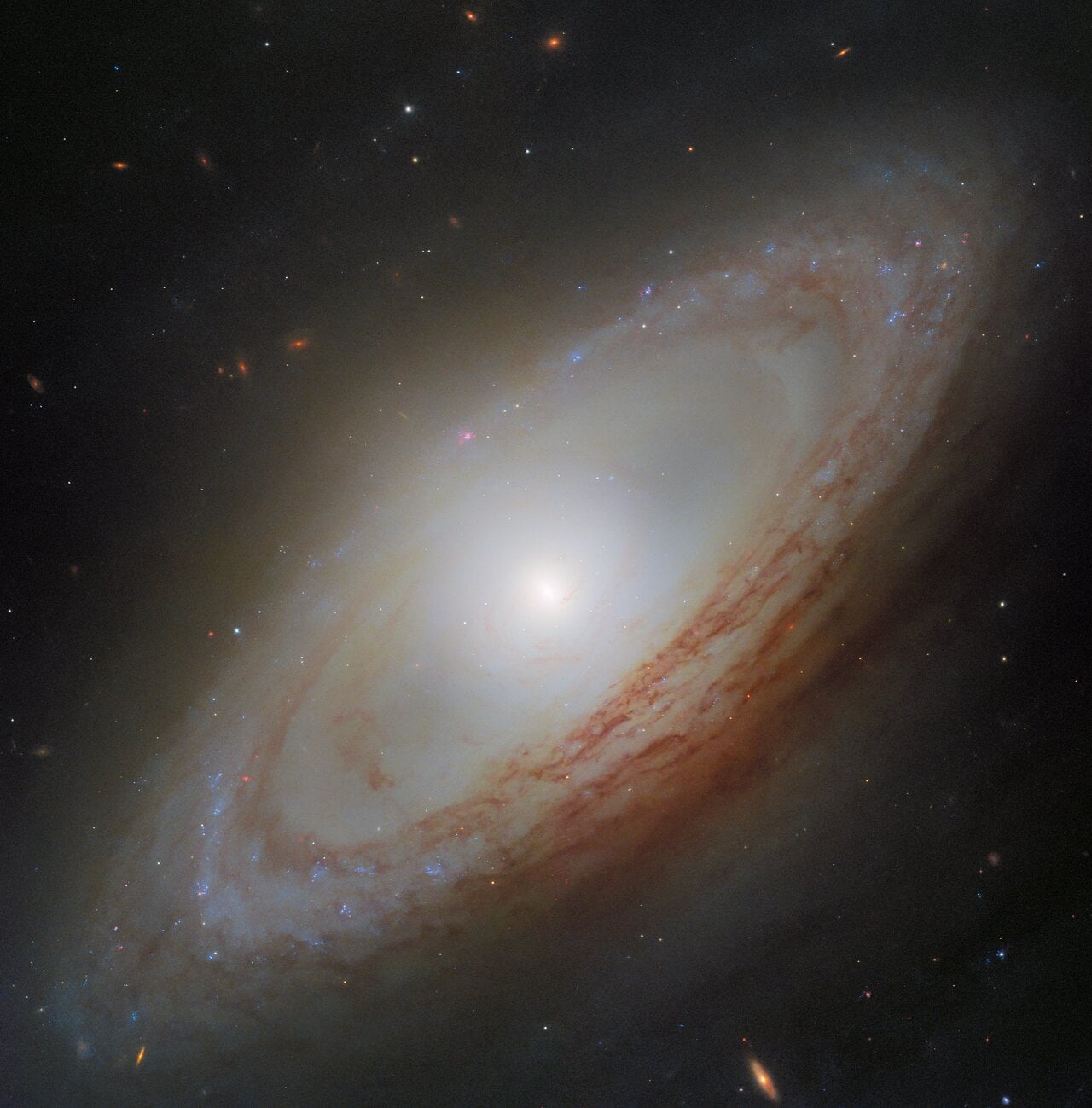
The Hubble Space Telescope has captured detailed images of NGC 4698, a spiral galaxy in the Virgo Cluster, revealing a structure far more complex than its serene appearance suggests. The observations expose a galaxy caught in a state of kinematic discord, where different components rotate at misaligned speeds, a condition that points to a violent past.
NGC 4698 displays what astronomers call decoupled rotation. The galaxy's spiral arms spin at a different rate than the stars and gas at its core, creating a system where the outer and inner regions operate independently. This kinetic mismatch represents a signature of gravitational disruption. The bulge, the dense central region typical of spiral galaxies, stretches into an unusual shape rather than the symmetric form expected in undisturbed systems.
The Hubble observations, conducted by the MAUVE-HST team led by D. Thilker, also revealed a hydrogen gas tail extending outward from the galaxy. This tidal stream indicates that NGC 4698 experienced a close encounter with another galaxy or suffered a merger event in its history. Tidal forces from such interactions can tear away material and leave long strands of gas trailing behind a galaxy as it moves through space.
The Virgo Cluster, a dense collection of roughly 1,300 galaxies located approximately 65 million light-years away, provides the gravitational environment where such interactions occur frequently. Galaxies within clusters experience frequent close passages and occasional mergers, fundamentally altering their structure and dynamics over cosmic time. NGC 4698 sits within this dynamic system, bearing the scars of its interactions etched into its morphology.
Decoupled rotation patterns in galaxies offer astronomers a window into galactic archaeology. When different components of a galaxy rotate at misaligned rates, it reveals that the galaxy has been disturbed or restructured after its initial formation. The mechanism behind such decoupling can involve multiple scenarios. A merger with another galaxy can introduce material with different angular momentum. A close gravitational encounter can torque the outer disk relative to the inner bulge. A collision between gas clouds within the galaxy itself can dissipate angular momentum selectively, causing parts of the structure to slow or accelerate relative to others.
The odd bulge morphology compounds the evidence of past trauma. In undisturbed spiral galaxies, bulges typically form through relatively quiescent processes, appearing as smooth, symmetric structures. An irregular bulge suggests that gravitational interactions deformed it, perhaps by stretching it along a particular axis or creating tidal ripples within its stellar population.
Understanding galaxies like NGC 4698 helps astronomers reconstruct how galaxies evolve over billions of years. Spiral galaxies were once thought to be relatively stable, unchanging structures. Modern observations reveal them as dynamic systems constantly shaped by interactions with their cosmic environment. Each warped arm, each kinematic anomaly, and each tidal tail carries information about collisions and near-misses that occurred in the distant past.
The Hubble Space Telescope continues to serve as the primary tool for resolving galactic structure at distances where individual interactions remain visible in the present-day configuration of galaxies. Images like this one of NGC 4698 transform abstract orbital mechanics into tangible visual evidence of the universe's violent and ongoing reshaping of matter across cosmic scales.