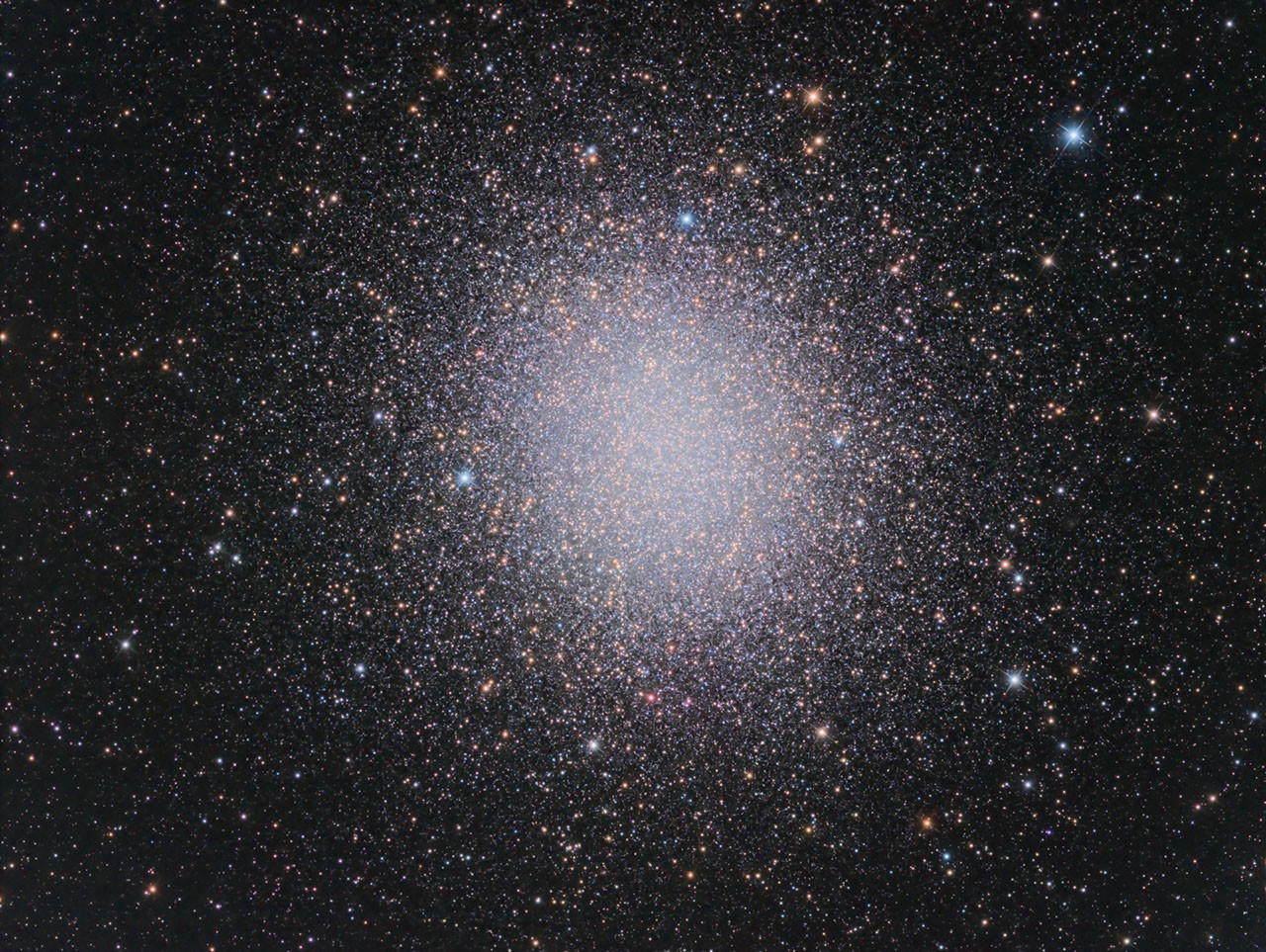
# Omega Centauri Reveals Its Ancient Structure in New NASA Image
NASA's Astronomy Picture of the Day has featured Omega Centauri, one of the most remarkable globular clusters visible from Earth. This dense collection of hundreds of thousands of stars orbits the Milky Way at a distance of roughly 15,800 light-years, making it the largest and brightest globular cluster accessible to human observation.
Omega Centauri contains an estimated 10 million stars packed into a sphere roughly 150 light-years across. The cluster's stellar population spans billions of years in age, with many stars formed during the early history of the galaxy itself. Astronomers classify it as a Class IV cluster on the concentration scale, indicating a moderate density that allows individual stars to resolve in ground and space-based telescopes.
The cluster's origin story remains partially mysterious. Recent research suggests Omega Centauri may not be a traditional globular cluster at all, but rather the stripped nucleus of a dwarf galaxy that merged with the Milky Way billions of years ago. This hypothesis explains its unusual mass, size, and the wide range of stellar ages found within it, distinguishing it from other globular clusters in our galaxy.
Observations from multiple wavelengths have enhanced understanding of Omega Centauri's structure. The Hubble Space Telescope has captured detailed images revealing the cluster's core and outer regions. Ground-based observatories continue to measure the velocities and compositions of individual stars, mapping the cluster's internal dynamics. These measurements show that the cluster rotates as a coherent system, another feature that sets it apart from typical globular clusters.
The scientific value of studying Omega Centauri extends beyond characterizing a single object. Globular clusters serve as laboratories for stellar physics and evolution. The dense environment forces stars into close encounters, creating binary systems and exotic stellar remnants like neutron stars and black holes. Omega Centauri hosts multiple black holes, detected through X-ray emissions and gravitational effects on nearby stars.
The cluster also preserves a chemical record spanning the Milky Way's early history. Spectroscopic analysis of Omega Centauri's stars reveals multiple stellar populations with distinct chemical compositions, suggesting the cluster experienced several waves of star formation. This chemical complexity provides evidence supporting the merger hypothesis and offers clues about galactic assembly.
For amateur astronomers, Omega Centauri presents a stunning target visible to the naked eye from the Southern Hemisphere and southern latitudes of the Northern Hemisphere. Binoculars reveal its bright core, while telescopes resolve individual stars across its face.
NASA's continued observation of Omega Centauri through missions like Hubble and ground-based surveys contributes to broader questions about globular cluster origin, stellar evolution in dense environments, and galactic history. The cluster stands as both a window into the cosmic past and a proving ground for theories of stellar dynamics and black hole behavior.