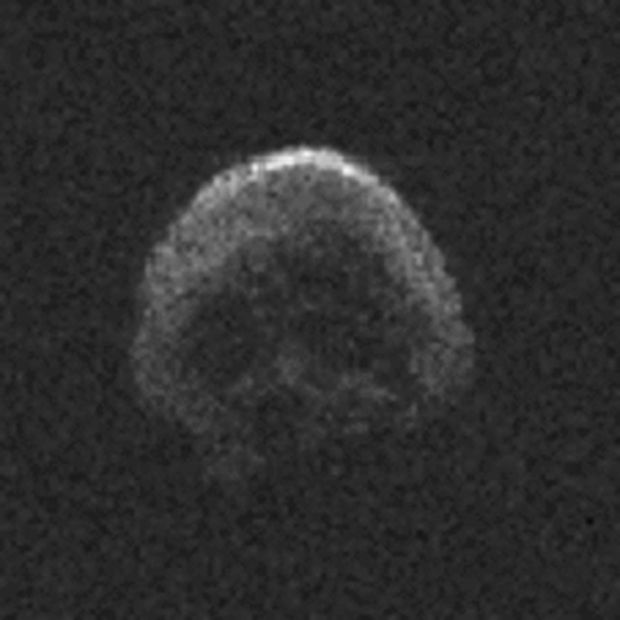
On October 31, 2015, asteroid 2015 TB145 passed within 300,000 miles of Earth, arriving on Halloween with a skull-shaped appearance visible in radar images. The object came no closer than 1.3 times the average Earth-moon distance, posing no threat to the planet.
The Pan-STARRS observatory in Hawaii discovered the asteroid only three weeks before its closest approach. The Arecibo Observatory in Puerto Rico captured the first radar images the day before Halloween, revealing the skull shape. NASA designated it the "Great Pumpkin," while others called it the "Halloween Asteroid."
Radar images came from NASA's DSS-14 antenna in Goldstone, California and the Green Bank Telescope in West Virginia. The asteroid measured roughly 2,600 feet in size, making it one of the largest near-Earth objects to approach Earth in recent years. According to NASA's Jet Propulsion Laboratory, asteroid 1999 AN10 held the record for the next closest approach by a comparably large object, predicted to pass at about 238,000 miles from Earth in August 2027.
The asteroid returned to Earth's vicinity in 2018 at a much greater distance of approximately 24 million miles, or about a quarter the distance between Earth and the sun.