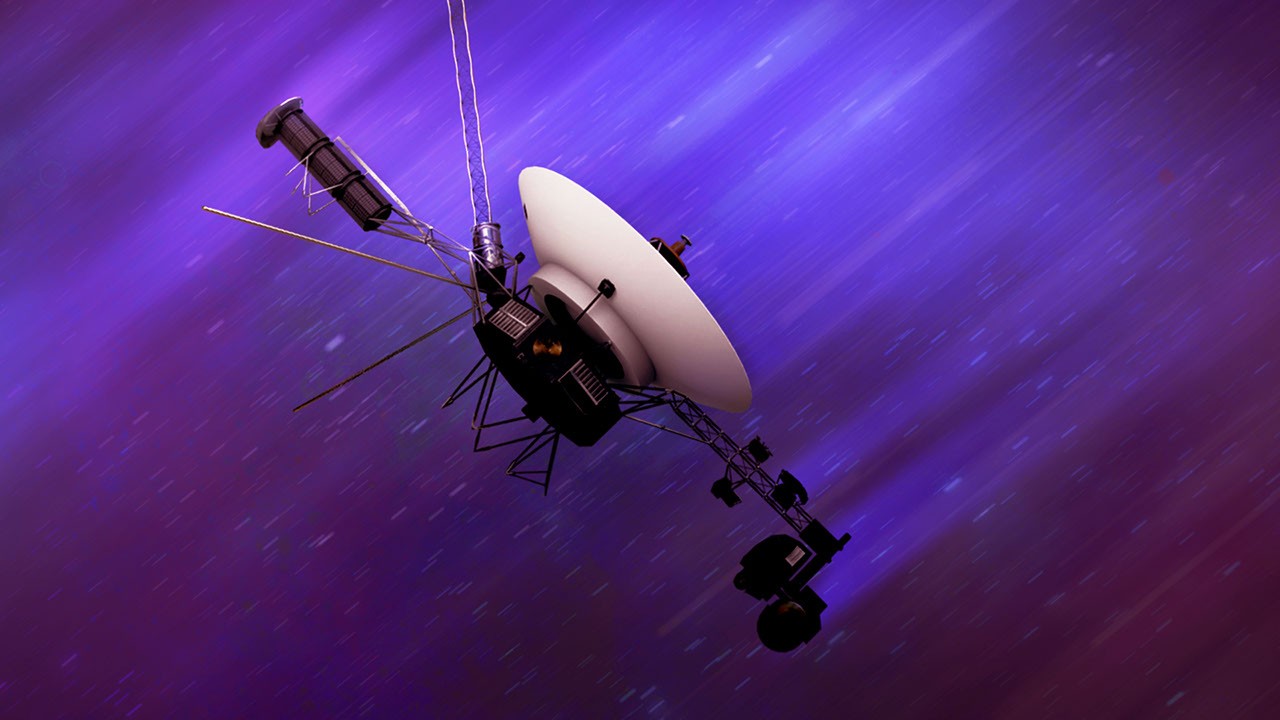
NASA's Voyager 1 spacecraft will reach one light-day of distance from the Sun on November 18, 2026, marking 49 years since its 1977 launch. At that milestone, Voyager 1 will be 16.1 billion miles away.
The twin Voyager probes exploited a rare planetary alignment occurring once every 175 years to visit Jupiter, Saturn, Uranus, and Neptune. Voyager 1 and 2 used six gravity assists between them to complete their Grand Tour of the gas and ice giants. By the 1980s the spacecraft separated at Saturn, with Voyager 2 continuing to the outer planets while Voyager 1 captured a final portrait of the solar system, including Earth as a pale blue dot.
Each Voyager carries the Golden Record, a 12-inch phonograph record containing spoken greetings in 55 languages, 27 musical tracks, 116 images, and sounds from Earth. The record cover features etchings showing the Sun's location relative to 14 pulsars. Copper and gold plating protect the record itself. The outer cover uses aluminum with an electroplate of ultra-pure uranium-238, which has a half-life of 4.468 billion years.
Both Voyager spacecraft crossed the heliopause in August 2012 and November 2018, entering interstellar space where the Sun's solar wind meets the interstellar medium. NASA's Deep Space Network tracks both probes. As of the article's writing, Voyager 1 sits at 25.80 billion kilometers, just over 16 billion miles from Earth.