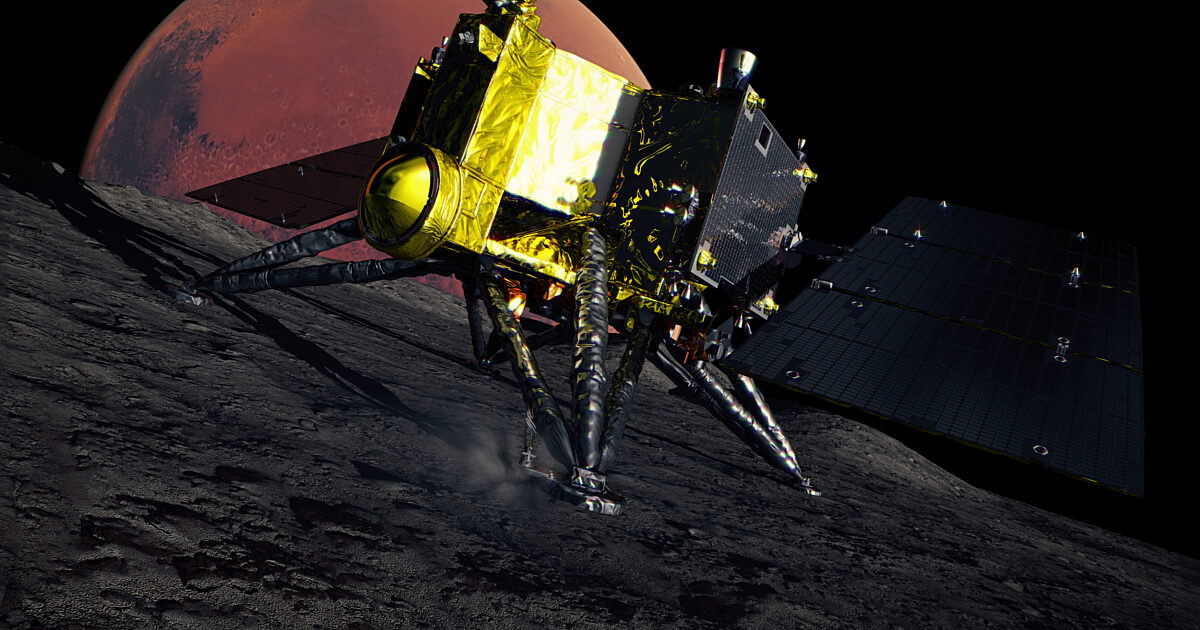
Japan's Martian Moons eXploration mission launched on October 19, 2026, carrying a sample collection instrument that The Planetary Society helped develop. The MMX spacecraft will study Phobos, one of Mars's two moons, and attempt to return the first-ever samples from its surface to Earth.
MMX aims to answer how Phobos formed. It may be a moon created by a giant impact on Mars, an asteroid captured by Mars' gravity, or formed through another mechanism entirely. Understanding Phobos could reveal details about giant impacts and asteroid migration during the Solar System's early history.
The Planetary Society funded development of P-sampler, one of two sample collection devices aboard MMX. This tool uses a technology called PlanetVac, which fires nitrogen gas to stir surface material into a whirlwind and captures it in a collection chamber. Honeybee Robotics created the technology with early support from NASA, but lacked resources for a full prototype. The Planetary Society members funded the first complete prototype and laboratory testing in simulated Mars conditions in 2013.
A second turning point came in 2018. The Planetary Society supported a flight test of PlanetVac aboard Xodiac, a vertical takeoff and landing rocket operated by Masten Space Systems in California's Mojave Desert. The instrument successfully collected 332 grams of simulated Martian soil. This test proved the technology could function in field conditions, making it a stronger candidate for future missions.
After arriving at Mars, MMX will orbit Phobos for one year while using cameras, lidar, spectrometers, and a dust monitor to map and study the moon's surface. The spacecraft will then deploy IDEFIX, a four-wheeled rover built by French and German space agencies, to explore Phobos from the ground. MMX will land on Phobos and collect samples using both P-sampler and a coring device. The mission may land a second time on Phobos's opposite side to collect additional samples.
MMX is scheduled to depart Mars in 2030 and pass by Deimos, Mars's other moon, before returning to Earth in 2031. The spacecraft will deposit its samples by parachute to a recovery site in Australia.