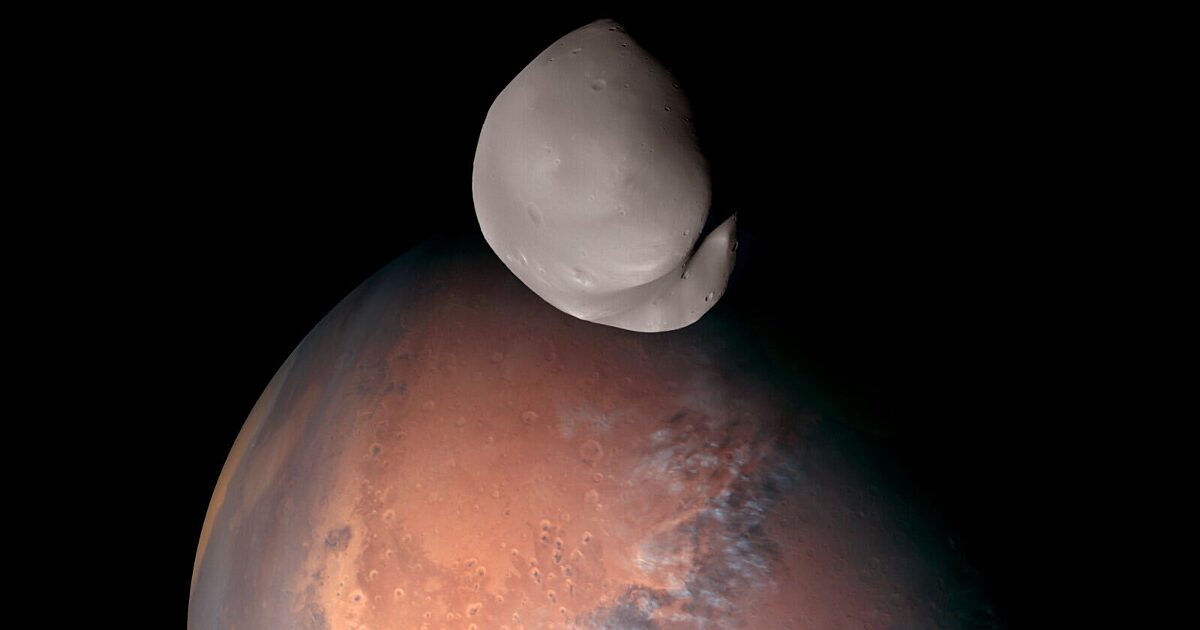
Mars has two small moons named Phobos and Deimos, discovered in 1877 and named after the sons of the Roman god of war in mythology.
Phobos orbits closest to any moon in the Solar System, at 5,989 kilometers above Mars' surface. Its irregular, lumpy shape spans roughly 27 by 22 by 18 kilometers. Mars' gravity pulls Phobos closer by 2 centimeters each year. In 30 to 50 million years, the tidal forces will tear it apart, scattering debris across Mars and potentially forming a ring around the planet.
Deimos orbits much farther out, at 23,460 kilometers from Mars. It measures about 15 by 12 by 11 kilometers. Unlike Phobos, Deimos' orbit is slowly expanding and may eventually escape Mars' gravity to become a Sun-orbiting asteroid.
The origins of both moons remain unknown. Three main hypotheses exist: they were asteroids captured by Mars, they formed from the disruption of a single parent body, or they accreted from debris left over from Mars' formation. Each hypothesis has supporting evidence and different implications for how the inner Solar System formed.
The Martian Moons eXploration (MMX) mission, led by the Japan Aerospace Exploration Agency with contributions from NASA, the European Space Agency, and the French and German space agencies, aims to solve this mystery. MMX launched in October 2026 to collect the first-ever samples from Phobos and return them to Earth by 2031. The mission will use two sample collection devices, including PlanetVac technology. Laboratory analysis will reveal water and organic material signatures that distinguish between the formation hypotheses.