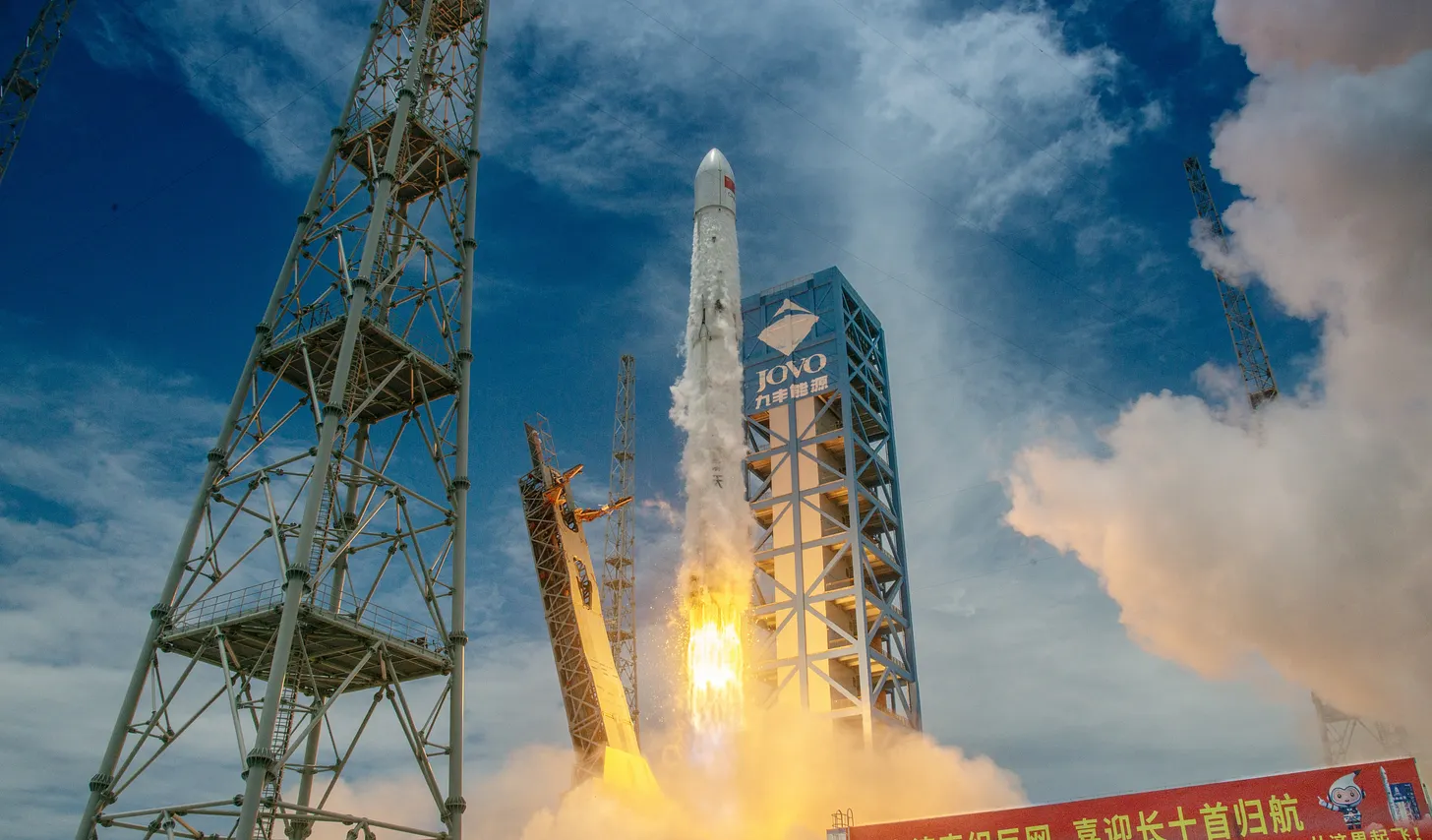
China is preparing its first commercial resupply spacecraft for Tiangong station operations. The China Manned Space Agency selected two designs in October 2024: Qingzhou, built by the Innovation Academy for Microsatellites under the Chinese Academy of Sciences, and Haolong, a reusable spaceplane from the Chengdu Aircraft Design Institute.
Qingzhou's prototype, Baixiang, launched in March carrying 1,020 kg of scientific payloads in sun-synchronous orbit. Experiments included revival of drought-tolerant moss Syntrichia caninervis in microgravity, a space fridge, and a tethered adhesive anchor called a "spider-grip" for potential orbital debris removal. A second Qingzhou is under construction for launch no earlier than January 2027 aboard CAS Space's Lijian-2 rocket, designed to carry up to 1,800 kg to the station and return 2,900 kg of downmass. The craft will burn up during atmospheric reentry.
Haolong is designed to land on a runway after multiple flights, carrying around 2,000 kg in each direction. Chengdu issued a tender this month for an orbital launch valued at no more than 100 million Yuan (approximately $14.9 million). The spaceplane's wings fold to under five meters for launch and extend to eight meters in orbit.
China also moves toward booster reusability. The Chang Zheng 12A's maiden flight in late December reached orbit but failed to recover its first stage when one of three engines did not restart for landing. A second CZ-12A is scheduled to launch no earlier than November 3. If successful, it would become China's third successful orbital-class booster recovery using a different rocket type.
The Chang Zheng 10B's first stage, recovered at sea on July 10 using a net catch system aboard the Linghangzhe recovery vessel, is being refurbished in Tianjin for reuse. Its transporter recently arrived at Commercial Launch Site 3 in Hainan for testing. The new pad is anticipated to conduct its inaugural launch before year's end with a previously-flown CZ-10B first stage.