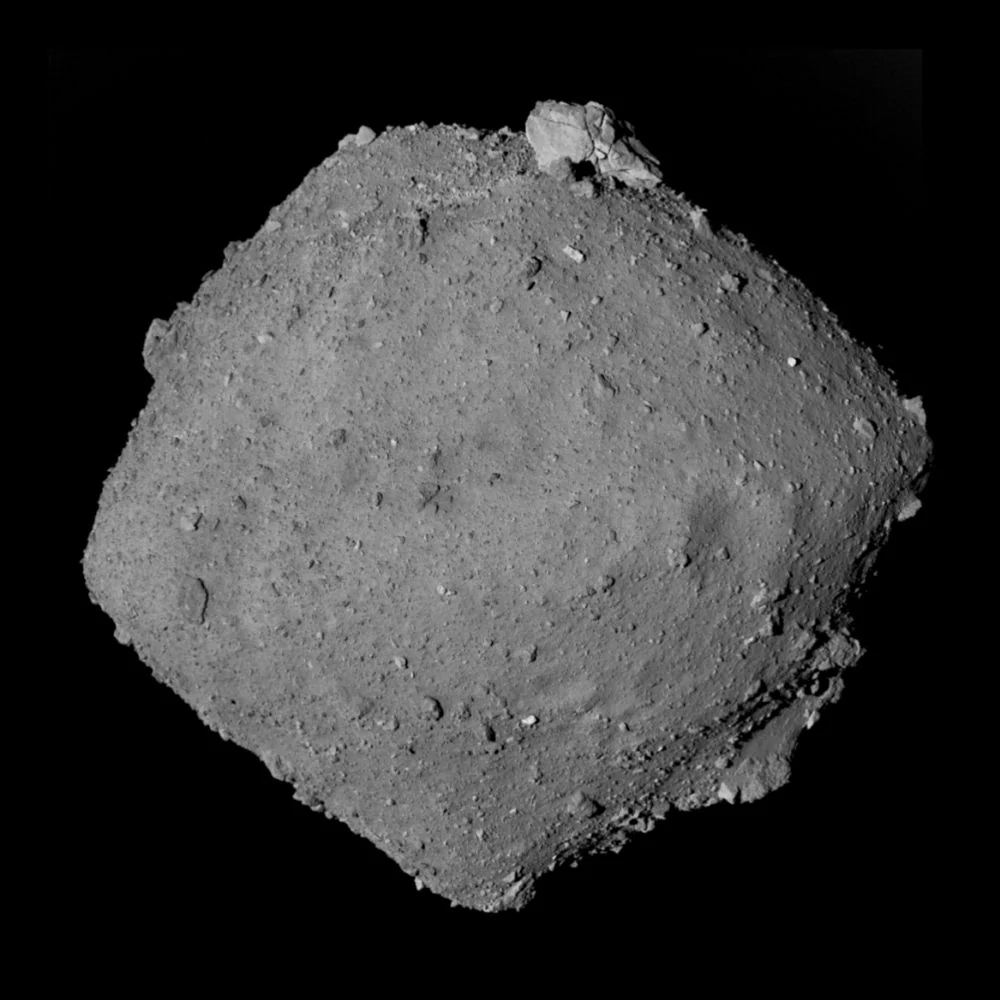
JAXA's Hayabusa 2 mission returned samples from asteroid Ryugu to Earth in 2020. Researchers examining those samples have identified poorly crystalline magnesium silicate hydrate (M-S-H) in the asteroid's matrix, potentially resolving a long-standing puzzle about how aqueous alteration shaped the asteroid's minerals.
Carbonaceous chondrites like Ryugu show evidence of water-rock interactions, but their mineral composition appeared contradictory. The asteroid's matrix seemed to contain two different mineral types, serpentine and saponite, each suggesting they formed under different aqueous conditions. This raised a question: how could such different mineral compositions exist within the same asteroid matrix if they required separate water environments?
The new research, led by Reon Okumura of Kanazawa University and published in Nature Communications Earth and Environment, used powerful x-ray facilities in Japan (SPring-8 and Photon Factory) to examine the Ryugu sample at high resolution. The team found that M-S-H, a poorly crystalline material with flexible magnesium-to-silicon ratios, makes up much of the asteroid's matrix.
"What makes M-S-H particularly interesting is that it can accommodate a wide range of magnesium-to-silicon ratios," said study corresponding author Keisuke Fukushi. "This flexibility may be key to understanding how water-rock interactions proceeded without erasing pre-existing chemical differences within their parent asteroids."
The findings suggest M-S-H formed first and later transformed into the more ordered serpentine and saponite minerals. This single material and its transformations could explain the compositional variation without requiring different aqueous alteration environments. The results may apply broadly to carbonaceous chondrite asteroids beyond Ryugu.